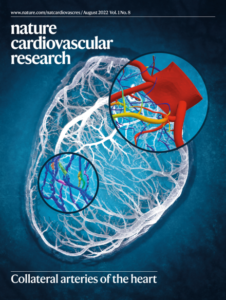
Academic Journal
Q1Nature Cardiovascular Research
About Nature Cardiovascular Research
Nature Cardiovascular Research is a scholarly journal published by Springer. SCImago 2025 places it in Q1 with an SJR of 4.767 and an H-index of 39.
Its listed coverage is 2022-2026 and its research categories include Biochemistry, Genetics and Molecular Biology (miscellaneous) (Q1); Cardiology and Cardiovascular Medicine (Q1); Cell Biology (Q1); Medicine (miscellaneous) (Q1). The 2025 dataset reports 174 documents and 2895 citations across the latest three-year reporting window.
Nature Cardiovascular Research is a high-impact, peer-reviewed scientific journal from the globally respected Nature Portfolio, dedicated to advancing the understanding of cardiovascular biology and disease. Launched to meet the growing need for reliable, cutting-edge cardiovascular research, this journal is a trusted platform for groundbreaking discoveries, interdisciplinary studies, and translational science that can directly impact clinical practice and global heart health.
With cardiovascular disease being the number one cause of death worldwide, Nature Cardiovascular Research addresses this urgent medical challenge by publishing only the most rigorous and innovative research that pushes the boundaries of current knowledge and therapies.
Mission and Vision
The mission of Nature Cardiovascular Research is to publish the highest-quality studies in cardiovascular science that lead to improved diagnosis, treatment, and prevention of heart-related diseases. The journal aims to bridge the gap between basic research and clinical application, encouraging collaboration between molecular biologists, clinicians, and medical innovators.
Its vision is to be the go-to journal for researchers, clinicians, and academics seeking the latest in cardiovascular science—from genetic discoveries to life-saving technologies.
Key Areas of Focus
Nature Cardiovascular Research covers a wide range of topics, including but not limited to:
-
Cardiac and Vascular Biology
Studies exploring heart muscle function, vascular development, and endothelial biology. -
Heart Failure and Ischemic Heart Disease
Research into mechanisms, interventions, and therapies for heart failure and myocardial infarction. -
Molecular and Cellular Cardiology
Investigations into the molecular pathways, genetic mutations, and epigenetic changes affecting heart health. -
Regenerative and Stem Cell Therapy
Breakthroughs in cardiac tissue engineering, stem cell applications, and regenerative approaches to heart disease. -
Cardiometabolic Disorders
Studies linking diabetes, obesity, and lipid disorders with cardiovascular conditions. -
Cardiovascular Imaging and Technology
Innovations in diagnostic imaging, wearable heart monitors, and AI-based detection tools. -
Clinical Trials and Translational Research
Translating laboratory discoveries into clinical therapies and real-world solutions.
Global Impact and Readership
As part of the Nature family, the journal has a vast international reach, attracting submissions and readership from leading institutions, hospitals, and research centers around the world. It serves as a critical resource for:
-
Cardiologists
-
Cardiovascular surgeons
-
Medical researchers
-
Public health experts
-
Biotech and pharmaceutical professionals
-
Academic institutions
Editorial Excellence
The journal boasts an esteemed editorial board composed of world-renowned experts in cardiology, molecular biology, pharmacology, and clinical medicine. Each submission undergoes a strict peer-review process to ensure scientific accuracy, innovation, and relevance.
SEO Keywords to Target
To boost discoverability, the following keywords are essential:
-
About Nature Cardiovascular Research
-
leading cardiovascular journal
-
cardiovascular research publication
-
heart disease scientific journal
-
top cardiology research journal
-
Nature journal on heart health
-
peer-reviewed cardiovascular studies
Journal Metrics
Metrics can change by reporting year. Verify time-sensitive values with the publisher or indexing service.
Aims & Scope
Nature Cardiovascular Research is a premier peer-reviewed journal under the renowned Nature Portfolio, dedicated to publishing innovative and high-quality research in all areas of cardiovascular science. The scope of the journal is broad, encompassing fundamental discoveries, translational studies, and clinical advancements that drive progress in understanding and treating cardiovascular diseases. As heart disease continues to be the leading global cause of death, the journal’s comprehensive focus plays a critical role in shaping the future of cardiovascular medicine.
Broad and Interdisciplinary Research Scope
The scope of Nature Cardiovascular Research spans the full spectrum of cardiovascular science, including basic biology, experimental medicine, and clinical studies. The journal emphasizes interdisciplinary research that bridges gaps between laboratory findings and patient care.
Key Focus Areas Include:
-
Cardiac Biology and Physiology: Studies on cardiac development, contractility, metabolism, and electrophysiology.
-
Vascular Biology: Research on endothelial function, angiogenesis, and vascular remodeling.
-
Molecular and Cellular Mechanisms: Investigations into the signaling pathways, genetic factors, and epigenetic regulation involved in cardiovascular health and disease.
-
Heart Failure and Myocardial Infarction: Advanced studies focused on pathogenesis, treatment, and prevention.
-
Congenital and Acquired Cardiovascular Diseases: Innovative research addressing both inherited and lifestyle-induced conditions.
-
Regenerative Medicine and Stem Cell Therapy: Development of new approaches for cardiac tissue regeneration and repair.
-
Cardiovascular Imaging and Diagnostics: Technological advancements in non-invasive imaging and molecular diagnostics.
-
Systems Biology and Computational Modeling: Integration of bioinformatics, AI, and machine learning in cardiovascular research.
-
Translational and Clinical Research: Bridging experimental science with human trials and clinical applications.
Global Relevance and Impact
The journal welcomes submissions from researchers around the world, promoting a global perspective in cardiovascular science. By highlighting region-specific and population-level studies, Nature Cardiovascular Research contributes to a broader understanding of cardiovascular disease risk, management, and outcomes across diverse demographics.
Commitment to Innovation and Excellence
As part of the Nature family, the journal upholds the highest standards of scientific integrity, peer review, and editorial rigor. It seeks to publish research that not only advances scientific knowledge but also has real-world clinical impact. Studies that challenge existing paradigms, offer novel hypotheses, or introduce new therapeutic strategies are particularly encouraged.
Who Should Read This Journal?
-
Cardiologists and cardiovascular surgeons
-
Medical researchers and laboratory scientists
-
Biomedical engineers and imaging specialists
-
Public health experts and policy makers
-
Pharmaceutical and biotech professionals
-
Graduate students and academic institutions
SEO Keywords to Target
To optimize visibility and reach, the following keywords are essential:
-
Scope of Nature Cardiovascular Research
-
cardiovascular science journal
-
heart disease research
-
cardiovascular biology and medicine
-
translational cardiology
-
vascular biology journal
-
cardiac regenerative medicine
Recent Research Articles
Latest publications matched automatically by ISSN.
Spatially guided in vivo single-cell functional genomics of postnatal heart
Haofei Wang, Yanhan Dong, Yiran Song, Marazzano Colon et al.
2026-09-07 · DOI: 10.1038/s44161-026-00861-zArtery tertiary lymphoid organs encode a pathogenic high-affinity autoantibody−autoantigen pair in atherosclerosis
Chuankai Zhang, Xi Zhang, Yi Ran, Zhihua Wang et al.
2026-09-07 · DOI: 10.1038/s44161-026-00864-wGenetic evidence supports the combined targeting of lipoprotein(a) and LDL cholesterol to reduce coronary artery disease risk
Shaoqi Wang, Yuzhong Tang, Yang Sui, Hongqiang Zhao et al.
2026-09-03 · DOI: 10.1038/s44161-026-00865-9Lifestyle and genetics modulate clonal hematopoiesis
Vesna Todorovic
2026-09-03 · DOI: 10.1038/s44161-026-00878-4A multiancestry polygenic risk score improves stratification in patients with hypertrophic cardiomyopathy
Harshvir S. Bal, Akhil Pampana, Amrita Nayak, Mokshad Gaonkar et al.
2026-09-01 · DOI: 10.1038/s44161-026-00866-8Psychological stress impairs hematopoietic stem cell function through a brain–gut–bone marrow axis
Andrea Tavosanis
2026-08-31 · DOI: 10.1038/s44161-026-00879-3ALPK3 gene addition to restore sarcomeric quality control
Julian Grünewald, Christian Kupatt
2026-08-31 · DOI: 10.1038/s44161-026-00867-7Author Correction: Endothelial IGFBP6 suppresses vascular inflammation and atherosclerosis
Meiming Su, Wenqi Zhao, Hui Jiang, Yaping Zhao et al.
2026-08-27 · DOI: 10.1038/s44161-026-00876-6Author Correction: The TRPM7 chanzyme in smooth muscle cells drives abdominal aortic aneurysm in mice
Xuan Wang, Mi Wang, Tian-Tian Zhu, Zi-Jie Zheng et al.
2026-08-25 · DOI: 10.1038/s44161-026-00877-5The neglected role of lethal arrhythmia in the sudden death of stroke survivors
Vishnu Kadiyala, Kyndaron Reinier, Sumeet S. Chugh
2026-08-25 · DOI: 10.1038/s44161-026-00868-6Bridging clinical and experimental research to unravel mechanisms of the cardiovascular–kidney–metabolic syndrome
Katherine R. Tuttle
2026-08-20 · DOI: 10.1038/s44161-026-00863-xAlpha protein kinase 3 gene therapy restores heart function in mouse and human models of cardiomyopathy
James W. McNamara, Ellen B. Keen, Rebecca Sutton, Yinghan She et al.
2026-08-19 · DOI: 10.1038/s44161-026-00843-1Incorporating uncertainty into digital twins can improve ablation planning for ventricular tachycardia
2026-08-14 · DOI: 10.1038/s44161-026-00860-0Accounting for uncertainty in computational models of ventricular tachycardia improves ablation guidance
Abdul Mateen Qadri, Ursula Rohrer, Fernando O. Campos, Iulia Nazarov et al.
2026-08-14 · DOI: 10.1038/s44161-026-00856-wSpatial transcriptomics reveals heterogeneity in rejection and recovery after heart transplantation
2026-08-13 · DOI: 10.1038/s44161-026-00855-xRethinking the selection of in vivo thrombosis models in the hybrid era
Kellie R. Machlus, Alisa S. Wolberg, Jessica C. Cardenas
2026-08-11 · DOI: 10.1038/s44161-026-00850-2Dynamic cellular programs of human cardiac allograft rejection revealed by spatial transcriptomics
Kaushik Amancherla, Angela M. Taravella Oill, Xavier Bledsoe, Arianna L. Williams et al.
2026-08-10 · DOI: 10.1038/s44161-026-00849-9Established and emerging roles of lysosomal dysfunction in cardiac aging
Yohan Santin, Ilias Simon, Angelo Parini, Frank Lezoualc’h et al.
2026-08-10 · DOI: 10.1038/s44161-026-00853-zReducing the mechanical load reawakens adult cardiomyocyte proliferation
2026-08-06 · DOI: 10.1038/s44161-026-00845-zMechanical unloading promotes adult cardiomyocyte proliferation through epicardial NRG1–ERBB4 signaling
Chenyu Jiang, Tianyu Liu, Zihao Dai, Li Xiang et al.
2026-08-05 · DOI: 10.1038/s44161-026-00841-3Reviews
Community Reviews
Version History
April 21, 2025 at 5:04 am
April 21, 2025