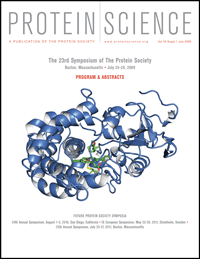
Academic Journal
Q1Protein Science
About Protein Science
Protein Science is a scholarly journal published by Wiley-Blackwell. SCImago 2025 places it in Q1 with an SJR of 3.041 and an H-index of 210.
Its listed coverage is 1992-2026 and its research categories include Biochemistry (Q1); Medicine (miscellaneous) (Q1); Molecular Biology (Q1). The 2025 dataset reports 402 documents and 6043 citations across the latest three-year reporting window.
The Fascinating World of Protein Science: Unlocking the Secrets of Life's Building Blocks
Protein science is a field of study that focuses on the structure, function, and behavior of proteins, which are essential molecules responsible for nearly every cellular function in living organisms. From supporting the immune system to enabling muscle movement, proteins are the building blocks of life, and understanding their mechanisms is key to advancing numerous fields in biology, medicine, and biotechnology.
What Are Proteins?
Proteins are large, complex molecules made up of chains of amino acids, which are linked together by peptide bonds. The sequence and structure of these amino acids determine the protein's function, shape, and interactions with other molecules. There are 20 different amino acids that combine in various ways to form proteins, each contributing unique chemical properties that allow proteins to perform a wide range of functions.
Proteins are categorized into various types, including enzymes, antibodies, structural proteins, and transport proteins, each with a specific role within the body. For example, enzymes catalyze biochemical reactions, antibodies defend against pathogens, and structural proteins provide support and shape to cells.
The Importance of Protein Science
The study of proteins is crucial in understanding health and disease at the molecular level. Protein science can help identify the causes of diseases, develop new treatments, and improve diagnostic methods. For example, scientists studying the structure of proteins have made significant breakthroughs in understanding diseases like Alzheimer's, cancer, and cystic fibrosis, leading to the development of targeted therapies and personalized medicine.
Additionally, protein science is pivotal in biotechnology, where proteins are engineered to perform tasks that can benefit humanity. Examples include the production of therapeutic proteins, such as insulin for diabetes treatment, and the design of bioengineered enzymes used in industrial applications like biofuel production and waste treatment.
Protein Structure: The Key to Function
The function of a protein is directly tied to its structure, which can be categorized into four levels:
-
Primary Structure: The sequence of amino acids in the polypeptide chain.
-
Secondary Structure: Localized folding patterns, such as alpha-helices and beta-pleated sheets, that are stabilized by hydrogen bonds.
-
Tertiary Structure: The overall three-dimensional shape of the protein, determined by interactions between the amino acid side chains.
-
Quaternary Structure: The assembly of multiple protein subunits to form a functional complex.
Understanding protein structure is essential for drug design and understanding how mutations in proteins can lead to diseases. By using advanced techniques like X-ray crystallography, nuclear magnetic resonance (NMR) spectroscopy, and cryo-electron microscopy, scientists can visualize protein structures at atomic resolution, aiding in the discovery of new therapeutic targets.
Protein Folding: A Critical Process
One of the most intriguing aspects of protein science is the process of protein folding. When a protein is synthesized, it begins as a linear chain of amino acids, but it must fold into its proper three-dimensional shape to function correctly. Misfolding can lead to diseases like Parkinson's and Huntington's, where abnormal protein aggregates accumulate in cells.
The study of protein folding is a major area of research, and scientists are working to understand how proteins fold spontaneously and what causes misfolding. This knowledge is crucial for developing treatments for protein misfolding diseases and for designing synthetic proteins that could have practical applications in medicine and industry.
The Future of Protein Science
The future of protein science is incredibly promising, with advancements in computational biology, artificial intelligence, and high-throughput screening accelerating our ability to predict and design proteins with specific functions. The ability to engineer proteins with tailored properties opens up new possibilities in drug discovery, vaccine development, and personalized medicine.
As we continue to unravel the complexities of proteins, we gain deeper insights into the molecular mechanisms that govern life. Protein science is not only advancing our understanding of biology but also driving innovations that will improve human health and well-being for generations to come.
In conclusion, protein science plays a pivotal role in unlocking the mysteries of life’s molecular machinery. From understanding disease mechanisms to developing cutting-edge therapies, the study of proteins is shaping the future of medicine and biotechnology. As research continues to evolve, we can expect even greater breakthroughs that will transform our understanding of biology and improve the lives of people around the world.
Journal Metrics
Metrics can change by reporting year. Verify time-sensitive values with the publisher or indexing service.
Aims & Scope
Scope: Protein Science – Advancing Molecular Research and Protein Understanding
Scope: Protein Science is a leading open-access journal that plays a pivotal role in the advancement of protein research across the globe. With its strong emphasis on structural biology, protein chemistry, and molecular mechanisms, this publication has become an indispensable resource for scientists, researchers, and academicians dedicated to uncovering the mysteries of proteins and their functions in biological systems.
What is Scope: Protein Science?
Scope: Protein Science serves as a comprehensive platform for publishing high-quality research articles, reviews, and perspectives in the field of protein science. The journal covers a wide range of topics including protein structure and function, protein folding and misfolding, enzymology, computational modeling, molecular dynamics, and protein-protein interactions. It is managed by Wiley and represents the official journal of The Protein Society, a globally recognized organization promoting excellence in protein research.
Why is Scope: Protein Science Important?
Proteins are fundamental building blocks of life, involved in nearly every biological process. Understanding how proteins work at the molecular level is crucial for advancements in medicine, biotechnology, and drug development. Scope: Protein Science provides an essential platform for disseminating cutting-edge findings that push the boundaries of our knowledge in these areas. By publishing peer-reviewed and scientifically rigorous articles, the journal ensures that the content it offers is both credible and impactful.
Key Features of Scope: Protein Science
-
Open Access: As an open-access journal, all articles in Scope: Protein Science are freely available to researchers, educators, and the general public worldwide, promoting broader dissemination and accessibility of knowledge.
-
High Impact Factor: The journal is widely cited and respected within the academic community, making it a preferred choice for authors aiming to reach a global audience.
-
Interdisciplinary Focus: It bridges gaps between various fields such as bioinformatics, molecular biology, structural biology, and biophysics, fostering cross-disciplinary collaboration.
-
Cutting-Edge Research: From novel protein engineering techniques to advancements in cryo-electron microscopy, Scope: Protein Science regularly features research that shapes the future of molecular science.
Audience and Contributors
The journal welcomes contributions from both established researchers and early-career scientists. It targets a global audience of biochemists, molecular biologists, structural biologists, and biotechnology professionals who are seeking to stay updated with the latest developments in protein science.
SEO Keywords to Note:
-
Protein science journal
-
Structural biology research
-
Protein folding studies
-
Molecular protein analysis
-
Open-access protein research
-
High impact biology journal
-
Protein Society journal
Recent Research Articles
Latest publications matched automatically by ISSN.
Structural and functional insights into Pseudomonas aeruginosa ApaH , a diadenosine tetraphosphatase crucial for bacterial virulence
Gianluca Pistoia, Matteo Cervoni, Flavia Catalano, Francesca Troilo et al.
2026-09 · DOI: 10.1002/pro.70781Reconsidering the rationale for macromolecular crowding studies
Gary J. Pielak
2026-09 · DOI: 10.1002/pro.70778Catalytic architecture and cyclase‐mediated dimerization of a newly identified class III ‐c lanthipeptide synthetase
Haojie Zhang, Yifan Li, Yi Shi, Jian Shi et al.
2026-09 · DOI: 10.1002/pro.70776Structural and biophysical characterization of Mycobacterium tuberculosis DciA reveals functional convergence in DnaB helicase recognition
Daniele Mazzoletti, Andrea Garavaglia, Hayden Fisher, Nicholas Gao et al.
2026-09 · DOI: 10.1002/pro.70771Molecular logics in dual sensor regulation of diguanylate cyclase activity—Phosphorylation OR blue‐light activation
Maximilian Fuchs, Andreas Winkler
2026-09 · DOI: 10.1002/pro.70765AVIDbase : A biologically accurate structural dataset of nanobody‐antigen complexes
Tadej Medved, Jurij Lah, Goran Miličić, San Hadži et al.
2026-09 · DOI: 10.1002/pro.70773Viral PDZ target sequences are not inherently more promiscuous than those derived from endogenous target proteins
Cole D. Masuga, Caroline Ceravolo, Elise F. Tahti, Daniel A. Pollard et al.
2026-09 · DOI: 10.1002/pro.70772A cofactor‐promiscuous HMGR from the Lyme disease pathogen illuminates diversity in bacterial isoprenoid biosynthesis
Isaac A. Paddy, Joshua McCausland, Madelyn Frazier, Poulami Chatterjee et al.
2026-09 · DOI: 10.1002/pro.70766A multiplex tissue resource for high‐resolution spatial protein profiling in the Human Protein Atlas
Borbala Katona, Rutger Schutten, Filippa Bertilsson, Feria Hikmet et al.
2026-09 · DOI: 10.1002/pro.70764Multimerization of a rationally designed nanobody for enhanced avidity toward Aβ42 oligomers
Magdalena Nowinska, Elijah Suh, Casey Mogilevsky, Michele Vendruscolo et al.
2026-09 · DOI: 10.1002/pro.70754A simple probabilistic AlphaFold interaction score
Mihaly Badonyi, Agnes Toth‐Petroczy
2026-09 · DOI: 10.1002/pro.70760Structure and conformational dynamics of the Pseudomonas CbrA transceptor
Melanie A. Orlando, Tejas Shah, Matthew W. Faber, Samik Bose et al.
2026-09 · DOI: 10.1002/pro.70775MAXTIA : A high‐throughput platform for rapid functional epitope mapping by kinetic screening of mutant libraries
Kihoon Kim, Ryo Matsunaga, Takanori Yokoo, Makoto Nakakido et al.
2026-09 · DOI: 10.1002/pro.70769Disulfide engineering of the FANCM – MHF complex reveals constraints on crosslink design in symmetric oligomers
Sho Ito, Tatsuya Nishino
2026-09 · DOI: 10.1002/pro.70761Donor‐induced conformational gating and substrate‐assisted catalysis in α ‐1,3‐galactosyltransferase
Javier A. Linares‐Pastén, Antoni Planas
2026-09 · DOI: 10.1002/pro.70770A protein chaperone can stabilize the intein‐containing precursor to indirectly promote protein splicing
John S. Smetana, Christopher R. Powell, Noy Bagdadi, Tia M. Ariagno et al.
2026-09 · DOI: 10.1002/pro.70768Adaptation of OXPHOS biogenesis to cellular requirements
Sven Dennerlein, Peter Rehling
2026-09 · DOI: 10.1002/pro.70763ContrastQA: A label‐guided graph contrastive learning‐based approach for protein complex structure quality assessment
Lei Zhang, Rui Ding, Xiao Chen, Jie Hou et al.
2026-09 · DOI: 10.1002/pro.70734Pro4S : Prediction of protein solubility by fusing sequence, structure, and surface
Jie Qian, Lin Yang, Renxiao Wang, Yifei Qi et al.
2026-09 · DOI: 10.1002/pro.70749Reviews
Community Reviews
Version History
April 22, 2025 at 4:46 am
April 22, 2025