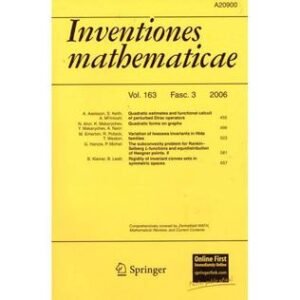
Academic Journal
Q1Inventiones Mathematicae
About Inventiones Mathematicae
Inventiones Mathematicae is a scholarly journal published by Springer New York. SCImago 2025 places it in Q1 with an SJR of 5.202 and an H-index of 137.
Its listed coverage is 1966-2026 and its research categories include Mathematics (miscellaneous) (Q1). The 2025 dataset reports 78 documents and 887 citations across the latest three-year reporting window.
Inventiones Mathematicae: A Premier Journal in Pure Mathematics
Inventiones Mathematicae is one of the most prestigious and influential journals in the field of pure mathematics. Established in 1966 and published by Springer, this peer-reviewed journal has long been a cornerstone for groundbreaking research, known for its rigorous standards, broad scope, and profound impact on the global mathematical community.
A Legacy of Excellence
Over the decades, Inventiones Mathematicae has earned its reputation by publishing high-quality, original research papers that significantly advance the understanding of pure mathematics. The journal is internationally recognized for its selectivity—only a small percentage of submitted papers are accepted for publication. This ensures that only the most impactful and innovative research reaches its readers.
Wide Scope and High Impact
The scope of Inventiones Mathematicae spans a broad range of topics within pure mathematics. These include, but are not limited to, algebra, geometry, number theory, topology, and analysis. The journal often features work that introduces new theories, solves long-standing problems, or connects previously unrelated areas of mathematics in novel ways.
Its high impact factor reflects its status as a top-tier publication. Researchers who publish in Inventiones Mathematicae contribute to discussions that shape the direction of mathematical research worldwide. The journal is also widely cited, indicating that its published papers are used as foundational resources for further mathematical discoveries.
Editorial Excellence
The editorial board of Inventiones Mathematicae consists of leading mathematicians from around the globe. These experts bring deep insight and critical review to every submission, ensuring that the journal maintains its high standards for clarity, originality, and scholarly importance.
The rigorous peer-review process helps authors refine their work, often resulting in papers that are both technically sound and elegantly presented. This meticulous process also assures readers of the validity and significance of the research they encounter in the journal.
Global Reach and Accessibility
Thanks to Springer’s distribution, Inventiones Mathematicae reaches academic institutions, researchers, and libraries around the world. Its online platform allows for easy access to current issues and archives, supporting both historical research and contemporary study. The journal is indexed in major databases such as Scopus, Web of Science, and Mathematical Reviews, making it discoverable and citable across the academic spectrum.
Why Inventiones Mathematicae Matters
For mathematicians aiming to make a mark in their field, publication in Inventiones Mathematicae is a significant achievement. It signals that the work is not only original and well-executed but also of exceptional importance to the broader mathematical community. For readers, the journal serves as a reliable source of cutting-edge mathematical knowledge and a window into the future of theoretical discovery.
Whether you're a researcher, student, or academic librarian, Inventiones Mathematicae remains a vital resource for those who seek to explore the frontiers of mathematical thought.
Journal Metrics
Metrics can change by reporting year. Verify time-sensitive values with the publisher or indexing service.
Aims & Scope
Exploring the Scope of Inventiones Mathematicae: A Leading Journal in Pure Mathematics
Inventiones Mathematicae is one of the most prestigious journals in the field of pure mathematics. Established in 1966, it is published by Springer and has gained a global reputation for excellence in mathematical research. The journal is well known for publishing high-quality, original papers that contribute significantly to the advancement of mathematics. Its rigorous peer-review process and emphasis on conceptual innovation make it a leading destination for top mathematicians around the world.
Broad Yet Focused: Core Areas of Publication
The scope of Inventiones Mathematicae is broad within the realm of pure mathematics. It covers a wide range of topics, including but not limited to:
-
Algebra
-
Number Theory
-
Algebraic Geometry
-
Topology
-
Differential Geometry
-
Complex and Real Analysis
-
Partial Differential Equations
-
Dynamical Systems
-
Mathematical Logic
The journal welcomes contributions that not only solve long-standing mathematical problems but also introduce new techniques and frameworks with the potential to influence multiple areas of mathematics. It is especially interested in deep theoretical work that provides a new understanding or significantly extends known results.
Emphasis on Originality and Impact
Inventiones Mathematicae is not a journal for incremental results. Instead, it prioritizes research that is innovative, impactful, and of interest to a wide mathematical audience. The journal’s editorial board is composed of leading mathematicians who ensure that only the most significant papers are published. Authors are encouraged to submit work that is both technically proficient and conceptually rich.
This focus on groundbreaking research has led to Inventiones Mathematicae becoming one of the highest-impact journals in its field. It regularly features papers that go on to receive widespread citation and recognition, influencing the direction of mathematical research worldwide.
International Reach and Audience
The journal has a truly international scope, attracting submissions and readership from all corners of the globe. It is a trusted resource for university professors, researchers, postdoctoral fellows, and graduate students in mathematics. Many groundbreaking discoveries and conjecture resolutions first appear in Inventiones Mathematicae, making it a go-to source for anyone serious about mathematical research.
Submission and Review Process
The peer-review process at Inventiones Mathematicae is known for its rigor and thoroughness. Every submission undergoes a detailed review by experts in the relevant field. The journal’s commitment to quality ensures that published papers meet the highest scholarly standards. Due to its selectivity, the acceptance rate is low, but being published in this journal is considered a significant academic achievement.
Recent Research Articles
Latest publications matched automatically by ISSN.
Quasiconformal characterization of Schottky sets
Dimitrios Ntalampekos
2026-09-08 · DOI: 10.1007/s00222-026-01447-zThe monochromatic Hahn-Wilson conjecture
David Jongwon Lee, Piotr Pstrągowski
2026-09-07 · DOI: 10.1007/s00222-026-01448-yCo-rank 1 arithmetic Siegel–Weil I: local non-Archimedean
Ryan C. Chen
2026-09-01 · DOI: 10.1007/s00222-026-01444-2The relative Manin–Mumford conjecture
Ziyang Gao, Philipp Habegger
2026-08-26 · DOI: 10.1007/s00222-026-01443-3Uniqueness of certain cylindrical tangent cones
Gábor Székelyhidi
2026-08-21 · DOI: 10.1007/s00222-026-01445-1On the Lawson-Osserman conjecture
Jonas Hirsch, Connor Mooney, Riccardo Tione
2026-08-14 · DOI: 10.1007/s00222-026-01442-4A Grauert–Riemenschneider vanishing theorem for Witt canonical sheaves
Jefferson Baudin
2026-08-04 · DOI: 10.1007/s00222-026-01441-5Proof of the Landau-Pekar formula for the effective mass of the polaron at strong coupling
Morris Brooks
2026-07-28 · DOI: 10.1007/s00222-026-01440-6Projections of self-affine fractals
Ian D. Morris, Cagri Sert
2026-07-21 · DOI: 10.1007/s00222-026-01439-zDiffeomorphisms of discs and the second Weiss derivative of BTop(–)
Manuel Krannich, Oscar Randal-Williams
2026-07-10 · DOI: 10.1007/s00222-026-01436-2The quantum connection, Fourier-Laplace transform, and families of $A_{\infty }$-categories
D. Pomerleano, P. Seidel
2026-07-07 · DOI: 10.1007/s00222-026-01435-3Brauer classes not split by genus one curves
Zinovy Reichstein, Federico Scavia
2026-07-02 · DOI: 10.1007/s00222-026-01437-1Conditions implying annular chaos
Alejandro Passeggi, Fábio Armando Tal
2026-07-02 · DOI: 10.1007/s00222-026-01438-0Exponential volumes of moduli spaces of hyperbolic surfaces
Alexander B. Goncharov, Zhe Sun
2026-06-26 · DOI: 10.1007/s00222-026-01434-4Conformal removability of non-simple Schramm-Loewner evolutions
Konstantinos Kavvadias, Jason Miller, Lukas Schoug
2026-08 · DOI: 10.1007/s00222-026-01427-3Calderón problem for fractional Schrödinger operators on closed Riemannian manifolds
Ali Feizmohammadi, Katya Krupchyk, Gunther Uhlmann
2026-06-09 · DOI: 10.1007/s00222-026-01432-6Geometric Eisenstein series I: finiteness theorems
Linus Hamann, David Hansen, Peter Scholze
2026-06-08 · DOI: 10.1007/s00222-026-01433-5The irreducibility of Hurwitz spaces and Severi varieties on toric surfaces
Karl Christ, Xiang He, Ilya Tyomkin
2026-05-27 · DOI: 10.1007/s00222-026-01430-8Cutoff for non-negatively curved diffusions
Justin Salez
2026-05-27 · DOI: 10.1007/s00222-026-01431-7Heat equation from a deterministic dynamics
Giovanni Canestrari, Carlangelo Liverani, Stefano Olla
2026-05-20 · DOI: 10.1007/s00222-026-01429-1Reviews
Community Reviews
Version History
April 23, 2025 at 3:29 am
April 23, 2025