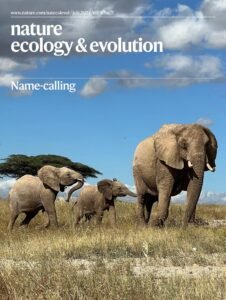
Academic Journal
Q1Nature Ecology and Evolution
About Nature Ecology and Evolution
Nature Ecology and Evolution is a scholarly journal published by Nature Research. SCImago 2025 places it in Q1 with an SJR of 4.671 and an H-index of 159.
Its listed coverage is 2016-2026 and its research categories include Ecology (Q1); Ecology, Evolution, Behavior and Systematics (Q1). The 2025 dataset reports 322 documents and 8127 citations across the latest three-year reporting window.
Nature Ecology and Evolution is a fascinating and rapidly growing field of science that explores the relationships between organisms, their environments, and the evolutionary processes that shape life on Earth. As climate change, biodiversity loss, and habitat degradation continue to impact ecosystems worldwide, the importance of ecological and evolutionary research has never been greater.
What is Nature Ecology and Evolution?
At its core, Nature Ecology and Evolution focuses on understanding how organisms interact with each other and their surroundings over time. Ecology examines the distribution, abundance, and interactions of organisms in various environments, while evolution explains how species adapt and change across generations. Together, these disciplines provide critical insights into the dynamics of natural systems, from the genetic level to entire ecosystems.
Key Areas of Research
Nature Ecology and Evolution encompasses a wide range of topics, including:
-
Biodiversity and Conservation: Studying species diversity and finding sustainable ways to protect endangered habitats and organisms.
-
Climate Change Impacts: Understanding how rising temperatures and shifting weather patterns affect ecosystems and species survival.
-
Evolutionary Adaptation: Investigating how species evolve in response to environmental pressures, competition, and predation.
-
Invasive Species: Examining how non-native organisms disrupt local ecosystems and threaten native species.
-
Ecosystem Services: Exploring the essential roles that ecosystems play, such as pollination, water purification, and carbon sequestration.
Why It Matters
The study of nature, ecology, and evolution is crucial for addressing many of the global challenges we face today. For example, ecological research helps predict how climate change will alter agricultural productivity, water availability, and disease dynamics. Evolutionary insights can guide the development of disease-resistant crops or inform conservation strategies for threatened species.
Moreover, understanding the evolutionary history of species can reveal how past environmental changes shaped current biodiversity—and how life might respond to future challenges. This knowledge is vital for creating effective policies that protect ecosystems and ensure the resilience of natural and human systems alike.
Nature Ecology and Evolution in Action
Leading scientific journals such as Nature Ecology & Evolution publish groundbreaking research that influences environmental policy, conservation strategies, and public awareness. These studies often involve interdisciplinary collaboration, combining data from genetics, climate science, geography, and even social sciences.
From tracking the migration patterns of birds using satellite data to mapping the genetic evolution of coral reefs, researchers are continually uncovering new ways ecosystems function and adapt.
Journal Metrics
Metrics can change by reporting year. Verify time-sensitive values with the publisher or indexing service.
Aims & Scope
Nature Ecology & Evolution is a premier, high-impact journal that serves as a leading platform for groundbreaking research in the fields of ecology and evolutionary biology. Launched by the Nature Portfolio, this journal has rapidly gained prominence for publishing studies that drive forward our understanding of the natural world. With a focus on high-quality, novel research, Nature Ecology & Evolution bridges multiple disciplines, providing comprehensive insights into the mechanisms that shape biodiversity, ecosystems, and evolutionary processes.
A Broad, Interdisciplinary Focus
The scope of Nature Ecology & Evolution is both broad and integrative, encompassing a wide range of topics within ecology and evolution. The journal welcomes research that spans the full spectrum of life—from microbes to plants and animals—and covers various levels of biological organization, from genes and genomes to populations, communities, and ecosystems.
Key areas of interest include:
-
Evolutionary biology: molecular evolution, speciation, phylogenetics, evolutionary developmental biology (evo-devo), and macroevolution.
-
Ecology: community ecology, behavioral ecology, conservation biology, ecosystem dynamics, and biogeography.
-
Environmental change and biodiversity loss: studies exploring the effects of climate change, habitat degradation, and anthropogenic impacts.
-
Interdisciplinary research: work that connects ecology and evolution with genomics, paleontology, epidemiology, and even social sciences to address pressing global challenges.
This inclusive approach makes Nature Ecology & Evolution a central forum for research that not only advances theoretical understanding but also has practical implications for conservation, sustainability, and policy-making.
Emphasis on Innovation and Global Relevance
One of the defining characteristics of the journal is its emphasis on innovation. Nature Ecology & Evolution prioritizes studies that offer novel insights, challenge existing paradigms, or use cutting-edge methodologies. From high-resolution genomic analyses to large-scale ecological modeling and long-term field experiments, the journal highlights work that redefines scientific boundaries.
Moreover, the journal is committed to publishing research with global relevance. Articles often feature studies from diverse geographic regions and ecosystems, addressing critical issues such as species extinction, ecological resilience, and adaptive evolution in changing environments.
High Standards and Broad Reach
Nature Ecology & Evolution maintains rigorous peer review standards and selects manuscripts based on originality, significance, and interdisciplinary appeal. By doing so, it ensures that published research reaches not only specialists but also a broader scientific audience and policy stakeholders.
In addition, the journal's affiliation with the Nature Portfolio enhances its visibility and accessibility. Researchers published in Nature Ecology & Evolution benefit from high citation potential, media exposure, and dissemination through Nature’s vast communication channels.
Recent Research Articles
Latest publications matched automatically by ISSN.
Ancient vocabulary for evolving cells
Kun Wang
2026-09-08 · DOI: 10.1038/s41559-026-03186-zFlexible use of conserved motifs constrains genome access in cell type evolution
Chew Chai, Jesse Gibson, Pengyang Li, Brennan D. McDonald et al.
2026-09-08 · DOI: 10.1038/s41559-026-03164-5Butterfly effects
2026-09-03 · DOI: 10.1038/s41559-026-03182-3Publisher Correction: Widespread thermophilization but weak link to climate warming in Europe’s summit plant communities
Johannes Hausharter, Johannes Wessely, Norbert Helm, Kryštof Chytrý et al.
2026-09-02 · DOI: 10.1038/s41559-026-03189-wJumping spiders (genus Portia)
Ximena Nelson
2026-09-02 · DOI: 10.1038/s41559-026-03174-3Spatially explicit forecasts of tree insect and disease incidence across North American forests under future climate scenarios
Zihui Wang, Andrew V. Gougherty, T. Jonathan Davies
2026-09-02 · DOI: 10.1038/s41559-026-03163-6Fourfold increase in fragmentation from road expansion in Siberian intact forests since 2000
Zi Jing Zhang, Zhongbin B. Li, Mengqiu Wang, Alexey Egorov et al.
2026-09-01 · DOI: 10.1038/s41559-026-03162-7Tree diversity and mycorrhizal type independently shape multitrophic biodiversity, with stronger effects belowground than aboveground
Huimin Yi, Olga Ferlian, Phillip J. Becker, Henriette Christel et al.
2026-08-31 · DOI: 10.1038/s41559-026-03147-6Temperature mediates variation in avian sensitivity to forest cover
Natasha R. Granville, Jessica J. Williams, Vivienne P. Groner, Jos Barlow et al.
2026-08-28 · DOI: 10.1038/s41559-026-03160-9Publisher Correction: Forecasting cyanobacterial blooms requires improved understanding of species interactions
2026-08-25 · DOI: 10.1038/s41559-026-03185-0Author Correction: Biotic interactions shape the realized niche of toxic cyanobacteria
Pinelopi Ntetsika, Stefanie Eyring, Ewa Merz, Marta Reyes et al.
2026-08-24 · DOI: 10.1038/s41559-026-03179-yPepper centromeres sit within ultra-long, trait-linked haplotypes
2026-08-24 · DOI: 10.1038/s41559-026-03146-7Coffee spillovers
Simon Harold
2026-08-21 · DOI: 10.1038/s41559-026-03177-0Insufficient tree acclimation
Walter Andriuzzi
2026-08-20 · DOI: 10.1038/s41559-026-03169-0Variation in the costs and ecological benefits of tropical natural forest regeneration
Jiaqi Li, Matthew S. Luskin, Robin L. Chazdon, Brooke A. Williams et al.
2026-08-20 · DOI: 10.1038/s41559-026-03154-7High-integrity biodiversity credits through recognition of culturally salient species
Charis Enns, Brock Bersaglio, Mali Ole Kaunga, Joseph Larpei et al.
2026-08-18 · DOI: 10.1038/s41559-026-03167-2Mycorrhizal strategy of non-native plants varies with biome and disturbance
Sara Giulia Cazzaniga, Thomas Lauber, Johan van den Hoogen, Evelyn M. Beaury et al.
2026-08-17 · DOI: 10.1038/s41559-026-03144-9Trophic hotspots as a perspective for understanding and managing ecosystem function
Timothy J. Fernandes, Kayla R. S. Hale, Bailey C. McMeans, Tyler D. Tunney et al.
2026-08-17 · DOI: 10.1038/s41559-026-03158-3Evolution and domestication-trait associations of ultra-long centromere haplotypes in pepper plants
Ming Hu, Jiahao Chen, Shaoxuan Huang, Jie Teng et al.
2026-08-14 · DOI: 10.1038/s41559-026-03143-wWidespread thermophilization but weak link to climate warming in Europe’s summit plant communities
Johannes Hausharter, Johannes Wessely, Norbert Helm, Kryštof Chytrý et al.
2026-08-14 · DOI: 10.1038/s41559-026-03150-xReviews
Community Reviews
Version History
April 23, 2025 at 12:21 pm
April 23, 2025