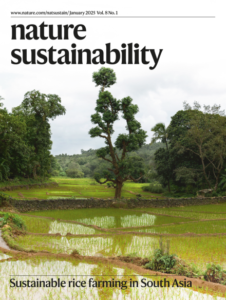
Academic Journal
Q1Nature Sustainability
About Nature Sustainability
Nature Sustainability is a scholarly journal published by Nature Publishing Group. SCImago 2025 places it in Q1 with an SJR of 7.896 and an H-index of 174.
Its listed coverage is 2018-2026 and its research categories include Ecology (Q1); Food Science (Q1); Geography, Planning and Development (Q1); Global and Planetary Change (Q1); Management, Monitoring, Policy and Law (Q1); Nature and Landscape Conservation (Q1); Renewable Energy, Sustainability and the Environment (Q1); Urban Studies (Q1). The 2025 dataset reports 218 documents and 14083 citations across the latest three-year reporting window.
In a world increasingly affected by climate change, pollution, and biodiversity loss, the concept of Nature Sustainability is more important than ever. Nature sustainability refers to the responsible use and management of natural resources to meet current needs without compromising the ability of future generations to meet theirs. It combines environmental, economic, and social considerations to promote long-term ecological balance.
Why Nature Sustainability Matters
The Earth provides everything we need to survive: clean air, fresh water, fertile soil, and a stable climate. However, these natural systems are under constant pressure from human activities such as deforestation, industrial pollution, overfishing, and carbon emissions. Without sustainable practices, we risk degrading the very ecosystems that support life.
Nature sustainability addresses these concerns by promoting practices that protect the environment, support biodiversity, and ensure the responsible use of resources. It encourages individuals, communities, and industries to reduce their ecological footprints while supporting long-term economic growth.
Key Principles of Nature Sustainability
-
Resource Efficiency: Using natural resources like water, energy, and raw materials more efficiently helps reduce waste and environmental harm.
-
Biodiversity Conservation: Preserving the variety of life on Earth is essential for ecosystem resilience and overall environmental health.
-
Renewable Energy Adoption: Transitioning from fossil fuels to renewable energy sources such as solar, wind, and hydropower reduces greenhouse gas emissions and combats global warming.
-
Sustainable Agriculture: Farming methods that preserve soil quality, reduce chemical use, and promote crop diversity contribute to food security and environmental health.
-
Circular Economy: A sustainable economy emphasizes reuse, recycling, and reducing waste, ensuring that products and materials are kept in use for as long as possible.
How Individuals Can Promote Sustainability
Every person has a role to play in fostering nature sustainability. Small lifestyle changes can have a significant impact:
-
Reduce plastic use and opt for reusable materials.
-
Conserve water and energy at home.
-
Support local and organic products.
-
Use public transportation, cycle, or walk whenever possible.
-
Educate others about the importance of environmental protection.
Corporate and Government Responsibility
Businesses and governments also play a critical role. Corporations must embrace sustainable supply chains, invest in eco-friendly technologies, and commit to reducing their carbon footprints. Likewise, governments must implement policies that protect natural habitats, support renewable energy, and incentivize green innovation.
Journal Metrics
Metrics can change by reporting year. Verify time-sensitive values with the publisher or indexing service.
Aims & Scope
In an age where climate change and environmental degradation are urgent global challenges, understanding the scope, nature, and sustainability of our actions has never been more critical. These three interconnected concepts form the foundation of a greener, more responsible future—for businesses, governments, and individuals alike.
What is the Scope of Sustainability?
The scope of sustainability refers to the breadth of areas and sectors it impacts. It is not limited to just the environment. In fact, sustainability spans three core pillars: environmental, economic, and social.
-
Environmental sustainability focuses on conserving natural resources, reducing carbon emissions, and preserving biodiversity.
-
Economic sustainability ensures that development is financially viable over the long term without depleting resources or harming the planet.
-
Social sustainability addresses human rights, equity, and community well-being.
This wide scope makes sustainability relevant to industries like agriculture, energy, fashion, technology, and construction. It encourages innovation in everything from renewable energy to eco-friendly packaging.
The Nature of Sustainability
The nature of sustainability is inherently long-term and holistic. It’s about meeting current needs without compromising the ability of future generations to meet theirs. Sustainability promotes balance—between growth and conservation, consumption and preservation.
Key characteristics of sustainability include:
-
Interdependence: Environmental, social, and economic systems are closely linked. A change in one affects the others.
-
Resilience: Sustainable practices build resilience to shocks, such as natural disasters or economic downturns.
-
Preventive action: Rather than reacting to problems like pollution or resource scarcity, sustainability emphasizes proactive solutions.
Understanding the nature of sustainability helps individuals and organizations align their decisions with long-term global goals like the UN Sustainable Development Goals (SDGs).
Why Sustainability Matters Today
Sustainability is not just a buzzword—it’s a necessity. Climate change, deforestation, water scarcity, and waste pollution are real threats to the planet and human well-being. Embracing sustainability helps mitigate these risks while creating opportunities for innovation, job creation, and economic growth.
Moreover, modern consumers and investors are increasingly drawn to companies with strong environmental and social values. This makes sustainability a competitive advantage in today’s marketplace.
Moving Toward a Sustainable Future
To drive sustainable change, both individual actions and systemic shifts are necessary. Here are a few ways to contribute:
-
Adopt green habits: Reduce, reuse, recycle, and conserve energy and water.
-
Support sustainable brands: Choose products and services that prioritize ethical sourcing and eco-friendly practices.
-
Advocate and educate: Spread awareness about the importance of sustainability and push for policy changes.
Recent Research Articles
Latest publications matched automatically by ISSN.
Global analysis of nitrogen inputs from irrigation water to cropland
J. Serra, L. Lassaletta, G. H. Ros, M. Quemada et al.
2026-09-07 · DOI: 10.1038/s41893-026-01930-83D-printed living materials for anammox–denitrification coupling in wastewater treatment
Yinuo Liu, Huilin Wan, Jiaojiao Niu, Enlei Liang et al.
2026-09-07 · DOI: 10.1038/s41893-026-01921-9Seagrass fisheries expose the poverty dimensions of marine conservation
Benjamin L. H. Jones, Richard K. F. Unsworth, Rohani Ambo-Rappe, Filippo Carli et al.
2026-09-01 · DOI: 10.1038/s41893-026-01932-6Land-use optimization for food security, bioenergy and forest conservation in Indonesia
Claire V. Squire, Jiehong Lou, Kyle J. Parker, Molly A. Schreier et al.
2026-08-31 · DOI: 10.1038/s41893-026-01923-7A membraneless electrochemical system for alcohol-laden wastewater upcycling
Shuai Wu, Chao Xiang, Jinfeng Dong, Qi Zhou et al.
2026-08-28 · DOI: 10.1038/s41893-026-01928-2Daily exposure to fine particulate matter from traffic increases cancer mortality risk
2026-08-26 · DOI: 10.1038/s41893-026-01927-3Maximizing electrochemical carbon dioxide reduction to achieve closed-loop reactive capture
Qi Gao, Sandra E. Kentish, Kathryn A. Mumford, Mengran Li et al.
2026-08-25 · DOI: 10.1038/s41893-026-01922-8The changing economics of public lands in the USA
Andrew R. Tilman, Tong Wu
2026-08-25 · DOI: 10.1038/s41893-026-01915-7Lessons learned from European land subsidence
Kay Koster, Manon Verberne, Ekbal Hussain, Luke Bateson et al.
2026-08-24 · DOI: 10.1038/s41893-026-01918-4Contributions of traffic to daily PM2.5 exposure and links to cancer mortality
Pei Yu, Rongbin Xu, Wenzhong Huang, Zhengyu Yang et al.
2026-08-21 · DOI: 10.1038/s41893-026-01925-5Diversity of circular economies from Global South evidence
Lucas Straub, Philipp Trotter, Elsie Onsongo, Detlef van Vuuren et al.
2026-08-20 · DOI: 10.1038/s41893-026-01901-zBlack carbon emissions and climate impacts of cost-saving Arctic transit shipping through 2050
Wen Yi, Nikita Strelkovskii, Tingkun He, Weiwei Zhang et al.
2026-08-18 · DOI: 10.1038/s41893-026-01877-wBeyond the engine room
2026-08-18 · DOI: 10.1038/s41893-026-01919-3Mapping hunting probability across the tropics in space and time
Martin Philippe-Lesaffre, Iago Ferreiro-Arias, Jedediah F. Brodie, Dominik Schüßler et al.
2026-08-18 · DOI: 10.1038/s41893-026-01924-6Phased fuel transitions for decarbonizing the Asia–Europe Green Shipping Corridor
Chengjiang Li, Xiu Gu, Quande Qin, Wei Zhang et al.
2026-08-18 · DOI: 10.1038/s41893-026-01878-9Phased fuel transition for low-carbon shipping
Chengjiang Li, Xiu Gu, Quande Qin, Wei Zhang et al.
2026-08-18 · DOI: 10.1038/s41893-026-01907-7Integrating shipping growth and ballast water management to assess invasive species risks
Zhaojun Wang, Zhe Dong, Sarah A. Bailey
2026-08-18 · DOI: 10.1038/s41893-026-01891-yScalable ambient fabrication of single-junction and perovskite–silicon tandem solar cells
Lingyuan Wang, Xiaodong Hu, Ben Niu, Yangyang Liu et al.
2026-08-13 · DOI: 10.1038/s41893-026-01916-6Author Correction: Biodiversity recovery is slow following clear-cut harvest of boreal forests
S. Ellen Macdonald, Anne C. S. McIntosh, Selena Schut, Samuel Bartels et al.
2026-08-12 · DOI: 10.1038/s41893-026-01926-4Sulfur-mediated electrochemical copper recovery from wastewater with net electricity generation
Songshan Bi, Francesca Demichelis, Sijia Xu, Xingyuan Chu et al.
2026-08-10 · DOI: 10.1038/s41893-026-01912-wReviews
Community Reviews
Version History
April 18, 2025 at 10:48 am
April 18, 2025