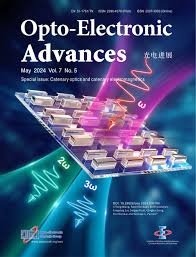
Academic Journal
Q1Opto-Electronic Advances
About Opto-Electronic Advances
Opto-Electronic Advances is a scholarly journal published by Chinese Academy of Sciences. SCImago 2025 places it in Q1 with an SJR of 3.315 and an H-index of 65.
Its listed coverage is 2018-2026 and its research categories include Atomic and Molecular Physics, and Optics (Q1); Electrical and Electronic Engineering (Q1); Electronic, Optical and Magnetic Materials (Q1); Surfaces, Coatings and Films (Q1). The 2025 dataset reports 62 documents and 3129 citations across the latest three-year reporting window.
In today's rapidly evolving technological landscape, opto-electronic advances are playing a pivotal role in driving innovation across various industries. From telecommunications and healthcare to aerospace and renewable energy, opto-electronic devices are redefining how we capture, transmit, and process information. This article explores the latest developments in opto-electronics, their applications, and their impact on the future of technology.
What Are Opto-Electronics?
Opto-electronics, or optical electronics, is a branch of electronics that deals with the interaction between light and electronic systems. It combines optics and electronics to develop devices that either produce, detect, or control light. Common examples include LEDs, lasers, photodiodes, solar cells, and optical fibers.
These devices are integral to many of the technologies we use daily, such as smartphones, high-speed internet, medical imaging systems, and solar panels.
Key Opto-Electronic Advances
Recent breakthroughs in opto-electronics are leading to faster, smaller, and more energy-efficient devices. Some of the most notable developments include:
-
Silicon Photonics: Integrating optical components into silicon chips has made it possible to transmit data using light, offering significantly higher speeds than traditional electrical signals. This is revolutionizing data centers and high-performance computing.
-
Quantum Dots and Nanophotonics: These materials enhance the efficiency of light emission and detection, leading to superior display technologies, advanced sensors, and more efficient solar cells.
-
Flexible and Wearable Opto-Electronics: Researchers are now developing bendable opto-electronic devices that can be embedded in fabrics or worn on the skin. These are ideal for health monitoring and wearable tech applications.
-
3D Optical Sensing: Widely used in smartphones and autonomous vehicles, 3D sensing uses lasers and light detection technologies (like LiDAR) for spatial awareness and precise imaging.
Applications Across Industries
The impact of opto-electronic advances can be felt across multiple sectors:
-
Telecommunications: Optical fibers powered by laser diodes enable high-speed internet and long-distance communication.
-
Healthcare: Medical imaging systems like OCT (Optical Coherence Tomography) rely on opto-electronics for non-invasive, high-resolution imaging of tissues.
-
Automotive: LiDAR systems, crucial for autonomous driving, use opto-electronic sensors to map environments in real time.
-
Energy: Solar panels utilize opto-electronic components to convert sunlight into electricity, playing a key role in clean energy solutions.
The Future of Opto-Electronics
As demand grows for faster, smarter, and more energy-efficient technologies, opto-electronic innovations will continue to shape the future. With ongoing research into materials like graphene and perovskites, and integration with AI and IoT systems, the potential for opto-electronic technologies is virtually limitless.
Journal Metrics
Metrics can change by reporting year. Verify time-sensitive values with the publisher or indexing service.
Aims & Scope
Opto-electronics is at the forefront of modern science and technology, bridging the gap between optics and electronics. The field has seen rapid growth over the last few decades, with innovative research and applications impacting industries from telecommunications to healthcare. As technology evolves, understanding the scope of opto-electronic advances is critical for researchers, professionals, and tech enthusiasts.
What is Opto-Electronics?
Opto-electronics is the study and application of electronic devices that source, detect, and control light. This includes devices such as LEDs, lasers, photodiodes, solar cells, and fiber optic communication systems. These devices convert electrical signals into photon-based signals and vice versa, allowing for ultra-fast, high-efficiency systems in various fields.
Key Areas of Opto-Electronic Advances
-
Telecommunications: The rise of fiber optic communication is one of the most prominent examples of opto-electronic advancement. By transmitting data through light signals, these systems offer higher bandwidth and faster speeds than traditional copper cables.
-
Healthcare and Medical Imaging: Technologies such as optical coherence tomography (OCT), laser surgery, and biosensors rely heavily on opto-electronics. These innovations enable non-invasive diagnostics and precision treatments.
-
Consumer Electronics: Devices like smartphones, digital cameras, remote controls, and virtual reality systems use opto-electronic components to deliver high-quality imaging and sensing functions.
-
Solar Energy: Photovoltaic (PV) cells, commonly known as solar panels, convert sunlight into electricity using opto-electronic principles. The ongoing research in perovskite solar cells and multi-junction cells aims to boost energy efficiency and reduce costs.
-
Defense and Security: Night vision, infrared sensors, laser range finders, and optical surveillance systems are widely used in military and security sectors. Opto-electronics provides enhanced accuracy and long-distance detection capabilities.
Future Trends in Opto-Electronic Research
The future of opto-electronics is promising, with emerging areas such as:
-
Quantum Opto-Electronics: Combining quantum computing with photonics to revolutionize data processing and cryptography.
-
Integrated Photonics: Miniaturizing optical circuits onto chips, leading to faster, more efficient data transfer systems.
-
Flexible and Wearable Opto-Electronics: Development of bendable sensors and light-emitting fabrics for healthcare monitoring and smart textiles.
Why Opto-Electronic Advances Matter
With global demand for faster communication, sustainable energy, and smarter devices, the advancement of opto-electronic technologies is vital. These innovations not only improve daily life but also play a significant role in addressing climate change, enhancing healthcare, and securing digital communications.
Recent Research Articles
Latest publications matched automatically by ISSN.
Ultrahigh-efficiency and robust thermophotovoltaic devices via spectral-heat filtering
Heng Zhang, Zhequn Huang, Min Ding, Yilin Feng et al.
2026 · DOI: 10.29026/oea.2026.250248Unlocking home-based nocturnal health management: A fiber-optic approach for early detection of cardiorespiratory rhythm disorders
Hanyu Jin, Hao Li, Zhuolin Chen, Liangye Li et al.
2026 · DOI: 10.29026/oea.2026.250334Learning from hybrid bright-dark field imaging for resolution-enhanced digital pathology
Runjie Huang, Runnan Zhang, Xiyu Chen, Yefeng Shu et al.
2026 · DOI: 10.29026/oea.2026.260060Integrated optical fiber devices
Wei Jin
2026 · DOI: 10.29026/oea.2026.250323A flexible wireless system for prospective photodynamic therapy applications
Rolan Mansour, Bhavani Yalagala, Vikas Vikas, Nikolas Bruce et al.
2026 · DOI: 10.29026/oea.2026.250275Metasurfaces forge new paths in quantum spaces
Pashlene Naidoo, Andrew Forbes
2026 · DOI: 10.29026/oea.2026.260118A compression-decompression framework for universal acceleration of photonic neuromorphic computing
Changdi Zhou, Deyu Cai, Yu Huang, Yigong Yang et al.
2026 · DOI: 10.29026/oea.2026.250350Fast step heterodyne light-induced thermoelastic spectroscopy gas sensing based on a quartz tuning fork with high-frequency of 100 kHz
Yuanzhi Wang, Ying He, Shunda Qiao, Xiaonan Liu et al.
2026 · DOI: 10.29026/oea.2026.250150Millisecond-level electrically switchable metalens for adaptive rotational depth mapping and diffraction-limited imaging
Yeseul Kim, Jihae Lee, Won-Sik Kim, Hyeonsu Heo et al.
2026 · DOI: 10.29026/oea.2026.250216Shedding light on glucose
Mohsen Rahmani
2026 · DOI: 10.29026/oea.2026.250265Timeshare surface-enhanced Raman scattering platform with sensitive and quantitative mode
Qianqian Ding, Xueyan Chen, Yunlu Jia, Hong Liu et al.
2026 · DOI: 10.29026/oea.2026.250269Deep-learning-assisted label-free single-cell identification and sorting using femtosecond laser fabricated microfluidic surface-enhanced Raman scattering (SERS) chips with plasmonic ring-shaped nanostructure arrays
Shi Bai, Kun Fang, Jingtian Hu, Ying Ma et al.
2026 · DOI: 10.29026/oea.2026.260071Dispersionless coupling control enabled by artificial gauge fields for dense waveguide arrays and arbitrary-ratio power splitters
Ting Li, Hong Zhang, Yuhan Sun, Xiaochuan Xu et al.
2026 · DOI: 10.29026/oea.2026.260026Topology transfer from vortex electrons to structured radiation via guided Cherenkov emission: orbital angular momentum and polarization skyrmions
Sun-Hong Min, Matlabjon Sattorov, Dongpyo Hong, Jin Pyung Kim et al.
2026 · DOI: 10.29026/oea.2026.260107Emerging landscape of photonic bound states in the continuum for next-generation metadevices
Thi Thu Ha Do, Ronghui Lin, Daniil A. Shilkin, Zhiyi Yuan et al.
2026 · DOI: 10.29026/oea.2026.250224Ultra-sensitive multi-band infrared polarization photodetector based on 1T'-MoTe<sub>2</sub>/2H-MoTe<sub>2</sub> van der Waals heterostructure
Yuting Pan, Lidan Lu, Bofei Zhu, Chunhua An et al.
2026 · DOI: 10.29026/oea.2026.250260Imprinted high-<i>Q</i> polymer micro-ring resonator array for high-resolution photoacoustic tomography
Hyeonwoo Kim, Wei-Kuan Lin, Linyu Ni, Mohammad Ali et al.
2026 · DOI: 10.29026/oea.2026.250215High-efficiency infrared upconversion imaging with nonlinear silicon metasurfaces empowered by quasi-bound states in the continuum
Tingting Liu, Jumin Qiu, Meibao Qin, Xu Tu et al.
2026 · DOI: 10.29026/oea.2026.250257PhyspeNet: An empirical physics-aware network for adaptive speckle reconstructive spectrometry
Junrui Liang, Min Jiang, Jun Li, Zhongming Huang et al.
2026 · DOI: 10.29026/oea.2026.250299Optical addressing enables a new architecture for spatial light modulators
Xiangyu Huang, Na Liu
2026 · DOI: 10.29026/oea.2026.260049Reviews
Community Reviews
Version History
April 22, 2025 at 1:03 pm
April 22, 2025