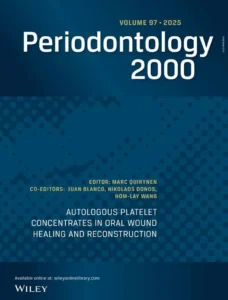
Academic Journal
Q1Periodontology 2000
About Periodontology 2000
Periodontology 2000 is a scholarly journal published by Blackwell Munksgaard. SCImago 2025 places it in Q1 with an SJR of 4.915 and an H-index of 171.
Its listed coverage is 1993-2026 and its research categories include Periodontics (Q1). The 2025 dataset reports 78 documents and 3926 citations across the latest three-year reporting window.
Periodontology 2000: Advancing Global Knowledge in Periodontal Science
Periodontology 2000 is a prestigious, peer-reviewed journal that serves as a cornerstone in the field of periodontics and dental research. Known for its comprehensive and in-depth reviews, this quarterly publication plays a vital role in advancing knowledge about periodontal diseases, their treatment, and associated oral health issues. As a trusted source among dental professionals, researchers, and academics, Periodontology 2000 has set a high standard for scientific quality and clinical relevance in the world of periodontal science.
What Is Periodontology 2000?
Launched in 1993, Periodontology 2000 is published by Wiley-Blackwell and is the official journal of the European Federation of Periodontology. Unlike typical research journals that feature original studies, Periodontology 2000 focuses on in-depth review articles. Each issue is dedicated to a specific theme or topic within periodontology and related fields, offering readers a holistic and updated understanding of current research, treatment techniques, and clinical approaches.
Why Is Periodontology 2000 Important?
Periodontology 2000 is highly respected for its scholarly content and expert contributors. Its publications are often authored by leading international researchers and clinicians, making it a go-to reference for evidence-based practice. The journal’s thematic approach allows dental professionals to stay informed about the latest advancements, emerging trends, and best practices in areas such as:
-
Periodontal disease pathogenesis
-
Regenerative procedures
-
Peri-implant diseases
-
Systemic links to periodontal conditions
-
Innovations in diagnosis and therapy
By compiling critical analyses and clinical insights, the journal helps bridge the gap between cutting-edge research and everyday dental practice.
Audience and Reach
The journal targets a wide audience, including periodontists, general dentists, oral surgeons, dental hygienists, researchers, and postgraduate students. Due to its authoritative voice and high citation rates, Periodontology 2000 is frequently used in dental schools and by professionals preparing for board certifications and academic teaching.
Its strong presence in major scientific databases like PubMed and Scopus enhances its visibility, making it a powerful tool for anyone looking to deepen their understanding of periodontal health.
Key Features
-
Thematic Issues: Each quarterly issue delves into a central topic, providing a multidimensional view.
-
Global Contributors: International experts contribute, offering diverse perspectives.
-
Evidence-Based Content: Articles are grounded in current research and clinical best practices.
-
High Impact Factor: It consistently ranks among the top journals in dentistry and periodontics.
Journal Metrics
Metrics can change by reporting year. Verify time-sensitive values with the publisher or indexing service.
Aims & Scope
Understanding Periodontology 2000: A Leading Voice in Periodontal Research
Periodontology 2000 is a highly respected, peer-reviewed journal that plays a crucial role in advancing knowledge in the field of periodontology and implant dentistry. Known for its in-depth reviews, comprehensive research, and thought leadership, Periodontology 2000 has become a go-to resource for dental professionals, researchers, and clinicians around the globe.
Published by Wiley-Blackwell on behalf of the European Federation of Periodontology (EFP), Periodontology 2000 differs from traditional scientific journals. Rather than publishing individual study results, it offers state-of-the-art review articles that summarize and interpret the existing body of literature in periodontics and related disciplines. This unique format makes it especially valuable for those looking to gain a deep understanding of a particular topic within the field.
What Makes Periodontology 2000 Stand Out?
One of the key features that sets Periodontology 2000 apart is its focus on evidence-based content. Each issue is typically centered around a specific theme or topic, such as peri-implant diseases, bone regeneration, periodontal-systemic health links, or microbiology in periodontal diseases. This thematic approach allows readers to gain comprehensive insights from multiple angles, written by world-renowned experts.
Moreover, the journal is known for its high impact factor, reflecting its influence and credibility in the dental and medical communities. With contributions from leading academics and clinicians, the journal maintains rigorous editorial standards to ensure scientific accuracy and clinical relevance.
Why Dental Professionals Trust Periodontology 2000
For periodontists, dental hygienists, general dentists, and oral health researchers, Periodontology 2000 serves as an invaluable educational tool. Whether preparing for board exams, planning treatment strategies, or staying updated on emerging trends, professionals rely on this journal to stay at the forefront of periodontal science.
Its reviews help bridge the gap between research and clinical application, providing actionable insights that can improve patient outcomes. By summarizing decades of research in each article, Periodontology 2000 saves readers time while delivering trustworthy information.
SEO Keywords and Relevance
From an SEO perspective, key search terms like “Periodontology 2000 journal,” “periodontal research reviews,” “dental implant publications,” and “evidence-based periodontics” are highly relevant. Professionals searching for authoritative content on periodontology are likely to include these keywords in their queries, making this article highly discoverable.
Additionally, keywords such as “peer-reviewed dental journals,” “systematic reviews in periodontics,” and “advancements in periodontal therapy” help broaden the reach to a wider audience interested in dental science and oral health.
Final Thoughts
Periodontology 2000 is more than just a journal—it is a vital resource that empowers dental professionals with the knowledge they need to deliver top-tier care. With its expert-written, evidence-based content and thematic depth, it continues to shape the future of periodontal education and clinical practice.
For anyone serious about staying informed in the rapidly evolving field of periodontology, subscribing to or regularly reading Periodontology 2000 is a wise and worthwhile investment.
Recent Research Articles
Latest publications matched automatically by ISSN.
Understanding exosomes: A history of EV ‐erything
Richard J. Miron, Paras Ahmad, Anton Sculean
2026-09-08 · DOI: 10.1111/prd.70092Oral health and systemic health outcomes: A call for interdisciplinary action
Moritz Kebschull, Ryan T. Demmer, Nigel Pitts, Huda Yusuf et al.
2026-08-31 · DOI: 10.1111/prd.70086Mapping the omics landscape for peri‐implant diseases: A scoping review
Ethan Ng, Ioannis Fragkioudakis, Jeniffer Perussolo, John Rong Hao Tay et al.
2026-08-31 · DOI: 10.1111/prd.70056Guiding the AI revolution in periodontology and implant dentistry: Concepts, ethics, accountability, and a roadmap for sustainable adoption
Aminollah Khormali, Negin Soghli, Patricia A. Miguez
2026-08-31 · DOI: 10.1111/prd.70078Understanding extracellular vesicles in antiaging
Paras Ahmad, Nathan E. Estrin, Anton Sculean, Richard J. Miron et al.
2026-08-31 · DOI: 10.1111/prd.70070Factors influencing the effectiveness of surgical therapy of peri‐implantitis
Ausra Ramanauskaite, Wenije Zhou, Emilio A. Cafferata, Frank Schwarz et al.
2026-08-31 · DOI: 10.1111/prd.70052Individualized healing significantly improves pink esthetics around immediate single implants: A systematic review and meta‐analysis
Xinyi Qian, Boldizsár Vánkos, Gergely Agócs, Kata Kelemen et al.
2026-08-31 · DOI: 10.1111/prd.70089Dentifrice formulations for the treatment of dentin hypersensitivity: A systematic review and network meta‐analysis
A. J. Gormley, T. Walsh, J. Twigg, C. Farrugia et al.
2026-08-31 · DOI: 10.1111/prd.70088Association of tooth wear with dentin hypersensitivity: A systematic review
Giovanna C. Denucci, Knut Adam, Nadine Schlueter, Cecilia P. Turssi et al.
2026-08-31 · DOI: 10.1111/prd.70090Flapless submucosal instrumentation treatment of peri‐implantitis: Contemporary evidence and clinical protocol
José Nart, Neus Carrió, Gonzalo Blasi, Maria Costanza Soldini et al.
2026-08-31 · DOI: 10.1111/prd.70091Soft tissue grafting for the prevention and management of peri‐implantitis
Eduardo Montero, Ignacio Sanz‐Sánchez, Myroslav Solonko, Javier Sanz et al.
2026-08-31 · DOI: 10.1111/prd.70084Decoding host–microbial dynamics in peri‐implantitis: Ecosystem‐specific experimental models
Georgios A. Kotsakis, Davi Araújo, Asaf Wilensky, Juliana Girón Bastidas et al.
2026-08-25 · DOI: 10.1111/prd.70076Dental implant survival, success, and failure in older populations: Beyond chronological age to systemic and local risk profiles
Liza Harutyunyan, Yvonne L. Hernandez‐Kapila
2026-08-25 · DOI: 10.1111/prd.70077Definition and recommendations for trial methods for evaluating dentin hypersensitivity: A hybrid AI‐assisted scoping review and Delphi consensus process
Alexander J. Pollard, Tom J. Pollard, Anne‐Marie Glenny, Jan Clarkson et al.
2026-08-25 · DOI: 10.1111/prd.70079Microbial and host‐derived biomarkers for the diagnosis and management of peri‐implant diseases
Su Sheng Quach, Ausra Ramanauskaite, Sašo Ivanovski, Pingping Han et al.
2026-08-25 · DOI: 10.1111/prd.70083Influence of defect morphology on the therapeutic outcomes of peri‐implantitis
Fernando Suárez, Alberto Monje
2026-08-25 · DOI: 10.1111/prd.70081Diagnostic use of extracellular vesicles in dentistry
Yu‐Chi Cheng, Eren A. Keles, David T. Wu, David R. Walt et al.
2026-08-25 · DOI: 10.1111/prd.70066Periodontitis and metabolic dysfunction‐associated steatotic liver disease
Rafael Scaf de Molon, Erica Dorigatti de Avila, Davi da Silva Barbirato, Mariana Fampa Fogacci et al.
2026-08-25 · DOI: 10.1111/prd.70072Management of extraction sites: From biological principles to clinical practice
Emilio Couso‐Queiruga, Gustavo Avila‐Ortiz
2026-08-25 · DOI: 10.1111/prd.70074Peri‐implantitis and systemic inflammation: Current evidence, biological plausibility, and research gaps
Yumeng Yan, Jeanie Suvan, Francesco D'Aiuto
2026-08-25 · DOI: 10.1111/prd.70080Reviews
Community Reviews
Version History
April 21, 2025 at 5:18 am
April 21, 2025