Academic Journal
Q1Annals of Mathematics
About Annals of Mathematics
Annals of Mathematics is a scholarly journal published by Department of Mathematics at Princeton University. SCImago 2025 places it in Q1 with an SJR of 9.137 and an H-index of 153.
Its listed coverage is 1996-2025 and its research categories include Mathematics (miscellaneous) (Q1); Statistics and Probability (Q1); Statistics, Probability and Uncertainty (Q1). The 2025 dataset reports 25 documents and 601 citations across the latest three-year reporting window.
The Annals of Mathematics is one of the most prestigious and influential journals in the field of pure mathematics. Established in 1884, this peer-reviewed academic journal has played a crucial role in advancing mathematical research across the globe. Jointly published by Princeton University and the Institute for Advanced Study, the Annals of Mathematics is widely recognized for its rigorous standards and groundbreaking publications.
A Legacy of Excellence in Mathematical Publishing
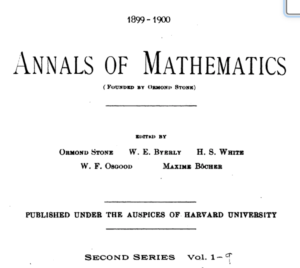
The Annals of Mathematics was initially founded at the University of Virginia, but it moved to Harvard in 1899 and eventually found a permanent home at Princeton University in 1911. Over the years, it has published pioneering works by some of the most notable mathematicians in history, including John Nash, Kurt Gödel, and Andrew Wiles. Its legacy includes the publication of many fundamental theorems and proofs that have significantly shaped modern mathematics.
Peer-Reviewed and Highly Selective
One of the defining features of the Annals of Mathematics is its exceptional editorial process. The journal is known for its high rejection rate, accepting only the most original and technically sound research papers. Each submission undergoes a thorough peer review by experts in the field, ensuring that only the most significant contributions make it to publication.
This strict review process contributes to the journal’s outstanding reputation and high impact factor. For researchers, having a paper published in the Annals of Mathematics is considered a major achievement and often marks a milestone in their academic careers.
Topics Covered by the Journal
The Annals of Mathematics covers a wide range of topics in pure mathematics, including but not limited to:
-
Algebra
-
Geometry
-
Number Theory
-
Topology
-
Analysis
-
Mathematical Logic
Its comprehensive scope ensures that it remains a valuable resource for mathematicians specializing in diverse subfields.
Online Access and Archives
The Annals of Mathematics is accessible through various academic databases and the journal’s official website. Many institutions provide access to the journal through JSTOR and Project Euclid, allowing students and researchers to explore its extensive archive of historic and contemporary articles. Additionally, recent volumes are often available for free, reflecting the journal’s commitment to advancing open-access academic publishing.
Importance for the Academic Community
For mathematicians, scholars, and institutions, the Annals of Mathematics serves as a benchmark of excellence. It not only reflects the current state of mathematical research but also influences the direction of future investigations. As such, it holds a central position in mathematical literature and is frequently cited in advanced studies and research papers.
Journal Metrics
Metrics can change by reporting year. Verify time-sensitive values with the publisher or indexing service.
Aims & Scope
The Annals of Mathematics is one of the most prestigious and long-standing mathematics journals in the world. Known for its high-impact, peer-reviewed publications, the journal is a collaborative effort between Princeton University and the Institute for Advanced Study. Its primary mission is to publish original research papers of the highest quality across all areas of pure and applied mathematics.
Core Focus Areas
The Annals of Mathematics is dedicated to advancing the frontiers of mathematical knowledge. It welcomes groundbreaking research in a wide spectrum of mathematical disciplines, including:
-
Algebra and Number Theory
-
Geometry and Topology
-
Analysis and Partial Differential Equations
-
Dynamical Systems
-
Logic and Foundations
-
Mathematical Physics
-
Combinatorics and Probability
-
Algebraic Geometry and Representation Theory
Each published paper undergoes a rigorous peer-review process, ensuring that only the most significant and innovative contributions are accepted. The journal places strong emphasis on originality, depth, and clarity.
High Impact and Global Reach
Consistently ranked among the top journals in mathematics, the Annals of Mathematics is widely cited and has a profound influence on both theoretical and applied mathematics. With a legacy that dates back to 1884, it has played a central role in shaping modern mathematical thought.
The journal has published many landmark papers, including work by Fields Medalists and other leading figures in the mathematical sciences. Because of its reputation, a publication in the Annals is considered a significant achievement in a mathematician’s career.
Publication Frequency and Accessibility
The Annals of Mathematics is published bimonthly, offering six issues per year. Each volume includes a selection of high-quality research articles that have passed multiple stages of review and editorial scrutiny. The journal is available both in print and digital formats, making it accessible to institutions and researchers around the world.
To ensure wide dissemination, the journal also maintains an online archive where past issues can be accessed for research and academic use. This digital repository supports advanced search functionality, making it easier for readers to locate relevant content by author, keyword, or mathematical subject classification.
Who Should Submit?
The Annals of Mathematics invites submissions from researchers worldwide who are working on cutting-edge problems in pure and applied mathematics. While the acceptance rate is low due to the high standards of the journal, it remains a platform for mathematicians who have produced results of exceptional depth and significance.
Recent Research Articles
Latest publications matched automatically by ISSN.
Tremors and horocycle dynamics on the moduli space of transition surfaces
Jon Chaika, John Smillie, Barak Weiss
2026-07-01 · DOI: 10.4007/annals.2026.204.1.1Hermitian K-theory for stable $\infty$-categories III: Grothendieck--Witt groups of rings
Baptiste Calmès, Emanuele Dotto, Yonatan Harpaz, Fabian Hebestreit et al.
2026-07-01 · DOI: 10.4007/annals.2026.204.1.2The $L^3$-based strong Onsager theorem
Vikram Giri, Hyunju Kwon, Matthew Novack
2026-07-01 · DOI: 10.4007/annals.2026.204.1.4Stable minimal hypersurfaces in $\mathbf{R}^5$
Otis Chodosh, Chao Li, Paul Minter, Douglas Stryker et al.
2026-07-01 · DOI: 10.4007/annals.2026.204.1.5Analytic pseudo-rotations
Pierre Berger
2026-07-01 · DOI: 10.4007/annals.2026.204.1.3Weakly mixing polygonal billiards
Jon Chaika, Giovanni Forni
2026-05-01 · DOI: 10.4007/annals.2026.203.3.1Rational approximations to linear subspaces
Nicolas de Saxcé
2026-05-01 · DOI: 10.4007/annals.2026.203.3.2The McKay Conjecture on character degrees
Marc Cabanes, Britta Späth
2026-05-01 · DOI: 10.4007/annals.2026.203.3.5Quantum variance on quaternion algebras, III
Paul D. Nelson
2026-05-01 · DOI: 10.4007/annals.2026.203.3.3An exponential improvement for diagonal Ramsey
Marcelo Campos, Simon Griffiths, Robert Morris, Julian Sahasrabudhe et al.
2026-05-01 · DOI: 10.4007/annals.2026.203.3.4Nash blowup fails to resolve singularities in dimensions four and higher
Federico Castillo, Daniel Duarte, Maximiliano Leyton-Álvarez, Alvaro Liendo et al.
2026-03-01 · DOI: 10.4007/annals.2026.203.2.7A new approach to strong convergence
Chi-Fang Chen, Jorge Garza-Vargas, Joel A. Tropp, Ramon van Handel et al.
2026-03-01 · DOI: 10.4007/annals.2026.203.2.4A counterexample to Viterbo's conjecture
Pazit Haim-Kislev, Yaron Ostrover
2026-03-01 · DOI: 10.4007/annals.2026.203.2.5Bethe–Sommerfeld Conjecture and absolutely continuous spectrum of multi-dimensional quasi-periodic Schrödinger operators
Yulia Karpeshina, Leonid Parnovski, Roman Shterenberg
2026-03-01 · DOI: 10.4007/annals.2026.203.2.1Good Locally Testable Codes
Irit Dinur, Shai Evra, Ron Livne, Alexander Lubotzky et al.
2026-03-01 · DOI: 10.4007/annals.2026.203.2.3An approach to universality using Weyl m-functions
Benjamin Eichinger, Milivoje Lukić, Brian Simanek
2026-03-01 · DOI: 10.4007/annals.2026.203.2.2New large value estimates for Dirichlet polynomials
Larry Guth, James Maynard
2026-03-01 · DOI: 10.4007/annals.2026.203.2.6Arithmetic bigness and a uniform Bogomolov-type result
Xinyi Yuan
2026-01-01 · DOI: 10.4007/annals.2026.203.1.2On locally analytic vectors of the completed cohomology of modular curves II
Lue Pan
2026-01-01 · DOI: 10.4007/annals.2026.203.1.3Symmetric power functoriality for Hilbert modular forms
James Newton, Jack Thorne
2026-01-01 · DOI: 10.4007/annals.2026.203.1.4Reviews
Community Reviews
Version History
April 20, 2025 at 1:26 pm
April 20, 2025