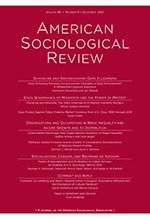
Academic Journal
Q1American Sociological Review
About American Sociological Review
American Sociological Review is a scholarly journal published by American Sociological Association. SCImago 2025 places it in Q1 with an SJR of 3.277 and an H-index of 252.
Its listed coverage is 1965-2026 and its research categories include Sociology and Political Science (Q1). The 2025 dataset reports 49 documents and 863 citations across the latest three-year reporting window.
About American Sociological Review: A Leading Journal in Sociological Research
The American Sociological Review (ASR) is widely recognized as one of the most prestigious and influential peer-reviewed journals in the field of sociology. Published bimonthly by the American Sociological Association (ASA), ASR is dedicated to advancing sociological knowledge by publishing original research articles that offer fresh insights into social phenomena, theories, and methodologies.
History and Purpose
Founded in 1936, the American Sociological Review was established to provide an independent forum for high-quality sociological research. Over the decades, it has maintained a commitment to publishing work that is both theoretically grounded and empirically rigorous. ASR aims to promote scholarly communication across all areas of sociology, from classical topics like social stratification and race relations to emerging issues such as digital sociology and environmental justice.
High Impact and Global Reach
The impact factor of the American Sociological Review consistently ranks it among the top sociology journals worldwide. Academics, researchers, and policymakers frequently cite its articles, which often shape discussions in the classroom, public discourse, and governmental policy. With an international readership, ASR helps bridge global sociological communities, encouraging comparative studies and cross-national research.
Content and Submission
ASR publishes original research articles, including both quantitative and qualitative studies. Authors explore diverse topics, including but not limited to:
-
Social inequality and mobility
-
Race, gender, and class
-
Education and labor markets
-
Culture and identity
-
Political sociology and public policy
-
Health and society
-
Urban and rural sociology
Each manuscript undergoes a rigorous peer-review process to ensure academic excellence and integrity. Submissions must present well-developed theoretical frameworks, clearly articulated research questions, and robust methodologies. The journal is open to innovative approaches that push the boundaries of traditional sociological inquiry.
Accessibility and Availability
The American Sociological Review is available in both print and digital formats. Subscribers, including university libraries and independent researchers, can access current and past issues through platforms such as JSTOR, SAGE Journals, and the ASA website. With digital access, researchers from around the world can engage with cutting-edge sociological research in real time.
Why Read or Publish in ASR?
Whether you're a seasoned sociologist, a graduate student, or a policy analyst, reading the American Sociological Review offers deep insights into the structures and dynamics that shape human societies. For scholars, publishing in ASR is a mark of distinction that can significantly enhance academic careers.
ASR is more than a journal—it's a vital resource for anyone passionate about understanding society. It encourages critical thinking, promotes evidence-based discourse, and contributes to the development of a more informed and equitable world.
Journal Metrics
Metrics can change by reporting year. Verify time-sensitive values with the publisher or indexing service.
Aims & Scope
Scope of the American Sociological Review: A Comprehensive Overview
The American Sociological Review (ASR) is one of the most prestigious and widely cited journals in the field of sociology. Published bimonthly by the American Sociological Association (ASA), the ASR plays a critical role in shaping scholarly discourse by featuring original research that advances theoretical understanding and empirical knowledge of social phenomena. Its broad and inclusive scope makes it a central publication for academics, researchers, and policy analysts interested in the complexities of social life.
What Is the Focus of the American Sociological Review?
The primary scope of the American Sociological Review encompasses all areas of sociology. It is committed to publishing high-quality, peer-reviewed research that makes significant theoretical, methodological, or empirical contributions. Unlike many specialized journals, ASR does not limit its content to specific subfields. Instead, it embraces a diverse range of topics including, but not limited to:
-
Social theory and methodology
-
Social stratification and inequality
-
Race, ethnicity, and gender
-
Politics, culture, and institutions
-
Family, education, and religion
-
Urban and rural sociology
-
Globalization and transnational processes
ASR is particularly known for its emphasis on theoretical innovation and rigorous empirical testing, encouraging submissions that push the boundaries of sociological knowledge and address contemporary social issues with scholarly depth.
Audience and Impact
ASR’s target audience includes professional sociologists, university faculty, graduate students, and interdisciplinary scholars. Its impact extends beyond academia, often informing public debate, influencing policy development, and contributing to sociological education across the globe. With a high impact factor and a reputation for intellectual rigor, the ASR is frequently cited in other academic publications and is considered a benchmark for excellence in the field.
Submission and Peer Review Process
The journal maintains a double-blind peer review process to ensure objectivity and academic integrity. Each submitted manuscript is evaluated by leading experts in the relevant subfield, ensuring that the research meets the highest standards. The ASR accepts both qualitative and quantitative studies, as long as the research demonstrates strong theoretical foundations and contributes to the advancement of sociological understanding.
Why Publish in the American Sociological Review?
Publishing in the American Sociological Review is a significant achievement for any sociologist. It offers:
-
High visibility among global sociology communities
-
Recognition from leading academics and institutions
-
A platform to influence future research and policy discussions
-
Opportunities for academic collaboration and career advancement
Recent Research Articles
Latest publications matched automatically by ISSN.
How Norms Depend on the Presence and Status of Observers: The Relational Contingency of Everyday Behaviors in 90 Societies
Brent Simpson, Kimmo Eriksson, Irina Vartanova, Pontus Strimling et al.
2026-08-27 · DOI: 10.1177/00031224261464586Relational Roots of Civic Fields: Capital Conversion and Organizational Reproduction in a Developing Country
Jose Eos Trinidad
2026-08-01 · DOI: 10.1177/00031224261465023The Gendered Intergenerational Transmission of Managerial Status
Nicholas Martindale, Thomas Lyttelton, Lasse Folke Henriksen
2026-08 · DOI: 10.1177/00031224261457151Religion Unbundled: Toward a Twenty-First-Century Paradigm for the Sociology of American Religion
Ruth Braunstein, Jaime Kucinskas, Brian Steensland, Daniel Winchester et al.
2026-08 · DOI: 10.1177/00031224261453543Handing Off: Frontline Redistribution of Work
Elizabeth Chiarello, Kelley Fong, Josh Seim
2026-08 · DOI: 10.1177/00031224261454367Neighborhood Desirability and Decision-Making in Online, Multiracial, Metropolitan America
Max Besbris, Ariela Schachter, John Kuk
2026-08 · DOI: 10.1177/00031224261446899Unstable Work in a Fissured Economy: Tracking Employment in Subcontractor Establishments in France
Clem Aeppli
2026-08 · DOI: 10.1177/00031224261448194Temporal Misalignment and Unequal Agency: What Terminal Cancer Patients Teach Us about Time and Inequality
Zhuofan Li, Daniel Dohan, Corey M. Abramson
2026-08 · DOI: 10.1177/00031224261448220Countervailing Powers: Labor Unions Against the Buyer Power of Walmart Supercenters
Joshua Choper, Lukas Lehner, Zachary Parolin
2026-06 · DOI: 10.1177/00031224261437057The Influence “Paradox”: When More Network Ties Lead to Less Change
Yuan Hsiao, Nicholas A. Christakis
2026-06 · DOI: 10.1177/00031224261438845Performing Nationalism: Celebrity Politics and Audience Boundary Work Under Authoritarianism
Lingxiao Chen
2026-06 · DOI: 10.1177/00031224261435132Between Two Rituals: Face and Effervescence as Moments of Social Life
Anders Vassenden, Nicholas Hoynes, Taylor Price, Iddo Tavory et al.
2026-06 · DOI: 10.1177/00031224261441865Colonization Fever: Malaria and the Israeli–Palestinian Conflict, 1882 to 1914
Omri Tubi
2026-06 · DOI: 10.1177/00031224261439738State Right to Work Laws and Economic Dynamism in U.S. Counties, 1946 to 2019
Alec P. Rhodes, Tom VanHeuvelen
2026-05-09 · DOI: 10.1177/00031224261433186Collateral Decision-Making: The Case of Pretrial Detention and the Criminal Courts
Caylin Louis Moore
2026-06 · DOI: 10.1177/00031224261423211Salience Shifts and Managerial Discretion: How Periods of Islamist Terrorism Affect the Employment of Middle Eastern Men
Malte Reichelt, Christoph Müller
2026-04 · DOI: 10.1177/00031224261424488Kinship Interlocks: How the Intimate Exchange of Wealth, Status, and Power Generates Upper-Class Persistence
Shay O’Brien
2026-04 · DOI: 10.1177/00031224261425688Living with Ghosts: How Physical Traces of the Past Shape Cultural Trauma in Chinatowns
Matt Patterson, Henry Tsang, Bryan Kuk, Weiqi Li et al.
2026-04 · DOI: 10.1177/00031224261422414Pedagogy of Fear: Folklore and the Far-Right in Weimar Germany
Elena Amaya, Robert Braun
2026-04 · DOI: 10.1177/00031224251409746Unsecured Credit and the Social Safety Net in U.S. States
Alec P. Rhodes, Davon Norris, Jason Houle, Rachel E. Dwyer et al.
2026-04 · DOI: 10.1177/00031224251411563Reviews
Community Reviews
Version History
April 23, 2025 at 6:08 am
April 23, 2025