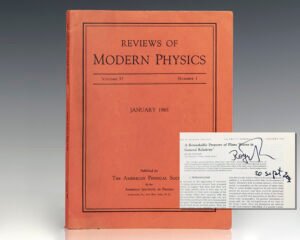
Academic Journal
Q1Reviews of Modern Physics
About Reviews of Modern Physics
Reviews of Modern Physics is a scholarly journal published by American Physical Society. SCImago 2025 places it in Q1 with an SJR of 13.041 and an H-index of 417.
Its listed coverage is 1929-2026 and its research categories include Physics and Astronomy (miscellaneous) (Q1). The 2025 dataset reports 32 documents and 4546 citations across the latest three-year reporting window.
Reviews of Modern Physics (RMP) is one of the most prestigious peer-reviewed journals in the field of physics. Published by the American Physical Society (APS), RMP is known for its high-impact factor and comprehensive review articles that cover groundbreaking advancements in modern physics. Established in 1929, the journal has consistently provided in-depth, authoritative content that serves as a valuable resource for researchers, educators, and students worldwide.
Why Reviews of Modern Physics is Highly Regarded- High Impact Factor: RMP boasts one of the highest impact factors among physics journals, reflecting the significance and influence of its published articles.
- Comprehensive Review Articles: Unlike conventional research papers, RMP features detailed review articles that summarize and critically analyze recent developments in various fields of physics.
- Expert Contributions: Articles are authored by leading experts in physics, ensuring a high standard of accuracy and reliability.
- Broad Coverage: The journal encompasses a wide range of topics, including quantum mechanics, astrophysics, condensed matter physics, nuclear physics, and more.
- Global Recognition: RMP is widely cited in scientific literature, making it a key reference for physicists and academics worldwide.
- Quantum Physics: Exploring foundational concepts, quantum computing, and quantum entanglement.
- Condensed Matter Physics: Covering superconductivity, nanotechnology, and material science.
- Astrophysics and Cosmology: Addressing the mysteries of the universe, black holes, and dark matter.
- Nuclear and Particle Physics: Discussing the fundamental particles and the forces governing them.
- Statistical and Computational Physics: Highlighting advancements in complex systems and simulation techniques.
Journal Metrics
Metrics can change by reporting year. Verify time-sensitive values with the publisher or indexing service.
Aims & Scope
Modern physics is a dynamic field that continues to shape our understanding of the universe. It encompasses various subfields, including quantum mechanics, relativity, particle physics, and condensed matter physics. The advancements in modern physics have led to revolutionary technologies and innovations that impact industries such as healthcare, computing, and energy.
Scope of Modern Physics
Modern physics primarily deals with phenomena at both macroscopic and microscopic scales that classical physics could not explain. Some of the key areas covered include:Quantum Mechanics
Quantum mechanics explores the behavior of matter and energy at atomic and subatomic levels. It has led to groundbreaking discoveries such as quantum entanglement, quantum tunneling, and quantum computing.Relativity
Einstein's theories of special and general relativity revolutionized our understanding of space, time, and gravity. These theories are crucial for technologies like GPS and have expanded our knowledge of black holes and cosmology.Particle Physics
Particle physics investigates the fundamental building blocks of matter. The Large Hadron Collider (LHC) at CERN has played a significant role in confirming the existence of particles like the Higgs boson, which provides mass to other particles.Condensed Matter Physics
This field examines the properties of materials in solid and liquid states. It has been instrumental in developing semiconductors, superconductors, and nanotechnology.Astrophysics and Cosmology
Astrophysics explores celestial bodies, while cosmology focuses on the origins and evolution of the universe. Discoveries such as dark matter, dark energy, and gravitational waves have reshaped our understanding of the cosmos.Reviews and Recent Advancements in Modern Physics
Quantum Computing
Quantum computing is one of the most exciting developments in modern physics. Companies like IBM, Google, and Microsoft are making significant strides in building quantum computers that can perform complex calculations exponentially faster than classical computers.Gravitational Waves
The detection of gravitational waves by LIGO and Virgo observatories confirmed Einstein’s predictions and opened a new era in astrophysics, allowing scientists to study cosmic events such as black hole mergers.Dark Matter and Dark Energy
Ongoing research on dark matter and dark energy seeks to explain the missing mass and accelerating expansion of the universe. These discoveries could lead to groundbreaking advancements in theoretical physics.Artificial Intelligence in Physics
AI and machine learning are transforming how physicists analyze data and make predictions. From simulating quantum systems to optimizing particle collisions, AI is accelerating research in various domains of physics.Recent Research Articles
Latest publications matched automatically by ISSN.
Security proofs for practical QKD: Variations, techniques, gaps, and limitations
Devashish Tupkary, Ernest Y.-Z. Tan, Shlok Nahar, Lars Kamin et al.
2026-09-08 · DOI: 10.1103/28rs-frmwPolarons in atomic gases and two-dimensional semiconductors
Pietro Massignan, Richard Schmidt, Grigori E. Astrakharchik, Ataç İmamoglu et al.
2026-09-02 · DOI: 10.1103/4nng-bb9zBoson-sampling: From theory to postclassical computation
Anonymous
2026-08-26 · DOI: 10.1103/6rzr-tv7wChirality and Handedness of Bodies and Fields
Anonymous
2026-08-25 · DOI: 10.1103/vwnt-54zfColloquium: Isotopes for medicine and fundamental physics
Anonymous
2026-08-21 · DOI: 10.1103/lsdy-ml45Colloquium : Strongly dipolar molecular Bose-Einstein condensates: From few- to many-body physics
Andreas Schindewolf, Jens Hertkorn, Ian Stevenson, Matteo Ciardi et al.
2026-08-20 · DOI: 10.1103/r55l-f93mPolarons from first principles
Anonymous
2026-08-19 · DOI: 10.1103/pkz4-pqhvPhoton localization
Anonymous
2026-08-07 · DOI: 10.1103/wxqn-hj7xIon Coulomb crystals: An exotic form of condensed matter
Giovanna Morigi, John Bollinger, Michael Drewsen, Daniel Podolsky et al.
2026-08-05 · DOI: 10.1103/tn8k-r4w8Ultralight Dark Matter: Progress and Current Constraints
Anonymous
2026-07-14 · DOI: 10.1103/j9ly-b6q3Colloquium : What do we mean by ‘active matter’?
Michael te Vrugt, Benno Liebchen, Michael E. Cates
2026-07-13 · DOI: 10.1103/wd4f-q7kvNaturalness and the hierarchy problems
Anonymous
2026-07-06 · DOI: 10.1103/h7xp-2h5lQuantum geometry phenomena in condensed matter systems
Anonymous
2026-07-01 · DOI: 10.1103/f78t-ky69Viscosity variation in fluid flows across scales
Anonymous
2026-07-01 · DOI: 10.1103/dj2s-sj4tPoltergeist mechanism: Enhancement of scalar-induced gravitational waves with early matter-dominated era
Anonymous
2026-07-01 · DOI: 10.1103/ddx9-p8rmTip-enhanced molecular fluorescence microscopy with atomic-scale resolution
Anna Rosławska, Katharina Kaiser, Sofia Canola, Song Jiang et al.
2026-06-30 · DOI: 10.1103/pqvw-kv92High-energy emission from the Galactic Center
Andrea Goldwurm, Maïca Clavel, Stefano Gabici, Régis Terrier et al.
2026-06-29 · DOI: 10.1103/9nww-fclbQuantum linear system solvers: A survey of algorithms and applications
Mauro E. S. Morales, Lirandë Pira, Philipp Schleich, Kelvin Koor et al.
2026-06-23 · DOI: 10.1103/x6gh-d8ghFundamentals of vacuum breakdown in high-gradient accelerator structures
Walter Wuensch, Sergio Calatroni, Flyura Djurabekova, Andreas Kyritsakis et al.
2026-06-05 · DOI: 10.1103/h8wb-y278Colloquium: Manabe’s legacy of simulating and understanding global warming
Anonymous
2026-05-29 · DOI: 10.1103/mfpg-3th9Reviews
Community Reviews
Version History
April 13, 2025 at 12:07 pm
March 18, 2025