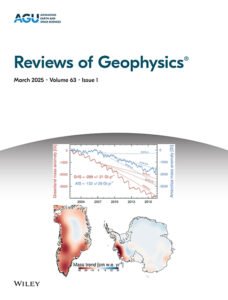
Academic Journal
Q1Reviews of Geophysics
About Reviews of Geophysics
Reviews of Geophysics is a scholarly journal published by John Wiley and Sons Inc. SCImago 2025 places it in Q1 with an SJR of 15.383 and an H-index of 219.
Its listed coverage is 1963-2026 and its research categories include Geophysics (Q1). The 2025 dataset reports 27 documents and 2867 citations across the latest three-year reporting window.
Reviews of Geophysics is a prestigious, peer-reviewed scientific journal published by the American Geophysical Union (AGU). As one of the highest-impact journals in the Earth and space sciences, it plays a critical role in synthesizing key research findings, identifying emerging trends, and guiding future studies. Since its inception in 1963, the journal has become a vital resource for researchers, students, and professionals in geophysics and related disciplines.
What Sets Reviews of Geophysics Apart?
Unlike standard research journals that focus on original studies, Reviews of Geophysics specializes in in-depth, comprehensive review articles. These articles summarize the current state of knowledge on specific geophysical topics, often written by leading experts in the field. The journal covers a broad range of topics, including but not limited to:
-
Seismology and tectonics
-
Volcanology and geodynamics
-
Hydrology and climate systems
-
Atmospheric sciences
-
Oceanography
-
Planetary and space physics
By consolidating and analyzing vast amounts of scientific literature, these reviews offer clarity and direction in an ever-expanding field. This makes the journal especially useful for early-career researchers seeking to understand complex subjects, as well as for seasoned scientists aiming to stay up to date with cross-disciplinary advancements.
High Impact and Academic Excellence
Reviews of Geophysics consistently ranks among the top journals in its field. Its high impact factor reflects both the quality and the influence of its publications. Articles published in this journal are widely cited, often serving as foundational references for subsequent research.
The editorial board, composed of respected scientists and researchers, maintains rigorous peer-review standards to ensure that each article meets the highest levels of accuracy, relevance, and scholarly value. This commitment to excellence has earned Reviews of Geophysics the trust of the academic community worldwide.
A Resource for the Global Scientific Community
With its open-access options and digital availability via the AGU website and various academic platforms, Reviews of Geophysics reaches a global audience. Scientists, educators, policy-makers, and students rely on it to gain insights into environmental challenges, natural hazards, and planetary phenomena. Its review articles often help shape research agendas and inform policy decisions related to climate change, natural disaster preparedness, and space exploration.
Journal Metrics
Metrics can change by reporting year. Verify time-sensitive values with the publisher or indexing service.
Aims & Scope
Geophysics, the scientific study of the Earth using physical principles, plays a critical role in understanding natural phenomena and resource exploration. From locating oil and gas reserves to predicting earthquakes and mapping groundwater resources, geophysics provides invaluable data that drive key industries and environmental studies. In this scope review of geophysics, we’ll explore its wide-ranging applications, career opportunities, and emerging trends shaping its future.
What is Geophysics?
Geophysics involves the application of physics to study the Earth’s interior and surface processes. By using tools like seismic waves, magnetic fields, and gravity measurements, geophysicists uncover insights about the Earth’s structure and dynamics. This field intersects with geology, environmental science, engineering, and data science—making it incredibly multidisciplinary.
Applications of Geophysics
One of the most valuable aspects of geophysics is its practical application across various sectors:
-
Natural Resource Exploration: Geophysics is crucial for locating and extracting resources like oil, gas, minerals, and groundwater. Seismic and electromagnetic surveys help identify subsurface structures without invasive digging.
-
Environmental Monitoring: Geophysical techniques assess soil contamination, groundwater flow, and subsurface pollution, aiding in sustainable development and environmental protection.
-
Earthquake and Volcano Prediction: Seismology, a branch of geophysics, helps monitor tectonic activity to predict natural disasters and mitigate risks.
-
Engineering and Construction: Geophysical surveys are used in infrastructure projects to evaluate ground stability, bedrock depth, and fault lines before construction begins.
Career Opportunities in Geophysics
The scope of geophysics offers numerous career paths. Professionals in this field are in demand in both the public and private sectors. Major employers include:
-
Oil and gas companies
-
Environmental consulting firms
-
Government research bodies
-
Space agencies (like NASA)
-
Academic and research institutions
Common roles include geophysical data analyst, exploration geophysicist, seismic interpreter, and environmental geophysicist. With the growing integration of artificial intelligence and big data in geophysical modeling, there is also increasing demand for tech-savvy geoscientists.
Emerging Trends in Geophysics
The future of geophysics is shaped by technological innovation. Remote sensing, machine learning, and advanced geophysical imaging are enhancing precision and efficiency. As climate change accelerates, the need for climate modeling and environmental monitoring using geophysical tools is on the rise.
Moreover, renewable energy exploration—like geothermal energy—is opening new opportunities for geophysicists. These developments expand the discipline’s relevance in a rapidly evolving world.
Recent Research Articles
Latest publications matched automatically by ISSN.
Inside the Fire Plume Chemical Interactions: A Review on Key Processes and Future Directions
E. Dovrou, A. Voulgarakis
2026-09 · DOI: 10.1029/2025rg000899Toward an Improved Understanding of the Antarctic Coastal Zone and Its Contribution to Future Global Sea Level
Kenichi Matsuoka, Geir Moholdt, Jennifer F. Arthur, Julien A. Bodart et al.
2026-09 · DOI: 10.1029/2022rg000803Composition of the Martian Crust and Its Relationship to the Martian Mantle: A Post‐InSight View
S. M. McLennan, A. Khan, P. A. Sossi, K. W. Cheng et al.
2026-09 · DOI: 10.1029/2025rg000882Measuring Ocean Surface Waves
Clarence O. Collins, Andre Amador, Alexander Babanin, James Behrens et al.
2026-09 · DOI: 10.1029/2025rg000888Changing Dynamics of the Arctic Ocean–Ice System: Drivers, Feedbacks, and Future Trajectories
Igor V. Polyakov, Qinghua Ding, Marika M. Holland, Julienne Stroeve et al.
2026-09 · DOI: 10.1029/2025rg000908River Sand and Gravel Mining: Global Drivers, Impacts, and Pathways for Sustainable Management
Edward Park, Christopher R. Hackney, Dung Duc Tran, Mette Bendixen et al.
2026-09 · DOI: 10.1029/2024rg000868Collisionless Shocks: Contemporary State After Three Quarters of a Century of Research
M. Gedalin, M. Balikhin, V. Krasnoselskikh
2026-09 · DOI: 10.1029/2025rg000893The Role of Bubbles in Air‐Sea Gas Exchange: A Critical Review
Yuanxu Dong, Bernd Jähne, David K. Woolf, Kerstin E. Krall et al.
2026-09 · DOI: 10.1029/2025rg000903Issue Information
2026-09 · DOI: 10.1029/rog.70018The Lightning Return Stroke Current: Formation, Propagation, Attenuation, and Dispersion Through the Lens of the Telegrapher's Equations
C. L. da Silva, L. Baeza, J. Wemhoner, S. Orizaga et al.
2026-09 · DOI: 10.1029/2025rg000914Rock Physics of the Critical Zone: Models, Inversion, and Interpretation
Dario Grana, Brady A. Flinchum, Denys Grombacher, Andrew D. Parsekian et al.
2026-06 · DOI: 10.1029/2025rg000912The United States Magnetotelluric Array and the National Impedance Map
Anna Kelbert, Paul A. Bedrosian, Adam Schultz, Gary D. Egbert et al.
2026-06 · DOI: 10.1029/2024rg000850The Influence of Sea Ice and Ice Mélange on Outlet Glacier Dynamics in the Arctic and Antarctic: Recent Progress and Future Challenges
Katherine A. Deakin, Chris R. Stokes, Stewart S. R. Jamieson, J. Rachel Carr et al.
2026-06 · DOI: 10.1029/2025rg000918Eruption Source Parameters in Volcanic Plume Modeling: Advances, Challenges, and Future Directions
A. Costa, A. Folch, Y. J. Suzuki, L. Mingari et al.
2026-06 · DOI: 10.1029/2025rg000897Arc Heat Flow and Magmatic Heat Budgets
S. E. Ingebritsen, Kazuki Sawayama, Yuri Taran, Giovanni Chiodini et al.
2026-06 · DOI: 10.1029/2025rg000922Expressing Gratitude to Reviewers: A Message From the Editors of Reviews of Geophysics for 2025
Qingyun Duan, Valerio Acocella, Ann Marie Carlton, Minhan Dai et al.
2026-06 · DOI: 10.1029/2026rg000940Terrestrial Analogs to Titan for Geophysical Research
Conor A. Nixon, Samuel Birch, Audrey Chatain, Charles Cockell et al.
2026-06 · DOI: 10.1029/2025rg000909Issue Information
2026-06 · DOI: 10.1029/rog.70014Reviews
Community Reviews
Version History
April 12, 2025 at 5:03 pm
April 12, 2025