Academic Journal
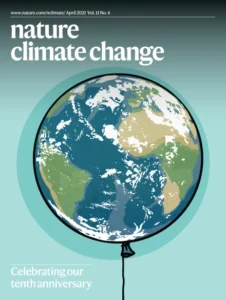
Q1Nature Climate Change
About Nature Climate Change
Nature Climate Change is a scholarly journal published by Nature Research. SCImago 2025 places it in Q1 with an SJR of 7.978 and an H-index of 322.
Its listed coverage is 2009, 2011-2026 and its research categories include Environmental Science (miscellaneous) (Q1); Social Sciences (miscellaneous) (Q1). The 2025 dataset reports 348 documents and 12673 citations across the latest three-year reporting window.
Climate change is one of the most pressing environmental challenges of our time. Driven largely by human activities such as deforestation, industrialization, and the burning of fossil fuels, climate change is dramatically altering the natural balance of our planet. The connection between nature and climate change is deep and complex—understanding it is crucial for creating sustainable solutions for our future.
How Climate Change Affects Nature
Rising global temperatures, shifting precipitation patterns, and more frequent extreme weather events are disrupting ecosystems across the world. Forests, oceans, wetlands, and grasslands are all under threat. Species are being forced to adapt, migrate, or face extinction. According to experts, over one million plant and animal species are at risk due to climate change and habitat loss.
Coral reefs, often referred to as the “rainforests of the sea,” are experiencing mass bleaching due to warmer ocean temperatures. In polar regions, melting ice caps and glaciers are destroying habitats for species like polar bears and penguins. Even terrestrial ecosystems are feeling the strain, as shifting temperatures affect the blooming of plants, the migration of birds, and the behavior of insects.
The Role of Nature in Combating Climate Change
Ironically, while nature is heavily impacted by climate change, it also holds the key to mitigating its effects. Forests absorb carbon dioxide from the atmosphere, acting as vital carbon sinks. Wetlands store large amounts of carbon in their soil. Oceans play a crucial role in regulating the Earth's climate by absorbing heat and carbon dioxide.
By protecting and restoring natural ecosystems, we can create climate-resilient landscapes that help buffer communities from the effects of climate change. Nature-based solutions—such as reforestation, sustainable agriculture, and wetland restoration—can provide cost-effective and long-lasting benefits for both people and the planet.
Why Biodiversity Matters
Biodiversity ensures ecosystem resilience, which is essential for food security, clean water, and disease regulation. When we lose biodiversity due to climate change, we also lose nature's ability to adapt and recover. Every species plays a role in maintaining ecological balance. A decline in pollinators, for example, directly impacts agricultural productivity and food availability.
Taking Action for a Sustainable Future
Individuals, communities, governments, and businesses all have a role to play in protecting nature from the impacts of climate change. Simple actions like reducing energy use, supporting conservation efforts, planting trees, and choosing sustainable products can make a difference.
On a larger scale, policies that prioritize clean energy, conservation, and sustainable land use are essential. International cooperation and global agreements, like the Paris Climate Accord, are key to creating systemic change.
Journal Metrics
Metrics can change by reporting year. Verify time-sensitive values with the publisher or indexing service.
Aims & Scope
Nature Climate Change is one of the leading journals at the intersection of climate science, policy, and sustainability. As a part of the prestigious Nature portfolio, this publication plays a critical role in advancing our understanding of climate change and its far-reaching impacts. Its scope is broad yet focused, aiming to publish high-quality, peer-reviewed research that addresses the full range of issues surrounding climate change—from the underlying science to the socioeconomic implications.
Multidisciplinary Coverage
One of the defining features of Nature Climate Change is its multidisciplinary nature. The journal welcomes contributions from various scientific domains, including atmospheric sciences, oceanography, ecology, and earth sciences, as well as social sciences, economics, and political science. This wide scope allows it to serve as a platform where natural sciences meet human behavior, policymaking, and technology, fostering a holistic understanding of climate dynamics.
Core Research Areas
The journal emphasizes both foundational and applied research. Core topics include:
-
Climate modeling and prediction
Articles in this area focus on improving our understanding of climate systems, projections of future climate scenarios, and the role of feedback loops in the climate system. -
Climate impacts and vulnerability
Nature Climate Change publishes studies on the effects of climate change on ecosystems, biodiversity, agriculture, water resources, and human health. -
Adaptation and mitigation strategies
The journal features research on technological innovations, policy frameworks, and behavioral changes aimed at reducing greenhouse gas emissions and increasing resilience to climate impacts. -
Climate policy and economics
With climate change becoming a central issue in global politics and economics, the journal explores carbon pricing, green finance, international agreements like the Paris Accord, and the economics of renewable energy.
Policy Relevance and Global Reach
Another key aspect of Nature Climate Change is its policy relevance. The journal seeks to inform global leaders, decision-makers, and stakeholders by publishing research that directly connects science with actionable solutions. Its readership includes not only scientists but also policy advisors, NGOs, educators, and sustainability professionals.
Moreover, the journal maintains a global perspective, encouraging submissions that address climate issues in both developed and developing countries. It often highlights regional case studies that can inform global strategies.
High Impact and Scientific Rigor
As part of the Nature family, Nature Climate Change maintains rigorous editorial standards. Articles go through a meticulous peer-review process and must present significant advances in the field. Its high impact factor reflects both the quality of its content and the trust it commands within the scientific community.
Recent Research Articles
Latest publications matched automatically by ISSN.
Physiological flexibility in changing climates
John S. Terblanche
2026-09-09 · DOI: 10.1038/s41558-026-02738-2Genetically engineered crop adoption support yields and cultivation under climate change
Caroline Yifan Dong, Chengcheng J. Fei, Bruce A. McCarl, David Zilberman et al.
2026-09-08 · DOI: 10.1038/s41558-026-02737-3Author Correction: Tree species richness relates to long-term forest photosynthesis increase
Ruochen Cao, Yongguang Zhang, Alessandro Cescatti, Philippe Ciais et al.
2026-09-07 · DOI: 10.1038/s41558-026-02761-3Declines in European bumblebee habitat suitability attributable to climate change
Bastien De Tandt, Kyla Serres, Rosa Pietroiusti, Diana Erazo et al.
2026-09-02 · DOI: 10.1038/s41558-026-02734-6Infrastructure links amplify impacts
Wenhui Cui
2026-09 · DOI: 10.1038/s41558-026-02747-1Record-breaking wildfires in Canada
Shuai Yang
2026-09 · DOI: 10.1038/s41558-026-02744-4Responding to ecological novelty
2026-09 · DOI: 10.1038/s41558-026-02742-6Policy returns
Lingxiao Yan
2026-09 · DOI: 10.1038/s41558-026-02746-2Power asymmetries in adaptation
Danyang Cheng
2026-09 · DOI: 10.1038/s41558-026-02745-3Restoring reefs with heat-tolerant corals
Bianca Nogrady
2026-09 · DOI: 10.1038/s41558-026-02721-xClimate warming drives thermal shocks and accelerated freshwater habitat fragmentation
Hong Wang, Junguo Liu, Joseph Holden, Penghan Chen et al.
2026-09 · DOI: 10.1038/s41558-026-02731-9Developing double materiality for climate-related financial policy
Kevin Stiroh
2026-09 · DOI: 10.1038/s41558-026-02725-7Thermal justice in urban climate change adaptation
L. Gobatti, P. M. Bach, A. Mazzone, G. Falchetta et al.
2026-09 · DOI: 10.1038/s41558-026-02727-5Bringing justice to informal adaptation to heat stress
Zakia Sultana, Heleen L. P. Mees, Bishawjit Mallick, Ilan Kelman et al.
2026-09 · DOI: 10.1038/s41558-026-02728-4A climate impact taxonomy operationalizing IPCC physical driver and risk concepts
Michaela Werning, Edward Byers, Marina Andrijevic, Carl-Friedrich Schleussner et al.
2026-09 · DOI: 10.1038/s41558-026-02717-7Cities need robust carbon dioxide removal strategies to meet net-zero targets
Giulia Ulpiani, Quirina Rodriguez Mendez, Valeria Todeschi, Gema Hernandez Moral et al.
2026-09 · DOI: 10.1038/s41558-026-02676-zParticulate air pollution undermines plant water-use efficiency by inhibiting photosynthesis
Jian Wang, Yuyu Zhou, Lingli Liu, Constantin M. Zohner et al.
2026-09 · DOI: 10.1038/s41558-026-02712-yEmpirical insights into residual emissions in urban net-zero targets
Giulia Ulpiani, Quirina Rodriguez Mendez, Valeria Todeschi, Gema Hernandez Moral et al.
2026-09 · DOI: 10.1038/s41558-026-02691-0Failure to track a stable AMOC state under rapid climate change
René M. van Westen, Reyk Börner, Henk A. Dijkstra
2026-08-13 · DOI: 10.1038/s41558-026-02730-wAuthor Correction: Enduring impacts of El Niño on life expectancy in past and future climates
Yanbin Xu, Wenjun Zhu, Dhrubajyoti Samanta, Benjamin P. Horton et al.
2026-08-10 · DOI: 10.1038/s41558-026-02735-5Reviews
Community Reviews
Version History
April 18, 2025 at 2:17 am
April 18, 2025