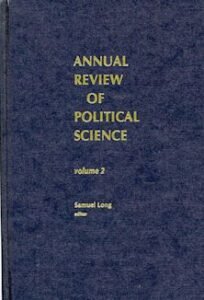
Academic Journal
Q1Annual Review of Political Science
About Annual Review of Political Science
Annual Review of Political Science is a scholarly journal published by Annual Reviews Inc.. SCImago 2025 places it in Q1 with an SJR of 6.416 and an H-index of 150.
Its listed coverage is 1998-2025 and its research categories include Sociology and Political Science (Q1). The 2025 dataset reports 27 documents and 965 citations across the latest three-year reporting window.
Annual Review of Political Science: Advancing Knowledge and Research in Political Science
The Annual Review of Political Science is a premier academic journal dedicated to publishing comprehensive, authoritative, and insightful reviews across the broad field of political science. Established in 1998, the journal is part of the prestigious Annual Reviews series and is recognized as a vital resource for researchers, scholars, policymakers, and students seeking to stay informed about the latest developments, theoretical advances, and empirical research in political science.
What is the Annual Review of Political Science?
The Annual Review of Political Science offers in-depth, peer-reviewed articles that synthesize the current state of knowledge on key topics within the discipline. Unlike traditional research journals that publish original research papers, this review journal focuses on summarizing and analyzing existing research. This approach helps readers gain a clear understanding of where a field stands, what major debates exist, and what future research directions are likely to emerge.
Key Focus Areas
The journal covers a wide range of subfields in political science, including but not limited to:
-
Political theory and philosophy
-
Comparative politics
-
Political behavior and public opinion
-
International relations
-
Public policy and administration
-
Political institutions and processes
-
Law and politics
By addressing both theoretical frameworks and empirical studies, the Annual Review of Political Science serves as a bridge between academia and real-world political issues.
Why It Matters
The value of the Annual Review of Political Science lies in its ability to make complex research accessible and relevant. Each article is written by leading scholars in the field, ensuring high quality and credibility. These reviews not only highlight the most important findings but also identify gaps in knowledge, methodological challenges, and emerging trends.
This is particularly useful for:
-
Researchers, who need comprehensive literature reviews to build upon existing work
-
Students, who benefit from clear and concise overviews of complex topics
-
Policymakers and practitioners, who rely on evidence-based insights to inform decisions
-
Educators, who use these reviews to guide curriculum development
Editorial Standards and Impact
The Annual Review of Political Science is known for its rigorous editorial process. Articles are commissioned by an editorial committee composed of leading experts in political science. This ensures a consistent standard of excellence and relevance. The journal has a high impact factor, making it one of the most influential publications in the field.
Accessibility and Availability
The journal is available both in print and online through the Annual Reviews website. Many institutions provide access to their students and faculty, and individual subscriptions are also available. With growing demand for open-access content, the journal has begun to make select articles freely available to promote wider dissemination of knowledge.
Journal Metrics
Metrics can change by reporting year. Verify time-sensitive values with the publisher or indexing service.
Aims & Scope
Scope of the Annual Review of Political Science: A Comprehensive Overview
The Annual Review of Political Science is one of the most respected academic journals in the field, offering comprehensive and critical reviews of significant developments across the discipline. Published by Annual Reviews, this peer-reviewed journal plays a pivotal role in shaping political science scholarship by synthesizing vast bodies of literature into accessible, authoritative articles. Understanding the scope of the Annual Review of Political Science is essential for researchers, educators, policymakers, and students seeking to stay current with theoretical, empirical, and methodological advancements.
Broad Coverage Across Political Science Subfields
One of the most distinctive aspects of the Annual Review of Political Science is its expansive coverage across all major subfields of political science. These include, but are not limited to:
-
Comparative Politics
-
Political Theory
-
International Relations
-
American Politics
-
Political Economy
-
Public Policy
-
Political Methodology
Each annual volume contains articles that review the state of the field, highlight emerging trends, and offer new perspectives on long-standing debates. The journal acts as a bridge between classical political science and contemporary developments, helping scholars navigate an ever-expanding academic landscape.
Emphasis on Interdisciplinary Approaches
Another key component of the journal's scope is its commitment to interdisciplinary approaches. Articles often integrate insights from sociology, economics, psychology, law, and history to provide a well-rounded understanding of political phenomena. This cross-disciplinary integration reflects the growing complexity of global political challenges and encourages scholars to think beyond traditional boundaries.
Focus on Methodological Rigor and Innovation
The Annual Review of Political Science also emphasizes the importance of methodological diversity and innovation. From quantitative and qualitative research methods to experimental and computational techniques, the journal reviews the strengths, limitations, and applications of various research approaches. This makes it an invaluable resource for scholars refining their methodologies or exploring new research tools.
Timely Reviews of Current Issues
The journal is known for its timely focus on pressing political issues such as democratic backsliding, climate governance, social movements, polarization, and political communication in the digital age. These reviews are especially useful for policymakers, journalists, and academics seeking to understand how current events fit into broader theoretical and historical contexts.
Global Perspective
While the Annual Review of Political Science features many articles focused on U.S. politics, it also provides extensive coverage of global political systems, institutions, and trends. By examining political developments across different regions, the journal promotes a more holistic understanding of politics in the 21st century.
Ideal for Teaching and Research
Due to its clarity, depth, and accessibility, the journal is widely used in both graduate and undergraduate education. Educators often assign its articles to provide students with expert overviews of complex topics. Researchers, meanwhile, rely on the journal to stay informed about the latest scholarly debates and to identify gaps in the literature for future study.
Recent Research Articles
Latest publications matched automatically by ISSN.
Original Peoples Count: Persistence and Strengthening of Indigenous Communities, Identities, and Nations in Latin America
Alberto Diaz-Cayeros, Irma Alicia Velásquez Nimatuj
2026-06-15 · DOI: 10.1146/annurev-polisci-041924-013956Participatory Democracy and Its Limits
Kevin J. Elliott
2026-06-15 · DOI: 10.1146/annurev-polisci-032724-125408Democracy and the Environment
Kathryn Baragwanath, Saad Gulzar
2026-06-15 · DOI: 10.1146/annurev-polisci-100325-075938Non-Western Visions of International Order
Dylan M.H. Loh, Lucas de Oliveira Paes, Ayşe Zarakol
2026-06-15 · DOI: 10.1146/annurev-polisci-032824-084913The Politics of Climate Change in the Developing World
Guy Grossman, Audrey Sacks, Alice Z. Xu
2026-06-15 · DOI: 10.1146/annurev-polisci-032624-014810Education as a Political Institution
Agustina S. Paglayan
2026-06-15 · DOI: 10.1146/annurev-polisci-042623-034027Fictive Politics
Reo Matsuzaki, Fabian Drixler, Anna Grzymala-Busse
2026-06-15 · DOI: 10.1146/annurev-polisci-032624-022830It Took a Village
Kathleen Thelen
2026-06-15 · DOI: 10.1146/annurev-polisci-041524-085607Bureaucratic Influence in International Politics
Richard Clark, Lindsay R. Dolan, Tyler Jost
2026-06-15 · DOI: 10.1146/annurev-polisci-032624-014313The Politics of Inflation
Lucy Barnes
2026-06-15 · DOI: 10.1146/annurev-polisci-050423-112502Principles of Political Equality and the Logic of Power
Pablo Beramendi, Timothy Besley, Margaret Levi
2026-06-15 · DOI: 10.1146/annurev-polisci-052125-121051The Power-Enhancing and Power-Diminishing Effects of Digital Technologies: Marginalized People and US Racial Authoritarianism
LaGina Gause, Angie Bautista-Chavez
2026-06-15 · DOI: 10.1146/annurev-polisci-042224-082228Did Globalization Undermine Governance and Spur a Backlash?
Judith L. Goldstein, Edward D. Mansfield
2026-06-15 · DOI: 10.1146/annurev-polisci-032624-022357Information Processing in Participatory Institutions
Daniel Berliner
2026-06-15 · DOI: 10.1146/annurev-polisci-032824-105816Monument Protection Laws and the Evolving American Monumental Landscape
Melynda Price, Zachary Bray
2026-06-15 · DOI: 10.1146/annurev-polisci-042224-082158Ethnography and Ethnographic Sensibility in Political Science
Diana Fu, Richard A. Nielsen, Edward Schatz
2026-06-15 · DOI: 10.1146/annurev-polisci-041224-084600Conceptualizing Academic Freedom
Jacob T. Levy
2026-06-15 · DOI: 10.1146/annurev-polisci-032624-025000Subaltern Mobilization in the Global South
Amit Ahuja
2026-06-15 · DOI: 10.1146/annurev-polisci-062221-054815Causal Inference, Agency, and the Problem of Inherent Endogeneity
Martin J. Williams
2026-06-15 · DOI: 10.1146/annurev-polisci-032624-013736Reviews
Community Reviews
Version History
April 20, 2025 at 6:45 am
April 20, 2025