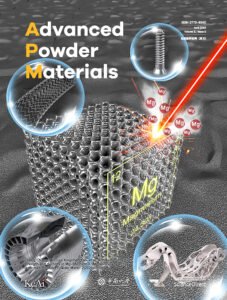
Academic Journal
Q1Advanced Powder Materials
About Advanced Powder Materials
Advanced Powder Materials is a scholarly journal published by KeAi Communications Co.. SCImago 2025 places it in Q1 with an SJR of 4.495 and an H-index of 54.
Its listed coverage is 2022-2026 and its research categories include Catalysis (Q1); Ceramics and Composites (Q1); Energy (miscellaneous) (Q1); Materials Science (miscellaneous) (Q1); Metals and Alloys (Q1); Surfaces, Coatings and Films (Q1). The 2025 dataset reports 59 documents and 3467 citations across the latest three-year reporting window.
Advanced powder materials are at the forefront of innovation in materials science, reshaping the way industries approach manufacturing, product design, and performance optimization. These finely engineered powders possess unique physical and chemical properties that make them indispensable in a wide range of high-tech applications, from aerospace and automotive to electronics and biomedical engineering.
What Are Advanced Powder Materials?
Advanced powder materials refer to finely divided solid particles engineered at the micro or nano scale. These powders are often composed of metals, ceramics, polymers, or composites and are designed to meet specific mechanical, thermal, electrical, or chemical requirements. Through precise control of particle size, shape, distribution, and composition, these materials deliver exceptional performance characteristics compared to traditional bulk materials.
Applications Across Industries
One of the most transformative uses of advanced powder materials is in additive manufacturing (3D printing). Metal powders such as titanium, aluminum, and stainless steel are used to create lightweight, high-strength components with complex geometries—ideal for aerospace and automotive applications. Similarly, ceramic powders like zirconia and alumina are utilized for their heat resistance and biocompatibility in dental and medical implants.
In the electronics industry, nanopowders are essential for producing high-performance batteries, conductive inks, and magnetic components. Energy storage devices, including lithium-ion batteries and supercapacitors, rely on powder-based electrodes that offer increased surface area and improved conductivity.
The pharmaceutical and cosmetic sectors also benefit from powder technology. Microencapsulated powders are used to enhance drug delivery and prolong shelf life, while ultra-fine powders in cosmetics improve texture and application efficiency.
Key Advantages of Advanced Powder Materials
-
Customization: Advanced powders can be engineered to possess specific traits, such as high thermal stability, corrosion resistance, or magnetic properties.
-
High Surface Area: Nanopowders offer increased surface reactivity, which is beneficial in catalytic and chemical applications.
-
Lightweight and Strong: Metal matrix composites made from powder materials can significantly reduce weight while maintaining strength, ideal for aerospace and defense.
Future Trends and Innovations
As demand for sustainable and high-performance materials grows, research into green manufacturing techniques and recyclable powder materials is gaining momentum. Innovations in powder metallurgy, such as spark plasma sintering and hot isostatic pressing, allow for the creation of near-net-shape components with minimal material waste.
Nanotechnology is another driver in the evolution of advanced powder materials. With enhanced control at the atomic level, manufacturers can create next-generation components for quantum computing, smart sensors, and nano-medicine.
Journal Metrics
Metrics can change by reporting year. Verify time-sensitive values with the publisher or indexing service.
Aims & Scope
In today's fast-paced, technology-driven world, advanced materials are transforming how industries operate. Scope Advanced Powder Materials stands at the forefront of this revolution, offering high-performance powders engineered for precision, strength, and efficiency. These materials are essential across sectors like aerospace, automotive, electronics, energy, and medical devices, providing the foundation for next-generation manufacturing and innovation.
What Are Advanced Powder Materials?
Advanced powder materials are finely engineered particles made from metals, ceramics, or composites. Designed for specific performance characteristics, these powders are used in additive manufacturing (3D printing), thermal spray coatings, metal injection molding, and sintering processes. The unique properties of advanced powders—such as controlled particle size distribution, purity, and flowability—ensure optimal performance in high-stress environments.
Scope Advanced Powder Materials are developed using cutting-edge technologies like gas atomization, plasma atomization, and chemical precipitation. These methods ensure uniformity, high purity, and tailored material properties to meet the demanding requirements of modern manufacturing.
Applications of Scope Advanced Powder Materials
-
Aerospace and Defense:
Lightweight, high-strength alloys such as titanium and nickel-based powders are crucial in producing aircraft components, turbine blades, and satellite parts. Scope's powders enhance durability while reducing weight, leading to improved fuel efficiency and performance. -
Automotive Industry:
With the push toward electric vehicles (EVs), thermal management and lightweight components are more important than ever. Advanced powder materials from Scope enable precision manufacturing of parts like battery components, gear systems, and structural frames through additive manufacturing. -
Medical Devices:
Biocompatible materials like titanium and cobalt-chrome powders are used in producing implants, surgical tools, and dental prosthetics. Scope ensures these powders meet stringent medical-grade standards for safety and performance. -
Energy Sector:
From solar energy systems to nuclear reactors, high-performance powders are vital in energy production. Scope’s powders are designed for extreme conditions, offering excellent thermal resistance and corrosion protection. -
Electronics and Semiconductors:
With the demand for miniaturized components, advanced powders facilitate precise manufacturing of connectors, sensors, and heat sinks with superior conductivity and strength.
Why Choose Scope Advanced Powder Materials?
-
Custom Solutions: Scope offers tailored powder formulations to meet specific client needs across various industries.
-
Superior Quality: Advanced quality control ensures consistency in particle size, shape, and purity.
-
Sustainability Focus: Scope prioritizes environmentally responsible manufacturing processes, aligning with global sustainability goals.
-
Global Reach: With a robust distribution network and technical support, Scope serves clients worldwide, providing fast, reliable service.
Future Outlook
The market for advanced powder materials is rapidly expanding, driven by technological advancements and growing industrial demand. Scope is continually investing in R&D to develop next-generation materials that push the boundaries of performance, efficiency, and sustainability.
Recent Research Articles
Latest publications matched automatically by ISSN.
Engineering porphyrinic MOFs via in-situ N–H chlorination for HOCl generation, detoxification, phototheranostics and antimicrobial activity
Yi Ge, Kaibo Li, Beibei Wang, Ruixuan Dong et al.
2027-02 · DOI: 10.1016/j.apmate.2026.100448Asymmetric polarization engineering of covalent triazine frameworks for efficient hydrogen peroxide photosynthesis
Ying Xu, Yunxi Sun, Zhen Zhan, Qi Huang et al.
2027-02 · DOI: 10.1016/j.apmate.2026.100462Manganese-doped metal-organic frameworks as a multifunctional agent for targeted diagnosis and therapy in nasopharyngeal carcinoma
Meiai Liao, Rong Wang, Haifeng Zheng, Guangrui Lai et al.
2027-02 · DOI: 10.1016/j.apmate.2026.100441Distorted high-entropy interface facilitates efficient catalysis for accelerated reversible hydrogen storage in magnesium hydride
Panpan Zhou, Jiaxin Wang, Nuo Lei, Qianwen Zhou et al.
2027-02 · DOI: 10.1016/j.apmate.2026.100459Harnessing synergistic d-p band center modulation of RuO2 nanofibers via dual-site doping for highly active and stable water electrolysis
Linfeng Zhang, Mingze Xia, Weimo Li, Siyu Ren et al.
2027-02 · DOI: 10.1016/j.apmate.2026.100463Asymmetric Ru–O–Co sites coupled adsorbate evolution and oxide pathway mechanisms for enhanced acidic water oxidation
Erkang Chen, Chuanhui Wang, Zhao Liang, Jun Ren et al.
2026-12 · DOI: 10.1016/j.apmate.2026.100450Coupled polymer-cation coordination and anion-derived inorganic-rich interphases in ionic liquid-regulated gel electrolytes for stable lithium metal batteries
Jiaying Chen, Kaizhen Li, Ruohan Hou, Shijie Zhang et al.
2026-12 · DOI: 10.1016/j.apmate.2026.100445Process-structure-property relationships in low-temperature microwave dielectric ceramics: from glass-assisted sintering to cold sintering for 5G/6G devices
Phieraya Pulphol, Ying Tang, Liang Fang, Wanwilai Vittayakorn et al.
2026-12 · DOI: 10.1016/j.apmate.2026.100444Deciphering the thermal depolarization mechanism to enhance the temperature stability of bismuth layer-structured piezoceramics
Yangyang Zhou, Yanyan Zhang, Chun Guo, Zhiyong Zhou et al.
2026-12 · DOI: 10.1016/j.apmate.2026.100442Coordination engineering directs d-band center optimization for efficient CO2 hydrogenation to formic acid on Ir–Nx single-atom catalysts
Yuankang Xu, Lin Wang, Yuanying Liu, Linghao Liu et al.
2026-12 · DOI: 10.1016/j.apmate.2026.100449Synergistic design and facile synthesis of zwitterionic vinylene-linked covalent organic frameworks for efficient photocatalytic hydrogen production
Yuqi Zhang, Qiyuan Wang, Jiaye Cai, Xiongxiong Su et al.
2026-12 · DOI: 10.1016/j.apmate.2026.100451Machine learning for carbon dots: Capabilities, limitations, and the path toward rational design
Shudie Shen, Leilei Zhang, Linquan Gan, Tao Li et al.
2026-12 · DOI: 10.1016/j.apmate.2026.100431Low electric field-induced ultrahigh strain in lead-free piezoelectric via synergistic approach of phase and defect engineering
Muhammad Habib, Attaur Rahman, Weiping Gong, Hang Luo et al.
2026-12 · DOI: 10.1016/j.apmate.2026.100429Inhomogeneous polarization configuration of high-entropy fillers boosting high-temperature capacitive performances of polymer nanocomposites
Yuyan Huang, Zhenhao Fan, Lei Zhang, Xuan Zhao et al.
2026-12 · DOI: 10.1016/j.apmate.2026.100447Unleashing superior strength and ductility in additively manufactured β-titanium alloys through spinodal decomposition
Yanghuanzi Li, Jianhong Yi, Hao Zhang, Changchang Liu et al.
2026-12 · DOI: 10.1016/j.apmate.2026.100428Targeted microstructural repair of lithium-ion battery cathodes via direct regeneration
Zhanfeng Ma, Hongli Chen, Chen Tang, Yong Chen et al.
2026-12 · DOI: 10.1016/j.apmate.2026.100446Effect of VC content on the protective oxide layer structure and ablation resistance of C/C-HfC-VC-SiC composites above 2500 °C
Tian Tian, Yueheng Zhang, Wei Sun, Yuzhu Shen et al.
2026-12 · DOI: 10.1016/j.apmate.2026.100443Asymmetrically Cu–O–Cu bridged dual-atom sites on bio-functionalized oxides for molecular nitrate upcycling
Yeryong Lee, Akash Prabhu Sundar Rajan, Jayaraman Theerthagiri, Anuj Kumar et al.
2026-10 · DOI: 10.1016/j.apmate.2026.100407Lattice-bulk regulation enables internal stress mitigation toward ultra-stable nickel-rich layered cathodes
Wei Shu, Qian Yu, Yehong Zhang, Yuan Yuan et al.
2026-10 · DOI: 10.1016/j.apmate.2026.100412Multimaterial 3D printing of high-strength metal-cermet inert anodes for aluminum electrolysis via interface-structure design
Decai Ouyang, Puyun Fan, Wangjia Zhang, Mengxiong Chen et al.
2026-10 · DOI: 10.1016/j.apmate.2026.100415Reviews
Community Reviews
Version History
April 20, 2025 at 3:45 am
April 20, 2025