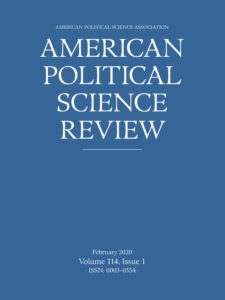
Academic Journal
Q1American Political Science Review
About American Political Science Review
American Political Science Review is a scholarly journal published by Cambridge University Press. SCImago 2025 places it in Q1 with an SJR of 5.433 and an H-index of 228.
Its listed coverage is 1906-2026 and its research categories include Political Science and International Relations (Q1); Sociology and Political Science (Q1). The 2025 dataset reports 170 documents and 2925 citations across the latest three-year reporting window.
The American Political Science Review (APSR) is the flagship journal of the American Political Science Association (APSA) and is widely recognized as the most prestigious publication in the field of political science. Since its establishment in 1906, the APSR has been a leading platform for scholarly research, critical debate, and academic discourse on global political issues. With its high impact factor and rigorous peer-review process, the APSR continues to set the standard for political science scholarship.
What is the American Political Science Review?
The American Political Science Review is a quarterly, peer-reviewed academic journal that publishes original research in all areas of political science. This includes subfields such as:
-
American government and politics
-
Comparative politics
-
International relations
-
Political theory
-
Public policy and administration
-
Political methodology
As a multidisciplinary journal, the APSR encourages diverse theoretical and methodological approaches, making it an inclusive and authoritative resource for political scientists, researchers, and policy analysts worldwide.
High Impact and Global Recognition
The APSR is consistently ranked as one of the top journals in political science based on citation metrics and academic reputation. Its articles are frequently referenced in scholarly publications, policy papers, and academic coursework. The journal’s commitment to publishing innovative and impactful research contributes to its reputation as a leader in the political science community.
Moreover, the American Political Science Review features contributions from scholars around the globe, making it a truly international publication. This global perspective enhances the journal’s relevance and ensures that it addresses a wide range of political systems, ideologies, and governance structures.
Rigorous Peer-Review and Editorial Standards
One of the defining characteristics of the APSR is its rigorous double-blind peer-review process. Every submission is evaluated by multiple experts to ensure it meets the highest standards of academic quality, originality, and analytical depth. The editorial team consists of respected scholars with deep expertise in various areas of political science, further reinforcing the journal’s academic credibility.
Why the APSR Matters
Publishing in the American Political Science Review is a significant achievement for any political scientist. It reflects a high level of scholarly impact and recognition. For readers, the journal offers access to some of the most important and timely research in the field, often influencing public debates, legislative decisions, and academic curricula.
Educators, students, and researchers alike rely on the APSR for in-depth analyses, theoretical advancements, and empirical findings on pressing political issues. From democracy and elections to global conflict and political ideologies, the APSR covers topics that shape the world we live in.
Journal Metrics
Metrics can change by reporting year. Verify time-sensitive values with the publisher or indexing service.
Aims & Scope
The American Political Science Review (APSR) is the flagship journal of the American Political Science Association (APSA) and is widely regarded as the leading publication in the discipline of political science. One of the key reasons for its global reputation and academic influence is the broad and inclusive scope of the journal. Since its inception in 1906, the APSR has continually evolved to reflect the dynamic and diverse nature of political science research. This article explores the scope of the American Political Science Review and how it supports scholarly advancement across a wide range of political topics.
Comprehensive Coverage Across Political Science Subfields
The scope of the APSR encompasses all major subfields of political science. This includes:
-
American Politics: Research on U.S. political institutions, electoral systems, political behavior, public opinion, and domestic policy.
-
Comparative Politics: Studies that compare political systems, governance models, and policy outcomes across different countries.
-
International Relations: Analyses of global political dynamics, international organizations, diplomacy, conflict, and cooperation between states.
-
Political Theory: Explorations of normative political ideas, ideologies, democratic theory, justice, and philosophical foundations of politics.
-
Public Policy and Administration: Research related to policy processes, government performance, public service delivery, and bureaucratic institutions.
-
Political Methodology: Articles focused on the development and application of quantitative and qualitative methods in political science research.
By covering these core areas, the APSR ensures that it remains an inclusive platform for all branches of the discipline, offering insights that are both deep and wide-ranging.
Interdisciplinary and Global Perspectives
Another defining feature of the American Political Science Review is its openness to interdisciplinary research. The journal often features studies that intersect with fields such as sociology, economics, history, law, psychology, and public health. This interdisciplinary approach broadens the journal’s scope and allows for more robust and contextually rich analyses of political phenomena.
Furthermore, the APSR values global perspectives, encouraging submissions from scholars around the world. Its scope includes research focused on diverse regions and political systems, from democracies and authoritarian regimes to emerging political movements and institutions in the Global South.
Theoretical and Methodological Diversity
The APSR is committed to theoretical and methodological pluralism. Its scope includes:
-
Empirical research using statistical, experimental, or case study methods.
-
Formal modeling and game theory.
-
Normative and philosophical arguments.
-
Critical and interpretive approaches.
This methodological diversity enhances the journal's ability to capture the complexity of political behavior, institutions, and ideologies.
Recent Research Articles
Latest publications matched automatically by ISSN.
Are Voters Myopic or Looking for Improvement?
MARKUS PRIOR, TALBOT M. ANDREWS
2026-09-01 · DOI: 10.1017/s0003055426101853Measuring Partisanship and Representation in Online Congressional Communications
MICHAEL KISTNER, MICHAEL HESELTINE, ROBERT ALVAREZ, MAYA FITCH et al.
2026-09-01 · DOI: 10.1017/s0003055426101841Instrumentally Inclusive: The Political Psychology of Homonationalism – CORRIGENDUM
STUART J. TURNBULL-DUGARTE, ALBERTO LÓPEZ ORTEGA
2026-08-10 · DOI: 10.1017/s000305542610197xPSR volume 120 issue 3 Cover and Back matter
2026-08 · DOI: 10.1017/s0003055425101123PSR volume 120 issue 3 Cover and Front matter
2026-08 · DOI: 10.1017/s0003055425101111Redistricting Reforms Reduce Gerrymandering by Constraining Partisan Actors
CORY McCARTAN, CHRISTOPHER T. KENNY, TYLER SIMKO, EMMA EBOWE et al.
2026-07-30 · DOI: 10.1017/s0003055426101610A Democratic Theory of Labor Unions
STEVEN KLEIN
2026-07-30 · DOI: 10.1017/s0003055426101804Contested Governance and Civilian Prosocial Behavior: Evidence from Lab-in-the-Field Experiments in India
BRANDON BOLTE, VINEETA YADAV, BUMBA MUKHERJEE
2026-07-29 · DOI: 10.1017/s0003055426101701Is Blood Thicker Than Water(-and-Earth)? Partisanship Geography in Imperial China and the Limits of Quantitative History
YAO LIN
2026-07-29 · DOI: 10.1017/s0003055425100853Still Instrumentally Inclusive
STUART J. TURNBULL-DUGARTE, ALBERTO LÓPEZ ORTEGA
2026-07-28 · DOI: 10.1017/s0003055426101828Rebel Victory and Authoritarian (Dis)Order
KILLIAN CLARKE, ANNE MENG, JACK PAINE
2026-07-15 · DOI: 10.1017/s0003055426101737Causal Panel Analysis under Parallel Trends: Lessons from a Large Reanalysis Study – CORRIGENDUM
ALBERT CHIU, XINGCHEN LAN, ZIYI LIU, YIQING XU et al.
2026-06-24 · DOI: 10.1017/s0003055426101798Efficient Production without Domination: The Case of Labor-Managed Firms
IÑIGO GONZÁLEZ-RICOY
2026-06-23 · DOI: 10.1017/s0003055426101750Portraits of Power: Facial Appearance and the Tacit Domain of Political Selection in China
JUNYAN JIANG, SONGPO YANG
2026-06-22 · DOI: 10.1017/s0003055426101749Vernacular Architecture and Grassroots Urban Politics: How Politics Is Embedded in Residential Design
PAIGE BOLLEN, NOAH L. NATHAN
2026-06-17 · DOI: 10.1017/s0003055426101592Beyond Belief Change: The Persuasive Returns of Targeting Attitude–Relevant Beliefs
YAMIL RICARDO VELEZ, PATRICK LIU, SCOTT CLIFFORD
2026-06-17 · DOI: 10.1017/s0003055426101622Correction to Feddersen and Pesendorfer (1998)
SAMI PETERSEN
2026-06-15 · DOI: 10.1017/s0003055426101762The Effects of Religious Messages and Endorsements on Political Attitudes: A Meta-Reanalysis
RADHA SARKAR, ALEXANDER COPPOCK
2026-06-10 · DOI: 10.1017/s0003055426101695The Domestic Sources of International Trust
MICHAEL A. GOLDFIEN, MICHAEL F. JOSEPH, ROSEANNE W. MCMANUS
2026-06-08 · DOI: 10.1017/s0003055426101713The Expressive Duty to Vote
CÉCILE FABRE
2026-06-08 · DOI: 10.1017/s0003055426101725Reviews
Community Reviews
Version History
April 22, 2025 at 1:33 pm
April 22, 2025