Academic Journal
Q1Annals of Mathematics
About Annals of Mathematics
Annals of Mathematics — Journal Profile
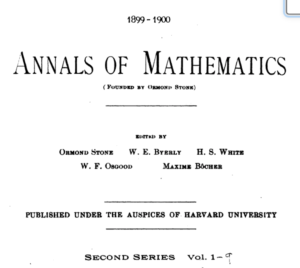
The Annals of Mathematics is one of the oldest and most selective journals in mathematics. Its official About page states the essential facts plainly: the Annals is published bimonthly by the Department of Mathematics of Princeton University with the cooperation of the Institute for Advanced Study; it was founded in 1884 by Ormond Stone of the University of Virginia; it was transferred in 1899 to Harvard University and in 1911 to Princeton University; and since 1933 it has been edited jointly by Princeton University and the Institute for Advanced Study. Its print ISSN is 0003-486X and its online ISSN is 1939-8980, confirmed on the journal's official Subscriptions page, in OpenAlex source S45918994 and on its Journals World record. The editorial office is at Fine Hall, Washington Road, Princeton University, Princeton, NJ 08544, USA.
A bimonthly cadence means six issues a year. The journal publishes research articles across pure mathematics — algebra, algebraic geometry, number theory, geometry and topology, analysis, partial differential equations, mathematical physics and neighbouring areas — at a level that the editorial board judges to be of lasting, field-shaping importance. That judgement, exercised by a board drawn from Princeton and the Institute for Advanced Study together with leading mathematicians elsewhere, is the journal's defining mechanism. The Annals does not compete on speed, article volume or breadth of acceptable topics. It competes on the significance of the relatively small number of papers it accepts, among them some of the most famous results of modern mathematics.
On Journals World the stored publisher field for this record was a bare number, 208, which is not a publisher. The correct identity, from the journal itself, is Princeton University (Department of Mathematics) with the cooperation of the Institute for Advanced Study. The template-era metrics previously shown on this page also mixed databases without attribution; the attributed figures in this profile replace them.
At a Glance
| Full title | Annals of Mathematics |
|---|---|
| Abbreviation | Ann. Math. |
| ISSN (print) | 0003-486X |
| ISSN (online) | 1939-8980 |
| Publisher | Department of Mathematics, Princeton University, with the cooperation of the Institute for Advanced Study (United States) |
| Country | United States |
| Founded | 1884, by Ormond Stone of the University of Virginia (official journal history) |
| Frequency | Bimonthly — six issues per year |
| Article publishing charges | No article publishing charges (official Submission Guidelines) |
| Languages of submission | English, French or German (official Submission Guidelines) |
History and Development
Founded in 1884 by Ormond Stone, the journal spent its first decades moving between institutions — to Harvard in 1899 and to Princeton in 1911 — before the joint Princeton and Institute for Advanced Study editorship was established in 1933. That arrangement placed the journal at the centre of one of the most concentrated mathematical communities in the world, in the decades when Princeton became a refuge and a home for many of the century's leading mathematicians. The archive that accumulated across that period is unusually deep: Crossref records 6,301 DOIs for this ISSN, with substantial annual counts reaching back through the twentieth century and into the nineteenth, and OpenAlex records a first publication year of 1884, 6,306 works and 521,059 citations for the source at the time of checking, by direct ISSN and source-ID fetches that agreed exactly.
The journal's place in mathematical culture is best conveyed by the results it has carried. Andrew Wiles's proof of Fermat's Last Theorem appeared in the Annals in 1995 (volume 141), in the paper Modular elliptic curves and Fermat's Last Theorem, together with the companion work of Taylor and Wiles in the same issue — arguably the most widely reported mathematics publication of the twentieth century. Papers in the Annals are routinely the definitive versions of major theorems, cited for decades rather than years. The journal's delayed open access arrangement, under which content becomes freely readable after a period (commonly described as five years in secondary reference sources), and the availability of its archive through JSTOR and Project Euclid channels, mean that this historical corpus remains in active use by working mathematicians, not merely by historians.
A recent operational change is documented on the journal's own site: the Annals moved to an online editorial system for new submissions, with the site stating that papers submitted before 22 August 2026 remain in the existing Annals database and that authors must use the new submission link via the MSP/Editflow route given on the Submission Guidelines page. Authors should always follow the live guidelines page rather than an older PDF or a third-party summary, because submission mechanics for this journal have changed within the last year and may change again.
Scope: What the Annals Publishes
The Annals publishes original research in mathematics without a narrow topical list; its scope is mathematics at the highest level of significance, as judged by its editors and referees. In practice, its pages span algebraic geometry and number theory (the largest topic cluster in OpenAlex for this source), geometry and topology, algebra, analysis and partial differential equations, probability in its pure-mathematical forms, mathematical physics, logic and combinatorics, among other areas. Papers are typically long by the standards of mathematics journals, because a major theorem with a complete proof cannot be compressed into a short-format letter, and the journal accommodates the length that a correct, self-contained proof requires.
Two scope consequences follow. First, correctness and completeness are non-negotiable: a submission must be a finished piece of mathematics, with proofs in full, not a progress report, an announcement without proofs, or a survey without substantial new results. Announcements of results proved elsewhere, expository articles and applied work without deep mathematical content are not the journal's material. Second, significance is judged relative to the whole of mathematics, not relative to a subfield's internal standards alone. A technically strong paper that settles a narrow question may be excellent and still not be an Annals paper; authors and advisers do young researchers a service by making that distinction honestly and early, and by identifying strong alternative venues — among them Inventiones Mathematicae, Acta Mathematica, the Journal of the American Mathematical Society and Duke Mathematical Journal — whose standards are also high but whose fit differs.
Submission Guidelines — the Official Requirements
The journal's Submission Guidelines page, consulted directly for this profile, states the following requirements and policies. Submissions are received through the online editorial system linked from that page. The submitted manuscript must be a PDF file. Submissions must be written in English, French or German. There are no article publishing charges. A brief abstract of about 200 words or less and a bibliography must be included; the abstract should be self-contained and should not make any reference to the bibliography; if the submission is not in English, two versions of the abstract must be included, one in the language of the article and one in English. Authors of accepted papers are asked to sign a copyright agreement; under that agreement, as summarised on the guidelines page, authors may post PDF files of the final accepted version on personal webpages, electronic preprint servers and institutional non-commercial repositories, and may attach a CC-BY licence only to the accepted version residing in an open-access environment such as the arXiv or a personal webpage — the CC-BY licence does not apply to the version published by the Annals.
The guidelines also carry an explicit policy on artificial intelligence and large language models: authors must be human, and they must take full responsibility for the content of the submission, including its correctness and the integrity and accuracy of its citations; AI agents cannot be named authors; and if an AI tool or LLM contributed an idea, authors should describe that idea and specify its location in the paper. Mathematicians considering any computational or AI assistance in preparing a submission should read that policy in full on the live page and comply with its disclosure expectation.
Editorial Process, Selectivity and Timescales
The Annals is edited jointly by Princeton University and the Institute for Advanced Study, with an editorial board listed on the journal's Editorial Board page. Refereeing in pure mathematics at this level is expert, detailed and often slow by the standards of other sciences: a long proof must be checked, and the small pool of referees able to check a frontier result is itself busy at the frontier. No acceptance rate and no guaranteed decision timetable are published in the official sources consulted for this profile, and none is stated here; third-party estimates of acceptance rates for this journal circulate widely but rest on no published denominator and should not be quoted as fact. What is safe to say — and consistent with the journal's reputation and with the experience reported across the mathematical community — is that acceptance is highly selective, that many strong papers are declined on significance grounds rather than correctness grounds, and that authors should plan a submission strategy that tolerates a long first decision and a real probability of rejection, with a clear next venue in mind.
Subscription information on the official site illustrates the journal's traditional institutional model: subscriptions are managed directly by the Annals office, 2026 prices were listed as 730 US dollars for electronic-only and 890 dollars for print plus electronic, with back-issue and archive access arrangements including usage statistics through Project Euclid. Those figures are reproduced here as dated, official-site subscription facts, not as author charges — for authors, the operative figure is the one already stated: there are no article publishing charges.
Indexing, Metrics and How to Read Them
The Annals is indexed in the major mathematics and citation services appropriate to its field, including MathSciNet, zbMATH, Scopus and the Web of Science, and its archive is held in JSTOR; authors with a formal indexing requirement should confirm current coverage in the owning service itself. Attributed metrics found during research include: OpenAlex h-index 325, two-year mean citedness about 8.57, i10-index 4,170, 6,306 works and 521,059 citations (OpenAlex, stable across repeated direct fetches); Crossref 6,301 registered DOIs for the ISSN; and secondary reference values including a 2023 impact factor of 5.7 reported by Wikipedia from Journal Citation Reports data. The previous template content on this page cited an h-index of 153 with no source — a figure consistent with a Scopus/SCImago calculation rather than with OpenAlex — which illustrates precisely why unattributed single numbers mislead: a mathematics journal's h-index depends entirely on which corpus counted the citations, over what years, with what coverage of books, preprints and older volumes. Readers should treat every metric as a property of a database and a time window, not as a permanent quality label attached to a title. A journal impact factor counts citations in one year to items published in the two preceding years. CiteScore uses a four-year window in Scopus. An h-index grows with the size and age of a corpus, so a journal founded in the nineteenth century and a journal founded in 2007 cannot be compared by h-index alone in any fair way. Two-year mean citedness in OpenAlex offers a further, independently calculated view. None of these numbers predicts whether an individual manuscript will be read, cited or accepted, and none of them replaces reading recent articles in the journal to judge fit, rigour and audience.
In mathematics specifically, citation counts accumulate slowly, proofs are cited for decades, and a journal's influence is carried as much by the theorems it published as by any two-year window. A two-year impact factor in the single digits, which would be unremarkable in molecular biology, places a pure-mathematics journal at the very top of its discipline. Readers comparing the Annals with journals in other fields by raw impact factor are comparing citation cultures, not quality.
For Authors: Preparing an Annals Submission
- Write the abstract to the official specification: about 200 words or fewer, self-contained, with no references to the bibliography; provide dual-language abstracts for a non-English submission.
- Submit a single PDF through the online editorial system linked from the live Submission Guidelines page; confirm the current system before submitting, because the route changed in August 2026.
- Present complete proofs. Do not omit a difficult step as routine unless it genuinely is; Annals referees check.
- Place the result honestly in the literature: state what was known, what the paper proves, and why it matters beyond its immediate subfield, in the introduction.
- Observe the journal's AI and LLM policy: human authorship, full author responsibility for correctness and citations, and disclosure of any AI-contributed idea with its location in the paper.
- On acceptance, complete the copyright agreement and use its self-archiving permissions correctly — the accepted version may be posted as the agreement allows; the published version is treated differently.
- Do not pay any article publishing charge to any party claiming to act for this journal: the official guidelines state that there are none.
Frequently Asked Questions
Who publishes the Annals of Mathematics?
The Department of Mathematics of Princeton University, with the cooperation of the Institute for Advanced Study, which has edited it jointly with Princeton since 1933 — not the bare number previously stored on this Journals World record.
What are the Annals' ISSNs?
Print ISSN 0003-486X and online ISSN 1939-8980, stated on the journal's official Subscriptions page and confirmed in OpenAlex and Crossref records.
How often does it appear and when was it founded?
Bimonthly — six issues a year. Founded in 1884 by Ormond Stone of the University of Virginia, moving to Harvard in 1899 and to Princeton in 1911, per the journal's official About page.
Does the Annals charge authors?
No. The official Submission Guidelines state that there are no article publishing charges.
Is the Annals listed in DOAJ?
A search of the DOAJ application programming interface by ISSN and by title returned no listing for this journal at the time of checking, and this profile claims none. The journal operates a subscription model with delayed free availability of older content, which is a different arrangement from immediate open access.
To aim at the Annals is to ask a hard question of one's own work: is this result one that mathematicians outside my area will still be using in twenty years? When the honest answer is yes, the journal's demands — complete proofs, a self-contained abstract, patience through expert refereeing — are simply the price of joining one of the longest and most distinguished conversations in mathematics. When the answer is not yet, the same work, placed in a strong specialist venue, will usually be read sooner and cited sooner. Either judgement, made honestly, serves the mathematics better than a prestige submission made on hope alone.
The Archive as a Working Resource
The Annals archive deserves separate attention because, for mathematicians, back volumes are not history in the passive sense. Theorems proved fifty or a hundred years ago are cited, taught and built upon today, and the journal's arrangements reflect that use. Older content becomes freely readable after a delay, the archive is preserved and searchable through JSTOR, and usage statistics are available through Project Euclid, as the journal's Subscriptions page notes. Doctoral students are routinely directed to Annals papers as the canonical statements of major results, and a modern literature search in pure mathematics that ignores the archive will miss foundational versions of results that later textbooks simplified. Libraries therefore treat a subscription as access to a continuing reference collection, not merely to six new issues a year, which helps explain why the journal has retained a direct subscription relationship with its readers through its own office rather than disappearing entirely into a large commercial bundle.
That continuity also shapes authorship expectations. A paper accepted by the Annals joins a numbered sequence of volumes running from the nineteenth century to the present, and editors and referees read submissions with that permanence in mind. Minor results can be published well in many places; a result admitted here is expected to be stated in its definitive form, with notation and framing that will still serve readers decades later. Authors can help that process by writing introductions that a mathematician in a neighbouring area can follow, by stating the main theorem early and precisely, and by separating clearly what is new from what is standard. Those are not formatting preferences. In a journal whose papers remain working documents for generations, clarity about the exact claim being added to the permanent record is part of the scholarly contribution itself, and referees reward it accordingly.
Source-backed journal facts
Topics in published research
Algebraic Geometry and Number Theory; Mathematics and Applications; Advanced Algebra and Geometry; Homotopy and Cohomology in Algebraic Topology; Advanced Topics in Algebra; Geometric and Algebraic Topology.
OpenAlex classifies topics from published works. These topics are not the publisher’s official aims and scope.
Source: OpenAlex source record. Retrieved 2026-10-03. Source record updated 2026-10-02. OpenAlex metrics are different from SCImago metrics and the Clarivate Journal Impact Factor.
Journal Metrics
Quartile, SJR and the listed SCImago H-index use the 2025 imported SCImago dataset. A quartile may vary by subject category. Values without a source or reporting year are unverified historical entries. Verify the current Journal Impact Factor with Clarivate or the publisher before using it.
Aims & Scope
The publisher’s official aims and scope have not yet been verified for this profile. Use the journal website to check subject fit and accepted article types before submitting.
Recent Research Articles
Latest publications matched automatically by ISSN.
On the generalized Ramanujan and Arthur conjectures over function fields
Dan Ciubotaru, Michael Harris
2026-09-01 · DOI: 10.4007/annals.2026.204.2.3$L^4$-norms and sign changes of Maass forms
Haseo Ki
2026-09-01 · DOI: 10.4007/annals.2026.204.2.5Effective equidistribution for some one parameter unipotent flows
Elon Lindenstrauss, Amir Mohammadi, Zhiren Wang
2026-09-01 · DOI: 10.4007/annals.2026.204.2.4Addendum to: Mahler's method in several variables and finite automata
Boris Adamczewski, Colin Faverjon
2026-09-01 · DOI: 10.4007/annals.2026.204.2.2Unknotting number is not additive under connected sum
Mark Brittenham, Susan Hermiller
2026-09-01 · DOI: 10.4007/annals.2026.204.2.7Mahler's method in several variables and finite automata
Boris Adamczewski, Colin Faverjon
2026-09-01 · DOI: 10.4007/annals.2026.204.2.1Exotic aspherical $4$-manifolds
Michael Davis, Kyle Hayden, Jingyin Huang, Daniel Ruberman et al.
2026-09-01 · DOI: 10.4007/annals.2026.204.2.6Tremors and horocycle dynamics on the moduli space of transition surfaces
Jon Chaika, John Smillie, Barak Weiss
2026-07-01 · DOI: 10.4007/annals.2026.204.1.1Hermitian K-theory for stable $\infty$-categories III: Grothendieck--Witt groups of rings
Baptiste Calmès, Emanuele Dotto, Yonatan Harpaz, Fabian Hebestreit et al.
2026-07-01 · DOI: 10.4007/annals.2026.204.1.2The $L^3$-based strong Onsager theorem
Vikram Giri, Hyunju Kwon, Matthew Novack
2026-07-01 · DOI: 10.4007/annals.2026.204.1.4Stable minimal hypersurfaces in $\mathbf{R}^5$
Otis Chodosh, Chao Li, Paul Minter, Douglas Stryker et al.
2026-07-01 · DOI: 10.4007/annals.2026.204.1.5Analytic pseudo-rotations
Pierre Berger
2026-07-01 · DOI: 10.4007/annals.2026.204.1.3Weakly mixing polygonal billiards
Jon Chaika, Giovanni Forni
2026-05-01 · DOI: 10.4007/annals.2026.203.3.1Rational approximations to linear subspaces
Nicolas de Saxcé
2026-05-01 · DOI: 10.4007/annals.2026.203.3.2The McKay Conjecture on character degrees
Marc Cabanes, Britta Späth
2026-05-01 · DOI: 10.4007/annals.2026.203.3.5Quantum variance on quaternion algebras, III
Paul D. Nelson
2026-05-01 · DOI: 10.4007/annals.2026.203.3.3An exponential improvement for diagonal Ramsey
Marcelo Campos, Simon Griffiths, Robert Morris, Julian Sahasrabudhe et al.
2026-05-01 · DOI: 10.4007/annals.2026.203.3.4Nash blowup fails to resolve singularities in dimensions four and higher
Federico Castillo, Daniel Duarte, Maximiliano Leyton-Álvarez, Alvaro Liendo et al.
2026-03-01 · DOI: 10.4007/annals.2026.203.2.7A new approach to strong convergence
Chi-Fang Chen, Jorge Garza-Vargas, Joel A. Tropp, Ramon van Handel et al.
2026-03-01 · DOI: 10.4007/annals.2026.203.2.4A counterexample to Viterbo's conjecture
Pazit Haim-Kislev, Yaron Ostrover
2026-03-01 · DOI: 10.4007/annals.2026.203.2.5Reviews
Community Reviews
Version History
October 18, 2026 at 3:24 am
April 20, 2025