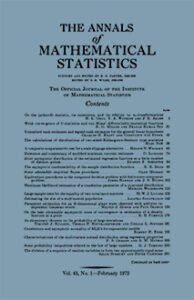
Academic Journal
Q1Annals of Statistics
About Annals of Statistics
Annals of Statistics is a scholarly journal published by Institute of Mathematical Statistics. SCImago 2025 places it in Q1 with an SJR of 3.697 and an H-index of 213.
Its listed coverage is 1996-2025 and its research categories include Statistics and Probability (Q1); Statistics, Probability and Uncertainty (Q1). The 2025 dataset reports 104 documents and 1702 citations across the latest three-year reporting window.
The Annals of Statistics is a world-renowned peer-reviewed academic journal dedicated to publishing the highest quality research in theoretical and applied statistics. Since its first issue in 1973, the journal has played a vital role in advancing the field of statistics and remains a top-tier resource for statisticians, data scientists, and researchers around the globe.
What Is the Annals of Statistics?
Published by the prestigious Institute of Mathematical Statistics (IMS), the Annals of Statistics focuses on cutting-edge statistical methodology, theory, and inference. The journal serves as a key platform for scholars to present new statistical models, innovative methodologies, and groundbreaking theoretical developments.
It covers a wide range of statistical topics including, but not limited to:
-
Probability theory
-
Statistical inference
-
Bayesian statistics
-
Nonparametric methods
-
High-dimensional data analysis
-
Machine learning theory
-
Semiparametric and robust methods
This wide coverage makes the Annals of Statistics one of the most comprehensive journals for anyone interested in both classical and modern statistical approaches.
Who Publishes in the Annals of Statistics?
The journal attracts submissions from leading academics and researchers at top institutions worldwide. With its rigorous peer-review process, only the most impactful and innovative papers are selected for publication. This ensures that each issue contributes meaningfully to the advancement of statistical science.
Researchers from universities such as Harvard, Stanford, MIT, Cambridge, and others frequently appear in its pages. By featuring the latest developments from top statisticians, the Annals of Statistics remains a cornerstone of scholarly excellence.
Why Is the Annals of Statistics Important?
In today’s data-driven world, the importance of reliable statistical methodology cannot be overstated. From machine learning to epidemiology and finance, accurate data analysis depends on sound statistical theory. The Annals of Statistics provides the tools and frameworks necessary for this kind of analysis, influencing a broad spectrum of disciplines.
Moreover, the journal is frequently cited in both academic and professional research, making it one of the most respected and influential statistical publications globally. Its articles are indexed in major academic databases like JSTOR, Scopus, Web of Science, and MathSciNet, ensuring wide visibility and accessibility.
Where to Access the Annals of Statistics?
The journal is available online through platforms such as Project Euclid and the IMS website. While it primarily operates on a subscription model, many articles—especially those published in earlier volumes—are freely accessible, supporting open academic exchange.
Journal Metrics
Metrics can change by reporting year. Verify time-sensitive values with the publisher or indexing service.
Aims & Scope
The Annals of Statistics is a leading peer-reviewed journal that publishes research of the highest quality in the field of statistics. Established as a flagship journal of the Institute of Mathematical Statistics (IMS), the Annals of Statistics is recognized worldwide for advancing the theoretical foundations of statistics while promoting impactful applications across diverse scientific disciplines.
Aims and Coverage
The journal aims to foster the development of modern statistical theory and methodology. It welcomes original research articles that contribute significantly to the understanding of statistical models, inference techniques, and methodological innovation. Both classical and contemporary approaches to statistics are within the journal's purview, including developments in high-dimensional data analysis, Bayesian inference, nonparametric statistics, machine learning, and causal inference.
The Annals of Statistics emphasizes rigorous mathematical foundations and innovative ideas that influence current statistical practice. Submissions are expected to be mathematically thorough, yet relevant to real-world applications. Articles that bridge the gap between theory and application—offering new tools or perspectives to solve practical problems—are particularly encouraged.
Key Areas of Interest Include:
-
Statistical theory and methodology
-
Asymptotic analysis and limit theorems
-
Bayesian and frequentist inference
-
Nonparametric and semiparametric methods
-
High-dimensional and complex data structures
-
Model selection and penalization techniques
-
Empirical processes and stochastic modeling
-
Machine learning from a statistical perspective
-
Causal inference and experimental design
-
Applications in science, engineering, economics, and beyond
Who Should Submit
The Annals of Statistics invites contributions from academic statisticians, mathematical scientists, and researchers working at the intersection of statistics and applied fields. Manuscripts that demonstrate originality, technical depth, and relevance to statistical science are especially valued.
Impact and Reputation
As one of the most prestigious journals in the field, the Annals of Statistics maintains a high standard of scholarship and has a strong global readership. Its articles are frequently cited in statistical literature and serve as foundational references for both theoretical advancement and methodological development.
Open Access and Availability
The Annals of Statistics supports open science by offering options for open-access publication. All accepted papers are published online and are accessible to researchers, institutions, and practitioners worldwide through Project Euclid and other academic platforms.
Recent Research Articles
Latest publications matched automatically by ISSN.
Pseudo-maximum likelihood theory for high-dimensional rank one inference
Curtis Grant, Aukosh Jagannath, Justin Ko
2026-08-01 · DOI: 10.1214/26-aos2639Uniform estimation and inference for nonparametric partitioning-based M-estimators
Matias D. Cattaneo, Yingjie Feng, Boris Shigida
2026-08-01 · DOI: 10.1214/26-aos2623DiPMInd: Distance profile based mutual independence testing for random objects
Yaqing Chen, Paromita Dubey
2026-08-01 · DOI: 10.1214/26-aos2624Association and independence test for random objects
Hang Zhou, Hans-Georg Müller
2026-08-01 · DOI: 10.1214/26-aos2632Unbiased kinetic Langevin Monte Carlo with inexact gradients
Neil K. Chada, Benedict Leimkuhler, Daniel Paulin, Peter A. Whalley et al.
2026-08-01 · DOI: 10.1214/26-aos2630Improved thresholds for e-values
Christopher Blier-Wong, Ruodu Wang
2026-08-01 · DOI: 10.1214/26-aos2626Gaussian and bootstrap approximation for matching-based average treatment effect estimators
Zhaoyang Shi, Chinmoy Bhattacharjee, Krishnakumar Balasubramanian, Wolfgang Polonik et al.
2026-08-01 · DOI: 10.1214/26-aos2647High-order accurate inference on manifolds
Chengzhu Huang, Anru R. Zhang
2026-08-01 · DOI: 10.1214/26-aos2622Sample size and power calculations for causal inference in observational studies
Bo Liu, Chengxin Yang, Fan Li
2026-08-01 · DOI: 10.1214/26-aos2649Estimating the false discovery rate of variable selection
Yixiang Luo, William Fithian, Lihua Lei
2026-08-01 · DOI: 10.1214/26-aos2625Local geometry of high-dimensional mixture models: Effective spectral theory and dynamical transitions
Gérard Ben Arous, Reza Gheissari, Jiaoyang Huang, Aukosh Jagannath et al.
2026-08-01 · DOI: 10.1214/26-aos2621On the efficiency of highly stratified experiments
Yuehao Bai, Jizhou Liu, Azeem M. Shaikh, Max Tabord-Meehan et al.
2026-08-01 · DOI: 10.1214/26-aos2636Fast mixing of data augmentation algorithms: Bayesian probit, logit and lasso regression
Holden Lee, Kexin Zhang
2026-08-01 · DOI: 10.1214/26-aos2641Estimation beyond missing (completely) at random
Tianyi Ma, Kabir A. Verchand, Thomas B. Berrett, Tengyao Wang et al.
2026-08-01 · DOI: 10.1214/26-aos2640Privacy guarantees in posterior sampling under contamination
Shenggang Hu, Louis Aslett, Hongsheng Dai, Murray Pollock et al.
2026-08-01 · DOI: 10.1214/26-aos2628Measuring evidence against exchangeability and group invariance with E-values
Nick W. Koning
2026-08-01 · DOI: 10.1214/26-aos2627Linear methods for nonlinear inverse problems
Geerten Koers, Botond Szabó, Aad van der Vaart
2026-08-01 · DOI: 10.1214/26-aos2634A nonasymptotic distributional theory of approximate message passing for sparse and robust regression
Gen Li, Yuting Wei
2026-08-01 · DOI: 10.1214/25-aos2612Generalized multivariate threshold autoregressive models with linearly partitioned threshold space
Gan Yuan, Chun Yip Yau
2026-08-01 · DOI: 10.1214/26-aos2638Statistical impossibility and possibility of aligning LLMs with human preferences: From Condorcet paradox to Nash equilibrium
Kaizhao Liu, Qi Long, Zhekun Shi, Weijie J. Su et al.
2026-08-01 · DOI: 10.1214/26-aos2643Reviews
Community Reviews
Version History
April 21, 2025 at 2:45 pm
April 21, 2025