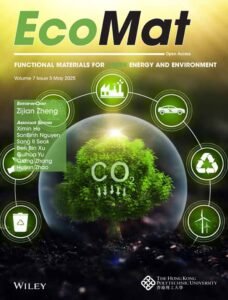
Academic Journal
Q1EcoMat
About EcoMat
EcoMat is a scholarly journal published by John Wiley and Sons Inc. SCImago 2025 places it in Q1 with an SJR of 2.64 and an H-index of 59.
Its listed coverage is 2019-2026 and its research categories include Chemistry (miscellaneous) (Q1); Materials Science (miscellaneous) (Q1); Physical and Theoretical Chemistry (Q1). The 2025 dataset reports 51 documents and 2854 citations across the latest three-year reporting window.
In today’s world, sustainability is more than just a buzzword—it’s a lifestyle choice. As consumers become increasingly aware of their environmental impact, products like EcoMat are gaining popularity for their eco-friendly design, functionality, and commitment to preserving the planet. Whether you're looking to upgrade your home, office, or yoga studio, EcoMat is the perfect solution for conscious consumers.
What is EcoMat?
EcoMat is a versatile, environmentally-friendly mat designed for multiple uses, including fitness, yoga, home decor, and industrial applications. Made from biodegradable, non-toxic, and recyclable materials, EcoMat offers a guilt-free alternative to traditional rubber or plastic-based mats. It combines durability with a strong commitment to sustainability.
Eco-Friendly Materials
One of the standout features of EcoMat is its construction. Made from natural rubber, jute, cork, or recycled materials, EcoMat avoids the use of harmful chemicals and synthetic substances. These materials are not only biodegradable but also renewable, meaning your EcoMat won’t spend decades in a landfill.
Key Benefits of EcoMat
-
Sustainability: By choosing EcoMat, you are actively reducing your carbon footprint. Each mat is crafted with minimal environmental impact, making it a responsible choice for eco-conscious consumers.
-
Durability: Despite its sustainable design, EcoMat does not compromise on strength. It is built to withstand daily wear and tear, making it ideal for workouts, yoga, or everyday home use.
-
Non-Toxic and Safe: Traditional mats often contain harmful chemicals like PVC, phthalates, or heavy metals. EcoMat is free from these toxic elements, making it safe for kids, pets, and sensitive skin.
-
Comfort and Grip: Whether you're using it for exercise or simply as a floor mat, EcoMat offers excellent cushioning and a non-slip surface, ensuring stability and comfort.
-
Stylish Design: EcoMat is available in various colors, textures, and patterns to suit different tastes and interior styles. It’s as aesthetically pleasing as it is functional.
Perfect for Multiple Uses
EcoMat is not limited to yoga or gym use. Its design makes it suitable for a range of applications:
-
Home decor: Use it as a stylish and sustainable rug or mat for your living room or bathroom.
-
Kids' play area: Safe, soft, and toxin-free, EcoMat is perfect for children's spaces.
-
Office settings: Add a touch of nature to your workspace while staying comfortable during long hours.
Why Choose EcoMat?
Choosing EcoMat is more than just a purchase—it’s a commitment to a better future. By incorporating EcoMat into your life, you're supporting sustainable manufacturing, reducing waste, and promoting a healthier environment for generations to come.
Journal Metrics
Metrics can change by reporting year. Verify time-sensitive values with the publisher or indexing service.
Aims & Scope
In today’s world, where sustainability and eco-consciousness are more important than ever, choosing the right products for your home and lifestyle can make a big difference. That’s where Scope EcoMat comes in — a premium, eco-friendly mat designed to meet the needs of modern consumers who care about the planet.
What is Scope EcoMat?
Scope EcoMat is a high-quality, environmentally friendly mat made from sustainable and biodegradable materials. Whether you need a mat for your home, office, gym, or yoga sessions, the EcoMat delivers superior comfort, durability, and eco-conscious performance. Its minimalist design and natural composition make it a perfect addition to any space.
Key Features of Scope EcoMat
-
Eco-Friendly Materials: Made from 100% biodegradable natural rubber and jute fibers, Scope EcoMat is completely free from PVC, EVA, or other harmful synthetics.
-
Non-Toxic and Hypoallergenic: It’s safe for kids, pets, and sensitive users, making it ideal for households aiming for a non-toxic living environment.
-
Slip-Resistant Surface: With a textured surface that provides excellent grip, the mat ensures safety during workouts, yoga poses, or daily use.
-
Durable and Long-Lasting: Despite being made from natural materials, Scope EcoMat is incredibly durable and resists wear and tear for years.
-
Stylish and Versatile Design: Available in multiple colors and patterns, it blends effortlessly with modern interiors and personal styles.
Why Choose Scope EcoMat?
The Scope EcoMat isn’t just another floor mat — it’s a statement of your commitment to sustainability. Many conventional mats contain harmful plastics that end up in landfills or oceans. In contrast, the Scope EcoMat decomposes naturally, reducing your carbon footprint.
Whether you’re a fitness enthusiast, an eco-conscious homeowner, or someone seeking cleaner indoor air, this mat is tailored for your lifestyle. It’s also perfect for yoga studios, eco-hotels, or any green business looking to promote sustainability.
Applications of Scope EcoMat
-
Home and Living: Use it in the kitchen, bathroom, entryway, or living room for comfort and cleanliness.
-
Fitness and Yoga: Ideal for workouts, stretching, or meditation thanks to its cushioning and grip.
-
Workspaces: Place under your standing desk or chair to reduce fatigue and add a stylish touch.
Customer Testimonials
“The Scope EcoMat is the best investment I’ve made this year. It’s soft, grippy, and I feel good knowing it’s eco-friendly.” — Sarah M., Yoga Instructor
“I use mine in the kitchen and my home office. It looks great and I love the sustainable materials.” — David K., Remote Worker
Recent Research Articles
Latest publications matched automatically by ISSN.
A Natural Plant‐Based Binder With Extremely Low Usage for Stabilizing Lithium‐Sulfur Batteries
Zhe Luo, Zhuzuan Chen, Rui Jia, Yu Yang et al.
2026-09 · DOI: 10.1002/eom2.70097Charge‐Decoupled Functional Switching in 2D / 3D Integrated Heterostructure Electrodes for Dual‐Mode Electrochemical and Photoelectrochemical Hydrogen Production
Hoki Son, Hyegyeong Hwang, Eungbeom Yeon, Seungwan Woo et al.
2026-09 · DOI: 10.1002/eom2.70096Issue Information
2026-09 · DOI: 10.1002/eom2.70076ZnO Decorated Electrospun Polylactic Acid Membrane for Organic Dyes Removal From Wastewaters
Gianluca Viscusi, Marta Balsamo, Maria Chiara Mistretta, Giuliana Gorrasi et al.
2026-09 · DOI: 10.1002/eom2.70095Polypyrrole‐Coated Hierarchical 3D Printed Graphene Electrodes for Reusable High‐Performance Biophotovoltaic System
Jinwook Moon, Mirkomil Sharipov, JongHyun Kim, JaeHyoung Yun et al.
2026-09 · DOI: 10.1002/eom2.70093Statistically Optimized Microwave Hydrothermal Na 3 V 2 ( PO 4 ) 3 /C: Process‐Structure‐Performance Mapping and Post‐Mortem Degradation Diagnostics
Hafiz Kashif Razzaq, Kainat Darwaish, Chun‐Chen Yang, Muhammad Norhaffis Mustafa et al.
2026-08 · DOI: 10.1002/eom2.70090Sustainable Photoelectrochemical Direct Lignin Upcycling via Ni‐Co Phthalocyanine Catalysts Integrated With Organic Semiconductors
Yoonsung Jung, Yejoon Kim, Yunseo Jang, Jun Beom Hwang et al.
2026-08 · DOI: 10.1002/eom2.70094Ag‐Assisted Interfacial Assembly of 2D / 0D / 2D Ti 3 C 2 T x /Ag@g‐ C 3 N 4 Films With Synergistic Electromagnetic Interference Shielding and Thermal Management
Baosong Li, Xuan Li, Shoaib Anwer, Abdallah Kamal et al.
2026-08 · DOI: 10.1002/eom2.70092CO 2 ‐Derived Architected Carbons for Sustainable Energy Conversion and Storage
Mohd Ubaidullah, Monika Singh, Anuj Kumar, Parth Bishnoi et al.
2026-08 · DOI: 10.1002/eom2.70091Carbon‐Nanotubes@ MnO 2 ‐Nanosheets Core‐Shell Arrays on Carbon Cloth for High‐Performance Flexible Supercapacitor and Capacitive Deionization
Ruixi Zhao, Canyan Yang, Zhi Zheng, Chao Liu et al.
2026-08 · DOI: 10.1002/eom2.70089Issue Information
2026-08 · DOI: 10.1002/eom2.70075Polymer‐Based Passive Radiative Cooling A Structural Design Perspective
Jeehoon Yu, Hyungu Im, Jaeho Lee, Youngjae Yoo et al.
2026-07 · DOI: 10.1002/eom2.70085Thermoelectric MOFs and Machine Learning Databases for Prediction of Next Generation Materials
Al Jumlat Ahmed, Hanif Bhuiyan, Xavier Mulet, Cara M. Doherty et al.
2026-07 · DOI: 10.1002/eom2.70084Engineering Photocatalytic Interfaces for the Inactivation of Antibiotic Resistance Bacteria and Genes
Rajendra Singh, Jin Chul Joo, Keugtae Kim
2026-07 · DOI: 10.1002/eom2.70088Environmentally Friendly R2R Process for Flexible Perovskite Solar Cells via DMF ‐Free Cosolvent Ink
Geon Yeong Park, Hyeji Han, Min‐Jae Kim, Nara Han et al.
2026-07 · DOI: 10.1002/eom2.70086Recovery of Battery‐Grade Lithium Precursors via Electrochemical–Chemical Rejuvenation of Spent Primary Lithium Batteries
Yi‐Chen Hung, Linh Chi Nguyen, Sih‐Ling Hsu, Wen‐Hsin Chang et al.
2026-07 · DOI: 10.1002/eom2.70087MXene–MOF Hybrid Nanocomposites: Emerging Platforms for Sustainable Wastewater Treatment
Kalaimani Markandan, Theeba Rajasegran, Sharoen Lim Yu Ming, Santheraleka Ramanathan et al.
2026-07 · DOI: 10.1002/eom2.70083Reviews
Community Reviews
Version History
April 23, 2025 at 8:32 am
April 23, 2025