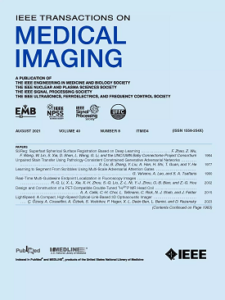
Academic Journal
Q1IEEE Transactions on Medical Imaging
About IEEE Transactions on Medical Imaging
IEEE Transactions on Medical Imaging is a scholarly journal published by Institute of Electrical and Electronics Engineers Inc.. SCImago 2025 places it in Q1 with an SJR of 2.501 and an H-index of 283.
Its listed coverage is 1982-2026 and its research categories include Computer Science Applications (Q1); Electrical and Electronic Engineering (Q1); Radiological and Ultrasound Technology (Q1); Software (Q1). The 2025 dataset reports 477 documents and 12479 citations across the latest three-year reporting window.
The IEEE Transactions on Medical Imaging is one of the most prestigious peer-reviewed journals in the field of biomedical engineering. Published by the Institute of Electrical and Electronics Engineers (IEEE), this journal plays a vital role in disseminating cutting-edge research focused on the development and application of imaging technologies in medicine and healthcare. With a high impact factor and global recognition, it serves as a crucial platform for researchers, engineers, and healthcare professionals.
What is IEEE Transactions on Medical Imaging?
IEEE Transactions on Medical Imaging (often abbreviated as TMI) is a monthly journal that publishes original articles on innovations in medical imaging techniques, algorithms, hardware, and software systems. It covers a wide range of imaging modalities including MRI (Magnetic Resonance Imaging), CT (Computed Tomography), PET (Positron Emission Tomography), ultrasound, and X-ray, among others.
The journal emphasizes quantitative analysis, image-guided procedures, machine learning in imaging, and computational modeling. Research published here is typically at the intersection of engineering, computer science, and clinical medicine.
Key Topics Covered
IEEE Transactions on Medical Imaging covers a diverse array of topics, including but not limited to:
-
Image reconstruction and processing
-
Deep learning and AI in medical imaging
-
Image segmentation and registration
-
Functional and molecular imaging
-
Real-time imaging systems
-
Multimodal imaging
-
Imaging system design and calibration
The journal is especially known for featuring work that combines technical innovation with strong clinical relevance, ensuring that the research is not only theoretically sound but also practical and impactful.
Why It’s Highly Regarded
IEEE TMI has consistently ranked among the top journals in the field of biomedical imaging due to its:
-
High Impact Factor: Reflecting the influence and citation of published papers.
-
Rigorous Peer Review: Ensuring only high-quality, original research is published.
-
Global Reach: Widely accessed by researchers and institutions around the world.
-
Prestigious Editorial Board: Comprised of leading scientists and engineers in the field.
Researchers who publish in this journal benefit from enhanced visibility and recognition within the global scientific community. For students and academics, it serves as an invaluable resource for understanding the current trends and future directions of medical imaging.
SEO Keywords to Note
To optimize this content for search engines, include relevant SEO keywords such as:
-
IEEE Transactions on Medical Imaging
-
Medical imaging research journal
-
Biomedical imaging
-
AI in medical imaging
-
Deep learning in healthcare
-
Imaging system innovation
-
Radiology and imaging research
Journal Metrics
Metrics can change by reporting year. Verify time-sensitive values with the publisher or indexing service.
Aims & Scope
The IEEE Transactions on Medical Imaging (TMI) is one of the most prestigious journals in the field of medical imaging and biomedical engineering. With a strong reputation for publishing cutting-edge research, this journal plays a crucial role in shaping the future of healthcare technologies. If you are a researcher, academic, or professional in biomedical imaging, understanding the scope of IEEE TMI is essential for aligning your work with its publication standards and gaining global recognition.
What is IEEE Transactions on Medical Imaging?
The IEEE Transactions on Medical Imaging is a peer-reviewed, monthly journal published by the IEEE Signal Processing Society, IEEE Engineering in Medicine and Biology Society, and the IEEE Nuclear and Plasma Sciences Society. It focuses on the development and application of medical imaging techniques and systems that support the detection, diagnosis, and treatment of diseases.
Scope and Coverage
The scope of IEEE Transactions on Medical Imaging covers a wide range of interdisciplinary areas, including but not limited to:
-
Image Acquisition and Reconstruction: Research on novel imaging modalities, sensor design, and image reconstruction algorithms such as CT, MRI, PET, SPECT, and ultrasound.
-
Image Processing and Analysis: Techniques involving image segmentation, enhancement, registration, and classification, including deep learning and machine learning applications.
-
Computer-Aided Diagnosis (CAD): Innovations in automated diagnostic systems, lesion detection, and disease classification to assist healthcare professionals.
-
Image-Guided Therapy and Interventions: Development of real-time imaging solutions for surgical navigation and minimally invasive procedures.
-
Quantitative Imaging Biomarkers: Studies that explore the extraction and validation of imaging biomarkers for precision medicine and clinical decision support.
-
Multimodal Imaging: Integration of data from multiple imaging modalities to enhance diagnostic accuracy and interpretation.
-
Artificial Intelligence in Medical Imaging: Advanced AI and neural network techniques for image interpretation, anomaly detection, and radiomics.
-
Radiological Informatics and Image Databases: Topics such as PACS, cloud storage solutions, image sharing, and big data in imaging.
Why Publish in IEEE TMI?
Publishing in IEEE Transactions on Medical Imaging offers numerous benefits:
-
High Impact Factor: With a consistently high impact factor, IEEE TMI is recognized as a leading journal in medical imaging.
-
Rigorous Peer Review: Ensures that only the most innovative and technically sound research gets published.
-
Global Reach: Being indexed in major databases like PubMed, Scopus, and Web of Science ensures your research gains international visibility.
-
Cross-Disciplinary Collaboration: The journal encourages collaboration across engineering, computer science, radiology, and clinical medicine.
Recent Research Articles
Latest publications matched automatically by ISSN.
Volumetric Functional Ultrasound Imaging in Macaques
Nora E. Fitzgerald, Gabriel Montaldo, Mathilda Froesel, Alan Urban et al.
2026-09 · DOI: 10.1109/tmi.2026.3710133PIPA: Prior-Driven Prompting With Diagnosis-Oriented Retrieval-Augmentation for 3-D Radiology Report Generation
Qiushi Yang, Wuyang Li, Xiaoqing Guo, Maymay Cerys Harwood et al.
2026-09 · DOI: 10.1109/tmi.2026.3710717Polar Subarea-Aware Fusion Net for Posterior Eyeball Shape Reconstruction
Jiaqi Zhang, Xiuzhe Wu, Jiahui Liu, Chunyu Zou et al.
2026-09 · DOI: 10.1109/tmi.2025.3642381Retrieval-Augmented Representation for Semi-Supervised Medical Image Segmentation
Huan Luo, Qingjie Zeng, Yanning Zhang, Yong Xia et al.
2026-09 · DOI: 10.1109/tmi.2026.3712008SynReEM: Synapse Reconstruction via Instance Structure Encoding in Anisotropic Electron Microscopic Volumes
Jinyue Guo, Yanchao Zhang, Hao Zhai, Yi Jiang et al.
2026-09 · DOI: 10.1109/tmi.2026.3706567UniOCTSeg++: Refined Hierarchical Prompt Strategy and Bi-Directional Progressive Consistency Learning for Universal Retinal Layer Segmentation in OCT
Jian Zhong, Li Lin, Kenneth K. Y. Wong, Xiaoying Tang et al.
2026-09 · DOI: 10.1109/tmi.2026.3710244MeCaMIL: Causality-Aware Multiple Instance Learning for Fair and Interpretable Whole Slide Image Diagnosis
Yiran Song, Yikai Zhang, Shuang Zhou, Guojun Xiong et al.
2026-09 · DOI: 10.1109/tmi.2026.3711803Informed-Exploration Reinforcement Learning for Automated Virtual Coronary Intervention Planning
Anbang Wang, Ming Lei, Heye Zhang, Zhifan Gao et al.
2026-09 · DOI: 10.1109/tmi.2026.3707748NGSE-Corr: A Technique for Objective Clinical Evaluation of Quantitative-Imaging Methods Without a Gold Standard
Yan Liu, Ziping Liu, Zekun Li, Jingqin Luo et al.
2026-09 · DOI: 10.1109/tmi.2026.3707743BrainCL: Transformer-Based Brain Network Contrastive Learning With Multi-Order Topology and Salience Masking
Yongliang Zhang, Haochen Qian, Jinbo Yang, Fangfang Chen et al.
2026-09 · DOI: 10.1109/tmi.2026.3709646The Ritz Adjoint Method for MRI Pulse Design
John M. Drago, Georgy D. Guryev, Nicolas Arango, Elfar Adalsteinsson et al.
2026-09 · DOI: 10.1109/tmi.2026.3709056From Slice to Sequence: Autoregressive Tracking Transformer for Consistent 3-D Lymph Node Detection in CT Scans
Qinji Yu, Yirui Wang, Ke Yan, Dandan Zheng et al.
2026-09 · DOI: 10.1109/tmi.2026.3701886EndoLRMGS: Combining Large Reconstruction Modelling and Gaussian Splatting for Complete Endoscopic Scene Reconstruction
Xu Wang, Shuai Zhang, Baoru Huang, Jialang Xu et al.
2026-09 · DOI: 10.1109/tmi.2026.3707404MUST: Multi-Style Virtual Staining With Incomplete Pairs
Jiaxin Zhuang, Yao Du, Xiaoyu Zheng, Linshan Wu et al.
2026-09 · DOI: 10.1109/tmi.2026.3709810Physiology-Guided Self-Supervised Learning for Simultaneous Dual-Tracer PET Separation
Yufei Jin, Hengjia Ran, Gaoning Ning, Xinhui Su et al.
2026-09 · DOI: 10.1109/tmi.2026.3708472DiffGeo-AOR: Diffusion-Optimized Medical Grading via Geometric Priors Enhanced Autoregressive Ordinal Regression
Qinkai Yu, He Zhao, Yanyu Xu, Meng Wang et al.
2026-09 · DOI: 10.1109/tmi.2026.3710844UniTransAD: Unified Translation Framework for Anomaly Detection in Brain MRI
Qi Zhang, Xia Li, Yibo Hu, Jianqi Sun et al.
2026-09 · DOI: 10.1109/tmi.2026.3711975Matrixed-Spectrum Decomposition Accelerated Linear Boltzmann Transport Equation Solver for Fast Scatter Correction in Multi-Spectral CT
Guoxi Zhu, Li Zhang, Zhiqiang Chen, Hewei Gao et al.
2026-09 · DOI: 10.1109/tmi.2026.3708964Table of Contents
2026-09 · DOI: 10.1109/tmi.2026.3726161LLM-Enhanced Neuron Segmentation and Reconstruction in Complex Mouse Brain Images
Chengda Mo, Xinle Dai, Qiufu Li, Linlin Shen et al.
2026-09 · DOI: 10.1109/tmi.2026.3709050Reviews
Community Reviews
Version History
April 21, 2025 at 6:14 am
April 21, 2025