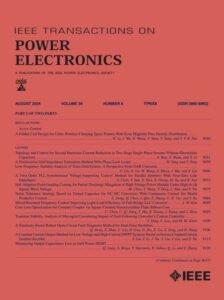
Academic Journal
Q1IEEE Transactions on Power Electronics
About IEEE Transactions on Power Electronics
Journal Overview
IEEE Transactions on Power Electronics (TPEL) is the flagship research journal of the IEEE Power Electronics Society (PELS), published monthly by the Institute of Electrical and Electronics Engineers (IEEE). Since its launch in 1986, it has grown into one of the most widely read and most cited periodicals in its discipline — PELS itself describes it as a top-referenced journal among all IEEE publications (source: IEEE Power Electronics Society via LinkedIn, accessed Oct 2026). The journal's core mission is to document and advance the science and engineering of electric power conversion: how electrical energy is converted, controlled, and conditioned using semiconductor and switching devices.
TPEL is a peer-reviewed archival journal. Every article it publishes has passed through a single-blind peer-review process in which at least two independent reviewers evaluate the manuscript, and every submission is screened for plagiarism before acceptance (source: 2025 TPEL Guidelines for Manuscript Submission, ieee-pels.org, accessed Oct 2026). The journal is indexed in both Scopus (with recorded coverage stretching from 1986 to the present) and the Web of Science's Science Citation Index Expanded, and it consistently sits in the first quartile (Q1) of the Electrical and Electronic Engineering category (source: Scopus/SJR listings, accessed Oct 2026).
In publication volume, TPEL is a heavyweight: Scopus-based records indicate the journal has published roughly one thousand to more than fifteen hundred citable documents per year in recent years, and it maintains a monthly cadence — twelve issues per year (source: ores.su/countryofpapers.com Scopus aggregations, accessed Oct 2026). Its standard bibliographic identifiers are print ISSN 0885-8993 and electronic ISSN 1941-0107, and its ISO 4 abbreviation is IEEE Trans. Power Electron. (source: Wikipedia, citing library records; accessed Oct 2026).
TPEL operates on the hybrid open-access model: authors can publish through the traditional subscription route at no charge (aside from any overlength page fees), or they can choose to make an individual article freely available by paying an article-processing charge (source: IEEE Publications APC List 2023 and 2025 TPEL guidelines, ieee-pels.org, accessed Oct 2026). The journal is aimed at researchers, engineers, and practitioners working on power converters, motor drives, renewable-energy integration, power supplies, wide-bandgap semiconductor devices, wireless power transfer, and every other corner of modern power electronics.
History
The story of IEEE Transactions on Power Electronics is inseparable from the institutional birth of power electronics as a recognized engineering discipline. Power electronics was formally established as a technical field within IEEE in 1986 through the creation of the IEEE Technical Council on Power Electronics — the body that would later become the IEEE Power Electronics Society (source: Don Tan, IEEE/IAS historical overview published in SOBRAEP journal, accessed Oct 2026). The journal itself was founded the same year, 1986, and has published continuously ever since — meaning the 2026 volume year marks its 40th anniversary.
In its early decades, TPEL chronicled the transition from the thyristor era to the modern world of high-frequency switching: the rise of insulated-gate bipolar transistors (IGBTs), advances in pulse-width modulation and converter topologies, and the maturation of modeling and control theory for switching power supplies. As the field expanded, so did the journal's remit — into motor drives, uninterruptible power supplies, telecom power, and later into renewable-energy conversion, electric-vehicle powertrains, solid-state transformers, grid-forming inverters, and wide-bandgap (silicon carbide and gallium nitride) devices.
A notable feature of TPEL's recent history is the growth of its Letters track. The journal now runs a dedicated Letters stream — handled by a Letters Executive Editor — designed for short, focused, rapidly published papers on emerging developments, reflecting the field's quickening pace (source: 2025 TPEL Guidelines for Manuscript Submission, ieee-pels.org, accessed Oct 2026). Alongside regular papers, TPEL periodically publishes special sections on forward-looking themes; one example is the Special Section on Visionary Papers, for which manuscripts were due in June 2025 with publication scheduled for December 2025 (source: ieee-pels.org call for papers, accessed Oct 2026).
Editorially, the journal has been led by a succession of editors-in-chief appointed through open calls run by the IEEE Power Electronics Society. A 2024 PELS call sought an Editor-in-Chief for a three-year term beginning January 1, 2025 (source: ieee-pels.org, accessed Oct 2026), and the position is currently held by Professor Xiongfei Wang (see Leadership section below). The journal's founding editor-in-chief is not named in the official sources consulted for this profile, so it is not stated here.
Leadership and Editorial Team
The current Editor-in-Chief of IEEE Transactions on Power Electronics is Professor Xiongfei Wang, who is identified as "TPEL Editor in Chief" in official IEEE Power Electronics Society documents from 2025 (source: ieee-pels.org Call for Co-EiCs, April 2025, accessed Oct 2026). The 2025 manuscript-submission guidelines list his affiliation as Tsinghua University, China, with the editorial contact address peleditor@ieee.org (source: 2025 TPEL Guidelines for Manuscript Submission, ieee-pels.org, accessed Oct 2026). Note that an earlier April 2025 PELS document gave his contact as xiongfei@kth.se (KTH Royal Institute of Technology, Sweden), suggesting a recent institutional move; authors should use the contact details given in the current guidelines.
TPEL's editorial structure extends well beyond the Editor-in-Chief. The society has also been recruiting Co-Editors-in-Chief for regular papers and for Letters, with terms running from mid-2025 through the end of 2027 (source: ieee-pels.org, April 2025, accessed Oct 2026). A dedicated Letters Executive Editor, Professor Maryam Saeedifard of Georgia Tech, manages the Letters stream (contact: PELletters@ieee.org) (source: 2025 TPEL guidelines, accessed Oct 2026). Day-to-day editorial administration is handled by the TPEL Administrator, Mary Beth Schwartz of IEEE PELS (marybeth.schwartz@ieee.org), who is the contact for special-section proposals and Co-EiC applications (source: ieee-pels.org, accessed Oct 2026).
Beneath this leadership sits a large board of associate editors drawn from universities and industry worldwide, organized along the technical areas of power electronics. The journal does not publish a public acceptance-rate figure, and the guidelines do not name individual associate editors, so those details are not listed here.
Aims & Scope
The official scope statement of IEEE Transactions on Power Electronics defines the journal as covering the full breadth of the power-electronics field: conversion, control, applications, conceptual questions, and the system-level integration of electric power handled through semiconductors and switching devices (source: 2025 TPEL Guidelines for Manuscript Submission, ieee-pels.org, accessed Oct 2026 — paraphrased).
In practical terms, the journal is interested in power converters together with their components and the way those components are integrated into complete systems for real applications. It welcomes work on the methods and techniques used across the entire lifecycle of power-electronic technology: modeling and simulation, analysis, design, fabrication, testing and characterization, evaluation and validation, and deployment of components, converters, converter systems, and integrated systems.
The journal also publishes review, tutorial, and survey articles that offer a perspective on the state of the art and where the technology is heading. Authors planning an uninvited survey paper must first send a one-page single-column summary to the editorial administrator, stating which of the journal's fourteen topic categories the review addresses, what insights it will share, and what qualifies the authors to write it (source: 2025 TPEL guidelines, accessed Oct 2026).
The scope statement draws a firm boundary as well: manuscripts that fall outside power electronics may be rejected without review. The guidelines specifically warn that work focused purely on device physics, materials science, or component characterization — without a demonstrated connection to power-electronics content — is likely to be turned away and redirected to a more suitable journal. In other words, TPEL wants the power-conversion angle to be central, not incidental.
Topic-wise, the journal's pages regularly feature dc-to-dc converters, inverters, rectifiers and ac-ac conversion, switching power supplies, motor drives and actuators, power semiconductor devices (silicon, SiC, GaN), magnetics and passive components, EMI/EMC, thermal management, control techniques (including digital control and modulation strategies), wireless power transfer, renewable-energy and energy-storage interfaces, electric-vehicle and transportation power systems, power quality, microgrids, and aerospace and harsh-environment power electronics.
Editorial Process and Peer Review
TPEL follows the IEEE's standard editorial framework. Articles are peer reviewed in accordance with the IEEE Publication Services and Products Board Operations Manual. Each published article is evaluated by a minimum of two independent reviewers under a single-blind model: the reviewers know who the authors are, but the authors do not learn the reviewers' identities. Every manuscript is also screened for plagiarism before it can be accepted (source: 2025 TPEL Guidelines for Manuscript Submission, ieee-pels.org, accessed Oct 2026).
Manuscripts are submitted electronically through the PELS Author Portal, and peer review itself is managed in ScholarOne (the successor to the older Manuscript Central workflow). The guidelines require that every submission carry a primary email address belonging to an institution — a university, government agency, company, or IEEE itself. Submissions without an institutional email address are not entered into the review process at all (source: 2025 TPEL guidelines, accessed Oct 2026).
Originality requirements are strict. Submissions must report original results not previously published in any archival venue, and each manuscript is run through a similarity-checking program that compares every word against previously published articles and web sources; papers that fail this check are not sent out for review. Conference papers previously presented at IEEE Power Electronics Society events — such as ECCE, APEC, or INTELEC — may be extended into journal submissions, but the journal version must contain genuine improvements and additions beyond the conference paper (per IEEE PSPB Operations Manual section 8.1.7.E), the original conference paper must be cited in the references and noted in a first-page footnote, and authors must disclose any prior presentation or parallel submission in their cover letter (source: 2025 TPEL guidelines, accessed Oct 2026).
The Letters track is deliberately expedited. Papers submitted as Letters go through a faster review with fewer revision rounds, with the goal of getting short, focused contributions on current topics into print as quickly as possible. Regular papers receive the full review treatment. Multi-part paper series (Part I, Part II, and so on) are discouraged as a matter of policy; authors may be asked to consolidate the work into a single submission (source: 2025 TPEL guidelines, accessed Oct 2026).
The journal does not publish an official acceptance rate or an official average time from submission to first decision. Those figures are not stated here.
Impact and Metrics
IEEE and the Power Electronics Society do not publish journal-level citation metrics on the journal's own website, so every figure below comes from the metric provider named in the table — not from the journal itself. Readers should verify the latest numbers in Clarivate's Journal Citation Reports and in Scopus/SCImago before citing them, because metric values change with each annual release.
| Metric | Value | Source |
|---|---|---|
| Journal Impact Factor (2023) | 6.6 | Clarivate Journal Citation Reports 2023, as cited on the journal's Wikipedia page (accessed Oct 2026) |
| Scopus coverage | 1986–present | Scopus-based aggregations (journalsearches.com; ores.su) (accessed Oct 2026) |
| Scopus / SJR quartile | Q1 — Electrical and Electronic Engineering | SCImago/Scopus listings (accessed Oct 2026) |
| Frequency | Monthly (12 issues/year) | Journal bibliographic records (accessed Oct 2026) |
| Documents per year (recent) | ~1,000–1,500 citable items | Scopus aggregations (ores.su; countryofpapers.com) (accessed Oct 2026) |
| Acceptance rate | Not officially published | — |
| Average review time | Not officially published | — |
A few interpretive notes. The 2023 impact factor of 6.6 places TPEL among the highest-impact journals in electrical and electronic engineering; it has held Q1 status in its Scopus category across recent years. Third-party metric sites report varying newer figures for subsequent JCR releases, but because those are not published by the journal or by Clarivate on a public page, this profile does not present them as official. Likewise, SJR and h-index values differ across aggregators depending on the year and methodology — treat any single number with caution and check SCImago directly.
Submission Guidelines
Authors preparing a submission to TPEL should work from the current official "Guidelines for Manuscript Submission" (2025 revision) on ieee-pels.org, since requirements evolve. The key practical points from that document are summarized below (source: 2025 TPEL Guidelines for Manuscript Submission, ieee-pels.org, accessed Oct 2026).
Manuscript types and length. Three categories are accepted. Regular papers have no page limit at submission; PELS provides ten journal pages at no charge, and every page from page 11 onward incurs a mandatory overlength charge of $200 per page. Letters are limited to four or fewer pages in final form, including references — longer Letter submissions are not reviewed — and are handled through an expedited review process. Correspondence papers, which address corrections to published papers or substantive technical discussion of them, are limited to two pages in final form (one page for simple corrections).
Format. Manuscripts must be prepared on letter-size or A4 paper in double-column, single-spaced format, submitted as PDF files no larger than 40 MB. Figures and tables should be embedded in the text with captions. Author bylines must appear beneath the title at all stages of review and must match the author list entered in the submission system. Author biographies, photos, and the copyright form are not included with the initial submission. Page and line numbers should not be added to the uploaded file.
Abstract and references. The abstract must be a single self-contained paragraph of 150 to 200 words, with no abbreviations, footnotes, references, equations, or tables. References use numbered square brackets in IEEE style. Paper titles should avoid low-search-value words such as "new" or "novel."
Language and literature. Papers must be written in acceptable English; inadequate English is itself grounds for rejection, and the volunteer reviewers are not expected to fix language problems. A thorough literature review is essential — inadequate referencing is also grounds for rejection.
Graphics. Figures should be high quality (TIFF preferred, minimum 300 dpi); web-resolution images are not acceptable. Because figures may be printed in black and white, authors should not refer to figure elements by color alone.
Supplementary material. Authors may submit active content or multimedia (videos, datasets, demonstration code) alongside the paper. Such material must be declared in the cover letter and in the submission questionnaire, described in the abstract, and is subject to the same editorial standards as the main manuscript.
Open Access and APC
IEEE Transactions on Power Electronics is a hybrid journal: the default route is the traditional subscription model, and authors may optionally pay an article-processing charge (APC) to make their individual article open access (source: IEEE Publications APC List 2023, accessed Oct 2026).
The official IEEE APC list classifies TPEL (acronym TPEL) as "Hybrid" with an open-access fee of $2,345, and it confirms the journal's page-charge structure: $200 per overlength page, with 10 pages allowed for regular papers and 4 for letters (source: IEEE Publications Article Processing Charge List 2023, accessed Oct 2026). The 2025 TPEL author guidelines independently confirm the overlength policy — $200 per journal page after page 10, invoiced by the IEEE Reprints department after final proof approval — and note that authors must commit to paying these charges before the paper is sent to IEEE for publication (source: 2025 TPEL guidelines, ieee-pels.org, accessed Oct 2026).
Authors who choose the traditional route pay no APC; they pay only mandatory overlength charges if their paper exceeds the free page allowance. The journal does not publish a separate official submission fee, and no submission fee is mentioned in the guidelines. Because APC figures are revised periodically by IEEE, authors should confirm the current amount on IEEE's official APC list before committing to the open-access option.
Key Facts
| Item | Detail |
|---|---|
| Journal title | IEEE Transactions on Power Electronics |
| Abbreviation | IEEE Trans. Power Electron. (ISO 4); TPEL |
| Publisher | IEEE (Institute of Electrical and Electronics Engineers) |
| Sponsoring society | IEEE Power Electronics Society (PELS) |
| Founded | 1986 |
| Frequency | Monthly (12 issues per year) |
| Language | English |
| Print ISSN | 0885-8993 |
| Online ISSN | 1941-0107 |
| Editor-in-Chief | Prof. Xiongfei Wang (per 2025 PELS documents) |
| Letters Executive Editor | Prof. Maryam Saeedifard, Georgia Tech |
| Peer review | Single-blind; minimum two independent reviewers; plagiarism screening |
| Manuscript types | Regular papers, Letters (≤4 pages), Correspondence (≤2 pages) |
| Submission system | PELS Author Portal; peer review in ScholarOne |
| Access model | Hybrid (subscription default; optional paid open access) |
| Indexing | Scopus; Web of Science (SCIE) |
| Homepage | tpel.ieee.org |
Frequently Asked Questions
What is the scope of IEEE Transactions on Power Electronics?
The journal covers the full field of power electronics — conversion, control, applications, and system integration of electric power using semiconductors and switching devices — including modeling, design, fabrication, testing, and validation of components, converters, and integrated systems (source: 2025 TPEL guidelines, ieee-pels.org, accessed Oct 2026).
Who is the current Editor-in-Chief of TPEL?
Professor Xiongfei Wang is identified as TPEL Editor-in-Chief in official IEEE Power Electronics Society documents from 2025. The July 2025 author guidelines list his affiliation as Tsinghua University, China, with editorial contact peleditor@ieee.org (source: ieee-pels.org, accessed Oct 2026).
How often is the journal published?
Monthly — twelve issues per year — and it has published continuously since 1986.
What types of manuscripts does TPEL accept?
Regular papers (no page limit), Letters (four or fewer pages in final form, expedited review), and Correspondence (two pages or fewer; one page for corrections). Special sections publish both Letters and Regular papers (source: 2025 TPEL guidelines, accessed Oct 2026).
How do I submit a paper to TPEL?
Manuscripts are submitted electronically through the PELS Author Portal as PDF files (maximum 40 MB), and peer review is conducted in ScholarOne. A primary institutional email address is mandatory for submission (source: 2025 TPEL guidelines, accessed Oct 2026).
What is the peer-review model?
Single-blind peer review with a minimum of two independent reviewers per article, plus plagiarism screening of every submission before acceptance (source: 2025 TPEL guidelines, accessed Oct 2026).
Does TPEL charge authors?
There is no submission fee. Regular papers include ten journal pages at no charge; pages from page 11 onward cost $200 each in mandatory overlength charges. Authors choosing open access pay an article-processing charge (listed at $2,345 in IEEE's 2023 APC list — confirm the current figure with IEEE) (source: 2025 TPEL guidelines; IEEE APC List 2023, accessed Oct 2026).
Is TPEL open access?
It is a hybrid journal: most articles are published under the subscription model, but authors can pay an APC to make their article freely available (source: IEEE APC List 2023, accessed Oct 2026).
Can I submit an extended version of my conference paper?
Yes — papers previously presented at IEEE Power Electronics Society conferences (such as ECCE, APEC, or INTELEC) may be extended for TPEL, but the journal version must add genuine improvements beyond the conference paper, cite the original, note it in a first-page footnote, and disclose the prior presentation in the cover letter (source: 2025 TPEL guidelines, accessed Oct 2026).
What is the impact factor of IEEE Transactions on Power Electronics?
The journal does not publish metrics on its own site. The 2023 Journal Citation Reports (Clarivate) figure most widely cited is 6.6; always check the current Clarivate JCR for the latest value rather than relying on third-party aggregator sites (source: Wikipedia citing 2023 JCR, accessed Oct 2026).
What is the acceptance rate?
The journal does not publish an official acceptance rate, and no reliable official figure is available — this profile does not state one.
Where is TPEL indexed?
Scopus (coverage 1986–present) and the Web of Science Science Citation Index Expanded; it holds Q1 status in Electrical and Electronic Engineering in Scopus/SJR listings (source: Scopus-based aggregations, accessed Oct 2026).
What are the ISSNs of the journal?
Print ISSN 0885-8993 and electronic ISSN 1941-0107 (source: bibliographic records, accessed Oct 2026).
Does TPEL publish review articles?
Yes — review, tutorial, and survey papers are welcome, but uninvited survey authors must first send a one-page summary to the editorial administrator describing the topic category, the insights the review will offer, and their qualifications (source: 2025 TPEL guidelines, accessed Oct 2026).
Sources
All factual claims in this profile are drawn from the following official or primary sources, accessed October 10–11, 2026: the 2025 TPEL Guidelines for Manuscript Submission (ieee-pels.org); the IEEE Power Electronics Society's April 2025 call for TPEL Co-Editors-in-Chief (ieee-pels.org); the February 2024 PELS call for TPEL Editor-in-Chief (ieee-pels.org); the TPEL journal site (tpel.ieee.org); the IEEE Publications Article Processing Charge List 2023; the IEEE Power Electronics Society's organizational profile (LinkedIn); Scopus-based journal aggregations (journalsearches.com, ores.su, countryofpapers.com); and the journal's Wikipedia entry (citing Clarivate Journal Citation Reports 2023 and library bibliographic records). Where the journal or its publisher does not publish a figure — such as the acceptance rate or average review time — this profile says so explicitly rather than substituting third-party estimates.
The IEEE Transactions on Power Electronics is one of the most prestigious journals in the field of electrical and electronic engineering. Published by the Institute of Electrical and Electronics Engineers (IEEE), this peer-reviewed journal focuses on the latest developments, innovations, and applications in power electronics—a critical domain that powers everything from renewable energy systems to electric vehicles and industrial automation.
What is IEEE Transactions on Power Electronics?
IEEE Transactions on Power Electronics is a monthly publication that provides a platform for researchers, engineers, and industry professionals to publish original research papers, review articles, and technical notes in the area of power electronics. The journal emphasizes cutting-edge research in design, development, modeling, control, and analysis of power electronic systems.
Scope and Topics Covered
The journal covers a wide range of topics, including but not limited to:
Power semiconductor devices and their applications
Power converter circuits and control strategies
Electric motor drives and control systems
Power electronics in renewable energy systems (solar, wind, etc.)
Smart grid and energy storage systems
Wireless power transfer and electric vehicle charging
Advanced control techniques including AI and machine learning applications in power systems
This broad scope makes the journal an essential resource for anyone involved in modern power engineering and smart energy solutions.
Importance in Academia and Industry
With a high impact factor, the IEEE Transactions on Power Electronics is highly respected by academics and industry leaders alike. Many researchers aim to publish in this journal due to its rigorous peer-review process and global recognition. For engineers in the field, it serves as a benchmark for quality and innovation in power electronics.
In industry, the findings and advancements published in the journal often lead to real-world applications, shaping how companies develop new products, improve energy efficiency, and implement sustainable solutions.
Who Should Read This Journal?
Academic researchers looking to stay updated with the latest scientific advancements.
Postgraduate students seeking credible references for their theses and dissertations.
Industry professionals involved in R&D of power systems, electric vehicles, and smart grids.
Policy makers and technical consultants interested in energy innovations and technology trends.
How to Access IEEE Transactions on Power Electronics
Access to the journal is available through the IEEE Xplore Digital Library, where users can browse current and archived issues, download articles, and explore related research. Many universities and institutions have subscriptions, but individual articles can also be purchased or accessed through membership benefits.
Source-backed journal facts
Topics in published research
Advanced DC-DC Converters; Multilevel Inverters and Converters; Silicon Carbide Semiconductor Technologies; Microgrid Control and Optimization; Wireless Power Transfer Systems; Power Systems and Renewable Energy.
OpenAlex classifies topics from published works. These topics are not the publisher’s official aims and scope.
Reported open-access list prices
2,645.00 USD
APC list prices reported by OpenAlex, which obtains this information from DOAJ. Confirm current charges, taxes, waivers and eligibility with the publisher; this is not a fee quotation.
Source: OpenAlex source record. Retrieved 2026-10-03. Source record updated 2026-10-02. OpenAlex metrics are different from SCImago metrics and the Clarivate Journal Impact Factor.
Journal Metrics
Quartile, SJR and the listed SCImago H-index use the 2025 imported SCImago dataset. A quartile may vary by subject category. Values without a source or reporting year are unverified historical entries. Verify the current Journal Impact Factor with Clarivate or the publisher before using it.
Aims & Scope
The IEEE Transactions on Power Electronics is one of the most prestigious and authoritative journals in the field of electrical engineering, particularly in the domain of power electronics. Published by the IEEE Power Electronics Society, this peer-reviewed journal is globally recognized for its high-quality research contributions and technical advancements. The scope of the IEEE Transactions on Power Electronics is broad and evolving, reflecting the rapid development in power electronics technology and its applications across various industries.
Key Focus Areas
The journal primarily covers original research and practical applications in power electronics, including both hardware and control aspects. Some of the key areas include:
Converter Circuits – Design, modeling, analysis, and performance of power converters such as DC-DC, AC-DC, DC-AC, and matrix converters.
Power Semiconductor Devices – Innovations in device structures, modeling, and application of semiconductors like IGBTs, MOSFETs, and SiC/GaN devices.
Control and Modulation Techniques – Advanced control methods including digital, analog, adaptive, predictive, and artificial intelligence-based controllers.
Magnetic Components – Design and optimization of transformers, inductors, and related electromagnetic components.
Modeling and Simulation – Techniques for system-level and component-level modeling and simulation.
Renewable Energy Systems – Power electronics applications in solar, wind, fuel cells, and energy storage integration.
Electric Vehicles and Transportation – Power electronics used in EVs, HEVs, and other electric transportation systems.
Industrial and Residential Applications – Efficient power conversion systems used in automation, lighting, appliances, and more.
Smart Grids and Energy Management – Role of power electronics in smart grid infrastructure, load management, and distributed generation.
EMI/EMC and Reliability – Studies on electromagnetic interference, compatibility, system reliability, and thermal management.
Target Audience
The IEEE Transactions on Power Electronics is intended for researchers, engineers, academicians, and practitioners who are actively involved in power electronics design, development, and application. The journal aims to bridge the gap between theoretical innovation and industrial implementation.
Why Publish in IEEE Transactions on Power Electronics?
High Impact Factor: The journal consistently ranks among the top in its category with a strong citation index.
Rigorous Peer Review: Articles undergo a comprehensive peer review process, ensuring credibility and academic excellence.
Global Reach: Published papers are accessed by professionals, institutions, and libraries across the globe, enhancing the visibility of your work.
Open Access Options: IEEE offers open-access publication options to increase readership and impact.
Recent Research Articles
Latest publications matched automatically by ISSN.
Sensorless Control of SynRM Considering Magnetic Saturation and Coupling Effects Based on Decoupled Auxiliary Model
Binxing Li, Qiwei Wang, Zhixuan Lai, Zexu Li et al.
2027-01 · DOI: 10.1109/tpel.2026.3722859Modeling and Design of Zero-Bias Trans-Inductor Voltage Regulator
Adhistira Madhyasta Naradhipa, Qiang Li
2027-01 · DOI: 10.1109/tpel.2026.3715689A K-Type Switched-Capacitor Multilevel Inverter With Soft Charging and Fault-Tolerant Capability
Deepak Singh, Priyankar Roy, Piyush Kant
2027-01 · DOI: 10.1109/tpel.2026.3730691Analytical Closed-Form Model of the PO/PON Boundary in LLC Resonant Converters
Sergio Fernández-Rojas, Dongsheng Yang, Krzysztof Puczko
2027-01 · DOI: 10.1109/tpel.2026.3723103Maximum Efficiency Operation Control of Multiphase Brushless DC Motor Systems Based on Variable Conduction Mode
Wei Chen, Rongkai Li, Lixiang Zhu, Xinmin Li et al.
2027-01 · DOI: 10.1109/tpel.2026.3723827Data-Driven Control Approach for Closed-Loop System of DAB DC/DC Converters Ensuring ZVS Constraints
Nguyen Ngoc Nam, Young Il Lee
2027-01 · DOI: 10.1109/tpel.2026.3726474IEEE Power Electronics Society Information
2027-01 · DOI: 10.1109/tpel.2026.3745803Table of Contents
2027-01 · DOI: 10.1109/tpel.2026.3745799Quantifying Cyber-Vulnerability in Power Electronics Systems via an Impedance-Based Attack Reachable Domain
Hongwei Zhen, Ze Yu, Xin Xiang, Wuhua Li et al.
2027-01 · DOI: 10.1109/tpel.2026.3721495Corrections to “A High-Gain Virtual-Ground Low-Stress Single-Phase Single-Stage Inverter With Input and Output Current Ripple Cancellation”
Bailong Xu, Qianming Xu, Peng Guo, Qiaopo Xiong et al.
2027-01 · DOI: 10.1109/tpel.2026.3729761Health Diagnostics of SiC MOSFET Devices Using Compensated On-State Resistance
Bhanu Pratap Singh, Enes Ayaz, Shahriar Sarmast Ghahfarokhi, Staffan Norrga et al.
2027-01 · DOI: 10.1109/tpel.2026.3723729Adaptive Disturbance Observer-Based Fixed-Time Super-Twisting Sliding-Mode Control for PMSMs
Ruiqi Xu, Zhuang Liu, Weiliang Chen, Xiaoning Shen et al.
2027-01 · DOI: 10.1109/tpel.2026.3722483A Self-Powered Gate Driver Module Applied Vertical Power-Drive Loop and Resonant Tracking Achieving 81.2% Efficiency and 36.5 mW/mm 3 Power Density
Xin-Ce Gong, Yan Huo, Chun-Wang Zhuang, Xin Ming et al.
2027-01 · DOI: 10.1109/tpel.2026.3725427Compensation Circuit for Mitigating Transient Current Imbalance in Parallel-Connected Power Devices
Yongfan Zhan, Xuebao Li, Hao Lin, Rui Jin et al.
2027-01 · DOI: 10.1109/tpel.2026.3729932Model-Free Predictive Current Control of CSC-Fed PMSM Drives Based on a Partially Structured Second-Order Ultralocal Model
Xuehan Chen, Haonan Yin, Li Ding, Binxing Li et al.
2027-01 · DOI: 10.1109/tpel.2026.3724881Administrative Committee Information
2027-01 · DOI: 10.1109/tpel.2026.3745928Stage-Dependent Active-Area Scaling of SiC DSRDs: Pulse Characteristics, Unified Interpretation, and Sizing Guideline
Tong Liu, Lin Liang, Hao Wang, Han Yang et al.
2027-01 · DOI: 10.1109/tpel.2026.3727655Modulation-Adaptive and Data-Light Parameter Estimation for DAB Converters With Physics-Informed Neural Network
Tanjing Xie, Yinxiao Zhu, Xiyun Wang, Yongheng Yang et al.
2027-01 · DOI: 10.1109/tpel.2026.3727468Soft-Switched-Bus Buck Converter
Yenan Chen, Yujie Jiang, Xinnuo Xu, Dehong Xu et al.
2027-01 · DOI: 10.1109/tpel.2026.3726057PSK-Free Mutual Authentication for WPT via Converter-Intrinsic In-Band Signaling
Seongmun Oh, Geun Wan Koo, Jung-Hoon Ahn
2027-01 · DOI: 10.1109/tpel.2026.3704720Reviews
Community Reviews
Version History
October 11, 2026 at 6:20 am
April 21, 2025