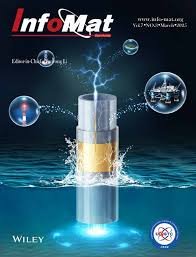
Academic Journal
Q1InfoMat
About InfoMat
InfoMat — Full Journal Profile
InfoMat is a fully open-access, interdisciplinary journal co-published by Wiley and the University of Electronic Science and Technology of China (UESTC). Launched in 2019, it sits at the meeting point of materials science and information technology: it publishes research on materials with distinctive electrical, optical and magnetic properties, and on how those materials can be built into the devices and systems that carry, store, sense and process information. Its principal ISSN is 2567-3165, with a second registered ISSN of 2770-5110 recorded alongside it by OpenAlex and library catalogues; the ISSN-L linking the two is 2567-3165. On this Journals World record (post 951, slug infomat), identity is anchored by those ISSNs and by the journal's home on Wiley Online Library.
InfoMat arrived with unusual speed of recognition. It received its first Journal Impact Factor of 25.405 in the 2021 Journal Citation Reports — a figure Wiley announced publicly, noting that the journal ranked in the top 5 per cent (11th of 335) of the Materials Science, Multidisciplinary category — and it has remained a Q1 title across all of its Scopus subject categories. It is one of a small group of partnership journals through which Wiley publishes with leading Chinese universities, and its authorship and readership are correspondingly global, with a strong base in China and East Asia. This profile sets out the journal's verified identity, history, scope, editorial leadership, metrics, open-access terms and submission process, attributing every figure to its source.
Quick Facts
| Field | Verified detail |
|---|---|
| Journal title | InfoMat |
| ISSN | 2567-3165 (ISSN-L); second ISSN 2770-5110 also registered |
| Publisher | Wiley, co-published with the University of Electronic Science and Technology of China |
| Launched | 2019 |
| Access model | Fully open access, CC BY licence; listed in DOAJ |
| Article processing charge | US$3,000 / £2,300 / €2,550 (DOAJ record and publisher open-access page) |
| Editor-in-Chief | Prof. Yanrong Li, University of Electronic Science and Technology of China |
| First Journal Impact Factor | 25.405 (2021 Journal Citation Reports, announced by Wiley) |
| SCImago standing | Q1 in all listed categories; h-index 103 in SCImago-derived listings |
| OpenAlex record | Source S4210212605: 933 works, 44,465 citations (checked October 2026) |
| Official site | Wiley Online Library, journal 25673165 |
History and Development
InfoMat was launched in 2019 as a co-publication of Wiley and the University of Electronic Science and Technology of China, an institution with deep strength in electronic science and engineering. The founding editorial, "InfoMat: a cross-field exploration of information technology and materials science," explained the wager behind the title: modern information technology is, at bottom, applied materials science — every advance in displays, sensors, memory, photonics and wearable devices rests on materials with the right electrical, optical or magnetic behaviour — yet the two communities published in separate places. InfoMat was designed as their shared platform, staffed by an international board drawn from leading groups across materials science, chemistry, physics and electrical engineering.
The founding Editor-in-Chief is Professor Yanrong Li of UESTC, director of the State Key Laboratory of Electronic Thin Films, who took responsibility for the whole publication process; at launch he was supported by five associate editors, including researchers based in Singapore and Europe, a structure intended to keep peer review fast and internationally balanced. The journal also began with a deliberate visibility strategy: there were no article publication charges for its first three publication years, removing the cost barrier while it built a reputation and an indexing record.
The strategy worked quickly. The journal was accepted into the Science Citation Index Expanded and Scopus, was listed in the Directory of Open Access Journals from 2019, and in July 2021 Wiley announced its first Journal Impact Factor of 25.405, placing it 11th of 335 journals in its Journal Citation Reports category and inside the top 5 per cent. Few journals reach that band within two citation cycles; it signalled both the citation density of the fields InfoMat covers — two-dimensional materials, energy-storage materials, flexible and wearable electronics — and the journal's success in attracting review and research articles that the community actually uses. Since then the journal has continued as a high-volume, selective open-access title, and its most-cited articles (surveyed below) show a consistent editorial taste: enabling materials, devices that exploit them, and computational methods that accelerate both.
Aims and Scope in Detail
The journal's own description is precise about its territory. InfoMat addresses the growing scientific interest in new materials with unique electrical, optical and magnetic properties, and in the application of those materials to the rapid development of information technology. It aims to publish experimental and theoretical work on advanced materials, with a particular focus on the fabrication and characterisation of materials with novel properties. Its scope is internationally broad and falls within the materials science, electrical and electronics, and telecommunication categories. It particularly welcomes innovative, interdisciplinary research with wide impact, and its readership spans researchers and engineers in both academia and industry.
In practice, the published record shows what that means. Highly cited InfoMat papers include work on wearable electronics and photonics moving toward intelligent, connected systems; strain engineering of two-dimensional materials; theoretical models for lithium–sulfur battery cathodes; manganese-based oxides for aqueous zinc-ion batteries; two-dimensional MXenes for wearable and flexible electronics; separator design enabling dendrite-free zinc anodes; and machine learning methods that accelerate materials development for energy storage and conversion. The pattern is consistent: a material or method, characterised convincingly, and connected to a device, system or information-technology application. Purely incremental synthesis reports without a property or application advance, and device papers with no materials insight, both fit the stated scope less well than work that crosses the boundary the journal was founded to cross.
The journal invites original research articles and review articles, and its founding editorial also lists Letters to the Editor among its formats; all papers are published online as soon as they are accepted and are fully citable. Reviews carry particular weight in the journal's citation profile, and prospective review authors should expect to demonstrate recognised standing in the topic they propose to survey. Because InfoMat is fully open access, everything it publishes is free to read worldwide immediately on publication, which suits its industry-facing readership as much as its academic one.
Editorial Leadership and Peer Review
Editor-in-Chief Yanrong Li leads the journal from UESTC in Chengdu, China, supported by associate editors and an international editorial board spanning materials science, chemistry, applied and theoretical physics, and electrical engineering. The launch editorial describes this board as the journal's gatekeepers, chosen from leading research groups worldwide; the board model differs from the in-house professional-editor model used by the Nature titles elsewhere in this batch, and it means manuscripts are typically handled by an editor who is an active researcher in a neighbouring area.
Peer review is single-anonymised in the Wiley partnership-journal pattern for this title (the sister partnership journals state this explicitly, and InfoMat's article PDFs carry the standard Wiley review and copyright lines, showing publication by UESTC and John Wiley & Sons Australia, Ltd on behalf of the partners). Accepted articles are published under the Creative Commons Attribution (CC BY) licence, as recorded in the journal's DOAJ listing, so authors retain copyright and the work can be reused with attribution — a term that satisfies the open-access mandates of most major funders. Wiley's production operation then publishes the version of record on Wiley Online Library with a DOI in the 10.1002/inf2 series, the "inf2" stem that appears on every InfoMat article and is a useful authenticity check when verifying a citation.
Metrics and What They Mean
InfoMat's headline historical metric is verified by its publisher: a first Journal Impact Factor of 25.405 in the 2021 Journal Citation Reports, announced by Wiley in July 2021 with a category rank of 11 of 335 in Materials Science, Multidisciplinary. Later cycles have been lower than that exceptional debut — a normal pattern for a young journal whose denominator grows — and aggregator listings based on recent Journal Citation Reports cycles report values in the high teens to low twenties (19.6 in one current listing, 22.7 in another). Because those aggregator figures disagree with each other, this profile does not present a single "current" impact factor as settled fact: authors who need the operative number should read it in Journal Citation Reports itself or on the journal's Wiley metrics page. What is not in dispute is the journal's tier: every listing places it in Q1 and among the leading titles in its categories.
On Scopus-derived measures, SCImago-based listings report an h-index of 103 and an SJR of 5.171, with Q1 rankings in Electronic, Optical and Magnetic Materials; Materials Chemistry; Materials Science (miscellaneous); and Surfaces, Coatings and Films. OpenAlex, counting a broader corpus, records 933 works and 44,465 citations for the journal (source S4210212605, fetched directly in October 2026), computes an h-index of 114 on its own data, and reports a two-year mean citedness of about 15.2. As with the other profiles in this batch, the OpenAlex and SCImago h-indexes (114 versus 103) differ because the underlying databases differ; both describe a journal whose average article is heavily cited by the standards of materials science. OpenAlex also confirms the journal's open-access status and records the same article processing charge as DOAJ, US$3,000, which cross-verifies the fee from an independent direction.
For context on selectivity and use: the journal publishes a few hundred articles a year (Wiley's metrics for the journal have reported roughly two hundred articles annually in recent cycles), which at its citation levels implies demanding selection rather than volume publishing. Its citation profile is led by reviews and by papers in fast-moving device-material areas — wearable electronics, MXenes, zinc-based batteries, two-dimensional materials — so citation expectations differ sharply by sub-field, and authors should compare their work against recent InfoMat papers in their own area rather than against the journal-wide averages.
Indexing and Discoverability
InfoMat is indexed in the Web of Science Core Collection (Science Citation Index Expanded) and in Scopus, and it is listed in the Directory of Open Access Journals, where its record (added 26 June 2019) confirms the publisher, the CC BY licence and the article processing charge quoted in this profile. Its articles are discoverable through Wiley Online Library, Google Scholar and the standard bibliographic databases, and because every article is open access under CC BY, the full text circulates through institutional repositories and scholarly networks without paywall friction. The journal's Crossref DOIs (prefix 10.1002, suffix stem inf2) and its dual-ISSN registration (2567-3165 and 2770-5110) are both normal features of its records in library catalogues; the Wageningen library catalogue entry, for example, lists "ISSN: 2567-3165 (2770-5110)" for this title.
Open Access and Charges
InfoMat is a gold open-access journal: every accepted article is published open access under CC BY, and the article processing charge recorded by DOAJ is US$3,000, £2,300 or €2,550 depending on the payer's currency. The charge in this record's earlier template (£2,300) matches the sterling figure in the DOAJ record, and OpenAlex independently records US$3,000, so the fee level is doubly verified; even so, fees are revised from time to time and the publisher's open-access page for the journal is the governing source at submission. There were no publication charges during the journal's first three publication years (2019–2021), a launch policy described in Wiley's own launch coverage; that waiver period has ended and should not be assumed to apply now. Authors at institutions with Wiley open-access agreements may find the charge covered centrally, and eligibility is checked during the submission process.
How to Submit and What to Expect
Manuscripts are submitted through Wiley's online submission system for the journal, linked from its Wiley Online Library homepage, where the author guidelines set out the criteria for each article type; the founding editorial explicitly encourages contributors to read those guidelines before submitting. Prepare a manuscript that leads with the materials advance and its information-technology relevance: editors and referees for this journal routinely ask what property is new, how convincingly it is characterised, and what device or system capability it enables. Strong InfoMat submissions typically combine synthesis or fabrication, rigorous characterisation, and a demonstration — a working device, a validated model, or a performance figure that moves a recognised frontier. Data should be presented to the standards of the relevant sub-community (electrochemical cycling protocols for battery papers, device statistics for electronics papers), because the journal's referees come from those communities.
Aggregator listings report a publication time of about eight weeks as an average for the journal, and Wiley partnership journals are generally run for speed; treat any such figure as indicative rather than promised, since review timelines depend on referee availability in the sub-field. Accepted papers are published online as soon as production is complete and are fully citable with their DOI before issue assignment.
Is InfoMat the Right Venue for Your Paper?
Choose InfoMat when your work is genuinely two-field work: a material, structure or method whose value is realised in an information technology — sensing, display, memory, communication, energy storage for devices, wearable or flexible systems, photonics — and when the results are strong enough to interest readers from both sides of that boundary. It is a particularly effective venue when open access matters, because the CC BY licence and the journal's visibility give papers a wide public reach at a fee well below the open-access charges of the large commercial selective journals. It is a weaker fit for single-discipline incremental studies, for application engineering with no materials insight, and for work whose natural audience is a narrow specialist community that already has its own leading journals. In those cases a specialist Wiley, society or institute title will usually serve the paper better and faster.
Frequently Asked Questions
What is the ISSN of InfoMat? 2567-3165 is the principal ISSN and the ISSN-L; a second ISSN, 2770-5110, is also registered for the title and appears in OpenAlex and library catalogue records.
Who publishes InfoMat? Wiley, in partnership with the University of Electronic Science and Technology of China. Article PDFs carry the line that InfoMat is published by UESTC and John Wiley & Sons Australia, Ltd.
Is InfoMat open access? Yes, fully. It is listed in DOAJ, publishes under CC BY, and charges an article processing charge of US$3,000 / £2,300 / €2,550 (DOAJ record).
What was InfoMat's first impact factor? 25.405, in the 2021 Journal Citation Reports, announced by Wiley in July 2021; the journal ranked 11th of 335 in Materials Science, Multidisciplinary. Later aggregator-reported values vary (19.6–22.7), so check Journal Citation Reports for the cycle you need.
Who is the Editor-in-Chief? Professor Yanrong Li of the University of Electronic Science and Technology of China, director of the State Key Laboratory of Electronic Thin Films, who has led the journal since its 2019 launch.
Where is the journal based? Sources describe different facets of a partnership title: the co-publishing university is in Chengdu, China (OpenAlex records the source country as China); the Journals World taxonomy lists John Wiley and Sons Ltd with the United Kingdom; and the DOAJ record gives the publisher's country as Australia, matching the Wiley Australia imprint on published articles. The editorial home is UESTC; the publishing operation is Wiley's.
What kinds of papers does it publish? Original research and review articles (with Letters among its founding formats) on materials with electrical, optical or magnetic properties and their information-technology applications, spanning fabrication, characterisation, devices and theory.
Sources and Verification
This profile was compiled from the journal's founding editorial (Li, "InfoMat: a cross-field exploration of information technology and materials science," 2019) for history, editorship and scope; Wiley's newsroom announcement of the first Journal Impact Factor (July 2021); Wiley's Advanced Science News launch description for scope and the initial no-charge period; the DOAJ record for ISSN 2567-3165, fetched directly from the DOAJ search API in October 2026 (publisher, licence, APC, listing date); the OpenAlex source record S4210212605, fetched directly in October 2026 (works, citations, h-index, ISSN pair, open-access status, APC); SCImago-derived listings for quartiles, SJR and h-index; and library catalogue records confirming the dual-ISSN registration. Where sources conflict — recent impact-factor values and the country attributed to a partnership publisher — the conflict is stated in the text rather than resolved by assertion. Verified October 2026.
Open-access policies and author information
Reported in the official DOAJ public CSV snapshot (2026-09-01), downloaded 2026-10-03. Record updated 2026-03-17. This snapshot does not establish today’s listing status or fee quotation.
Publisher policy links recorded by DOAJ
- Aims and scope ↗
- Editorial board ↗
- Instructions for authors ↗
- Peer-review policy ↗
- Publication fees ↗
- Fee waivers ↗
- Licence terms ↗
- Copyright policy ↗
- Preservation policy ↗
Source: DOAJ journal record. Journal metadata is distributed by DOAJ under CC0. Confirm current fees, tax, eligibility and waiver terms with the publisher.
Source-backed journal facts
Topics in published research
Perovskite Materials and Applications; 2D Materials and Applications; Advanced Battery Materials and Technologies; Advancements in Battery Materials; Advanced Sensor and Energy Harvesting Materials; Advanced Memory and Neural Computing.
OpenAlex classifies topics from published works. These topics are not the publisher’s official aims and scope.
Source: OpenAlex source record. Retrieved 2026-10-03. Source record updated 2026-10-02. OpenAlex metrics are different from SCImago metrics and the Clarivate Journal Impact Factor.
Journal Metrics
Quartile, SJR and the listed SCImago H-index use the 2025 imported SCImago dataset. A quartile may vary by subject category. Values without a source or reporting year are unverified historical entries. Verify the current Journal Impact Factor with Clarivate or the publisher before using it.
Aims & Scope
The publisher’s official aims and scope have not yet been verified for this profile. Use the journal website to check subject fit and accepted article types before submitting.
Recent Research Articles
Latest publications matched automatically by ISSN.
Regulating electronic coupling and molecular vibration to facilitate exciton transfer of fused ring electron acceptors enables 20.66% efficiency of organic solar cells
Yufan Zhu, Jingyao Kong, Fusen Jia, Nuo Chen et al.
2026-10-22 · DOI: 10.1002/inf2.70179Organic electrochemical transistors for neural recording and modulation: From mixed‐conduction physics to closed‐loop biointerfaces
Chao Zhao, Zhongqing Sun, Shijie Wang, Bingjun Wang et al.
2026-10-21 · DOI: 10.1002/inf2.70195Bonding‐chemistry‐guided design of carbon frameworks for rechargeable‐ion batteries
Fei Wang, Ruogu Xu, Tianzhao Hu, Weidong Zhang et al.
2026-10-04 · DOI: 10.1002/inf2.70183Issue Information
2026-10 · DOI: 10.1002/inf2.70174Cover Image
Zhaoying Dang, Yifei Zhao, Feng Guo, Tao Yu et al.
2026-10 · DOI: 10.1002/inf2.70187Three‐dimensional hybrid perovskite heterostructure single crystals toward highly efficient x‐ray detectors
Hang Li, Ji Qi, Qianwen Guan, Chengmin Ji et al.
2026-09-30 · DOI: 10.1002/inf2.70185Gallium‐assisted entropy engineering of high‐entropy oxide nanoparticles for solar/electrical dual‐mode thermal management textiles
Kaiming Liang, Wenqiang Wan, Yifei Li, Pengyu Zhu et al.
2026-09-30 · DOI: 10.1002/inf2.70192Local‐distortion regulation of small‐polaron transport: A design degree of freedom for thermoelectric oxides
Yang Zhang, Chengpeng Dong, Huimin Chen, Yihua Zhang et al.
2026-09-27 · DOI: 10.1002/inf2.70190Frontiers in transition‐metal single‐atom electrocatalysts: Design tactics, mechanistic regulation, and electrochemical sensing technologies
Yue Cao, Bo‐Yu Chen, Yiru Sheng, Haoyuan Song et al.
2026-09-25 · DOI: 10.1002/inf2.70181Organic neuromorphic optoelectronic sensing materials, intelligent devices, and bionic systems
Yu‐ang Liu, Guocai Liu, Lang Jiang, Yunqi Liu et al.
2026-09-24 · DOI: 10.1002/inf2.70188Origin, verification, and device‐level impacts of p‐doping in two‐dimensional transition metal dichalcogenides
Seo Yeon Han, Hye In Choi, Ji Yeon Kim, Wenhu Shen et al.
2026-09-20 · DOI: 10.1002/inf2.70193Programmable solar‐blind ultraviolet sensors enabling integrated single‐pixel sensing and neuromorphic processing
Hongbin Wang, Zhuangzhuang Li, Zhongshi Ju, Cheng Zhou et al.
2026-09-20 · DOI: 10.1002/inf2.70189Controllable growth of two‐dimensional molecular crystals for high‐performance hybrid heterostructure imaging device
Huijuan Zhao, Zijie Lai, Xiaoyu Xie, Bihua Xie et al.
2026-09-18 · DOI: 10.1002/inf2.701823D integration of 2D electronics for AI hardware
Hyunho Seok, Sihoon Son, Hyunbin Choi, Geonwook Kim et al.
2026-10 · DOI: 10.1002/inf2.70191Van der Waals ferroelectric semiconductor tunnel junction with ultra‐low switching voltage
Fuqin Sun, Ruihuan Duan, Ziqian Xin, Yinxiao Li et al.
2026-09-15 · DOI: 10.1002/inf2.70186Issue Information
2026-09 · DOI: 10.1002/inf2.70173Cover Image
Qingbin Wang, Yuanzheng Li, Hang Li, Chuxin Yan et al.
2026-09 · DOI: 10.1002/inf2.70180Efficient near‐infrared light‐emitting diodes via enlarging grains of tin‐based perovskites
Piaoyang Shen, Shuo Ding, Shaowen Chen, Chang Gu et al.
2026-10 · DOI: 10.1002/inf2.70177Reviews
Community Reviews
Version History
October 18, 2026 at 3:26 am
April 20, 2025