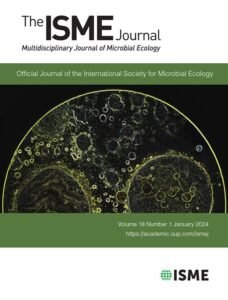
Academic Journal
Q1ISME Journal
About ISME Journal
ISME Journal is a scholarly journal published by Oxford University Press. SCImago 2025 places it in Q1 with an SJR of 3.415 and an H-index of 267.
Its listed coverage is 2007-2026 and its research categories include Ecology, Evolution, Behavior and Systematics (Q1); Microbiology (Q1). The 2025 dataset reports 298 documents and 8037 citations across the latest three-year reporting window.
The ISME Journal, short for The International Society for Microbial Ecology Journal, is a leading peer-reviewed scientific publication dedicated to microbial ecology. Jointly published by the International Society for Microbial Ecology (ISME) and Springer Nature, the journal serves as a vital platform for scientists and researchers around the world who study the diverse roles microorganisms play in various ecosystems.
What is the ISME Journal?
The ISME Journal was launched in 2007 and has quickly become one of the most respected journals in the field of microbiology. Its primary focus is on the ecological, evolutionary, and functional roles of microorganisms in their environments, including soil, water, air, and living organisms. The journal covers a wide range of topics in microbial ecology, including:
-
Microbial diversity and evolution
-
Host-microbe interactions
-
Biogeochemical cycles
-
Environmental microbiology
-
The human microbiome
-
Marine and freshwater microbiology
-
Synthetic and systems biology
By bridging basic and applied microbial research, the ISME Journal contributes significantly to our understanding of the microbial world.
Why is the ISME Journal Important?
Microorganisms are essential to life on Earth. They influence climate, agriculture, human health, and ecosystem functioning. The ISME Journal plays a crucial role in disseminating high-impact research that uncovers the complexities of microbial life and its interactions with the environment.
The journal’s articles are widely cited, reflecting their importance to the scientific community. It also maintains a high impact factor, which is a strong indicator of the journal’s quality and influence in the scientific world.
Features and Benefits
-
Peer-Reviewed Content: All submissions go through rigorous peer-review to ensure scientific accuracy and quality.
-
Open Access Options: Authors can choose open-access publishing to make their research freely available to the global community.
-
Wide Readership: The journal is accessed by thousands of researchers, educators, and professionals worldwide.
-
Multidisciplinary Scope: It welcomes submissions from microbiologists, ecologists, environmental scientists, and more.
Who Should Read the ISME Journal?
The ISME Journal is ideal for:
-
Microbiologists
-
Ecologists
-
Environmental scientists
-
Biotechnologists
-
Academic researchers
-
Graduate and postgraduate students
Whether you are investigating the effects of microbes on climate change or exploring the human microbiome, the ISME Journal provides a wealth of up-to-date and scientifically robust information.
How to Submit or Access Articles
Authors interested in submitting to the ISME Journal can find submission guidelines on the official ISME website or through Springer Nature’s journal portal. Readers can access articles through institutional subscriptions or choose open-access content for free.
Journal Metrics
Metrics can change by reporting year. Verify time-sensitive values with the publisher or indexing service.
Aims & Scope
The ISME Journal (International Society for Microbial Ecology Journal) is a highly respected, peer-reviewed scientific journal that plays a pivotal role in advancing the field of microbial ecology. Published in partnership with Springer Nature and the International Society for Microbial Ecology (ISME), this journal serves as a key platform for disseminating cutting-edge research on all aspects of microbial interactions and their ecological significance.
What is the ISME Journal?
The ISME Journal focuses on the intricate world of microorganisms and how they interact with each other, with their hosts, and with the environment. From bacteria and archaea to viruses and microbial eukaryotes, this journal covers a vast array of topics that are essential to understanding ecosystems, global climate change, human health, agriculture, and biotechnology.
Since its inception, the journal has maintained a high impact factor, attracting submissions from leading researchers around the world. It is indexed in major databases such as PubMed, Scopus, and Web of Science, making it a trusted source for academics and professionals alike.
Scope and Key Areas of Research
The scope of The ISME Journal is broad but centered around microbial ecology and evolution. Some of the major research themes include:
-
Microbial Diversity and Evolution
Studies that explore the genetic, metabolic, and evolutionary diversity of microorganisms in various environments. -
Microbial Interactions
Research focusing on symbiotic, competitive, and cooperative relationships among microbes and between microbes and their hosts. -
Environmental Microbiology
Understanding how microbes shape and respond to environmental changes, including soil, water, air, and extreme habitats. -
Host-Microbe Interactions
Investigations into how microbes interact with animal and plant hosts, impacting health, disease, and development. -
Microbiomes
Comprehensive studies of microbial communities in the human gut, oceans, forests, and other ecosystems. -
Theoretical and Computational Microbial Ecology
Application of modeling and computational biology to better understand complex microbial systems.
Who Should Read the ISME Journal?
The ISME Journal is ideal for a wide range of professionals including:
-
Microbiologists
-
Ecologists
-
Environmental scientists
-
Medical researchers
-
Agricultural scientists
-
Biotechnologists
Its interdisciplinary approach ensures that it provides valuable insights to anyone interested in microbial systems and their broader ecological impact.
Why ISME Journal Matters
Microbes play a crucial role in maintaining life on Earth. From recycling nutrients to influencing climate, their impact is profound yet often overlooked. The ISME Journal brings these microscopic powerhouses into the spotlight, offering rigorous scientific studies that enhance our understanding of life and ecosystems.
Recent Research Articles
Latest publications matched automatically by ISSN.
Fungi associated with Norway spruce and its bark beetles detoxify spruce defense compounds by conjugation to α-ribose
Shivani Kiran Nimbkar, Yoko Nakamura, Baoyu Hu, Benke Hong et al.
2026-09-04 · DOI: 10.1093/ismejo/wrag230Rainfall-induced microbial resuscitation reveals functional decoupling across biocrust succession
Raúl Román, Fernando T Maestre, Estelle Couradeau
2026-09-04 · DOI: 10.1093/ismejo/wrag231Competition between resident rhizosphere bacteria enhances phytopathogen suppression via emergent antagonism
Yue Yin, Thomas Pommier, Xiaoni Zhang, Fang Chi et al.
2026-09-04 · DOI: 10.1093/ismejo/wrag229Lifestyle Differentiation Among Marine Denitrifying Microorganisms
Xin Sun, Irene H Zhang, Andrew R Babbin, J L Weissman et al.
2026-09-04 · DOI: 10.1093/ismejo/wrag232Gut microbial H2S promotes metabolic dysfunction in mice via hepatic PPARα suppression
Shibo Lei, Xuan Qiu, Zhen Wang, Zuyang Zhang et al.
2026-09-02 · DOI: 10.1093/ismejo/wrag226Free Ammonia Stress Rewires Microbial Signaling Networks and Constrains Metabolic Cooperation in Oxygenic Photogranules
Bing Zhang, Xinya Xu, Ming Zhang, Bowen Qi et al.
2026-09-02 · DOI: 10.1093/ismejo/wrag225Conservation agriculture buffers persistent carbon loss under warming by microbial adaptation
Jun Ling, Wolfgang Wanek, Kyle Mason-Jones, Jennifer A J Dungait et al.
2026-08-30 · DOI: 10.1093/ismejo/wrag224Differential aggregation properties among Baltic Sea picocyanobacterial strains impact their export
Martin Ekman, Elina Viinimäki, Anders Svensson, Ryan W Paerl et al.
2026-08-27 · DOI: 10.1093/ismejo/wrag214Carbon substrate type shapes spatial self-organization in a multi-species biofilm community
Deyong Zhu, Anna J Svagan, Nan Yang, Mads Frederik Hansen et al.
2026-08-27 · DOI: 10.1093/ismejo/wrag223Heterologous expression in E. coli reveals that bicarbonate transporter BicA2 mediates carbon uptake in marine Prochlorococcus spp.
Loraine M Rourke, Caitlin S Byrt, G Dean Price, Benedict M Long et al.
2026-08-27 · DOI: 10.1093/ismejo/wrag222Enrichment and Characterization of a Haloalkaline-tolerant Anammox Bacterium
Han-Yin Chuang, Jer-Horng Wu, Shan-Hua Chen, Wei-Yu Chen et al.
2026-08-27 · DOI: 10.1093/ismejo/wrag221Oxygen-dependent metabolism of dissolved organic matter in hypoxic marine environments
Benjamin N Daniels, Sarah Wolf, Qi Chen, Fabian Wittmers et al.
2026-08-26 · DOI: 10.1093/ismejo/wrag220Site-specific recombination and purifying selection influence Cry toxin formation and specialization
Anton E Shikov, Ruslan O Alagov, Maria E Belousova, Anton A Nizhnikov et al.
2026-08-26 · DOI: 10.1093/ismejo/wrag218Soil amelioration impacts viral ecology in saline-alkali lands
Junxi Liu, Guixiang Zhou, Lin Chen, Yu Xiao et al.
2026-08-26 · DOI: 10.1093/ismejo/wrag217Metabolic division of labour drives estuarine-coastal N2O emissions
Enquan Zhang, Shengjie Li, Ehui Tan, Qiuyun Jiang et al.
2026-08-26 · DOI: 10.1093/ismejo/wrag216Model-guided design of defined microbial community reveals interactions underpinning plant growth and stress tolerance
Shinichi Yamazaki, Masaru Nakayasu, Keiko Kanai, Rie Mizuno et al.
2026-08-26 · DOI: 10.1093/ismejo/wrag219Lives in a gram of soil: linking life cycle biology to soil ecology
Jordi van Gestel
2026-08-20 · DOI: 10.1093/ismejo/wrag215Streptococcus pneumoniae adaptation to nutrient deprivation and immune modulation drives upper respiratory tract colonization
Daan W Arends, Kristin Surmann, Lucille F van Beek, Robert S Jansen et al.
2026-08-19 · DOI: 10.1093/ismejo/wrag213Adaptations of gummivorous primate gut-associated bifidobacteria to type-II arabinogalactan utilisation
Yuki Sasaki, Tomoya Kozakai, Moe Inoue, Mikiyasu Sakanaka et al.
2026-08-19 · DOI: 10.1093/ismejo/wrag210High molecular weight dissolved organic matter drives soil resistome proliferation by enhancing microbial competition and viral carbon metabolism
Zi-Teng Liu, Xin-Di Zhao, Jia-Qi Li, Shu-Xin Li et al.
2026-08-18 · DOI: 10.1093/ismejo/wrag212Reviews
Community Reviews
Version History
April 21, 2025 at 6:40 am
April 21, 2025