Academic Journal
Q1Journal of Marketing Research
About Journal of Marketing Research
Journal of Marketing Research is a scholarly journal published by SAGE Publications Ltd. SCImago 2025 places it in Q1 with an SJR of 7.363 and an H-index of 221.
Its listed coverage is 1967-1968, 1971-1973, 1976-1981, 1983, 1986-1987, 1989-2026 and its research categories include Business and International Management (Q1); Economics and Econometrics (Q1); Marketing (Q1). The 2025 dataset reports 62 documents and 1541 citations across the latest three-year reporting window.
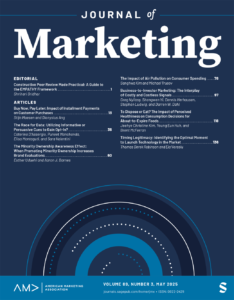
The Journal of Marketing Research (JMR) is one of the most prestigious and widely recognized academic journals in the field of marketing. Published by the American Marketing Association (AMA), JMR is known for delivering cutting-edge research that advances marketing theory and guides real-world marketing practices. Since its inception in 1964, the journal has become an authoritative source for academics, researchers, and marketing professionals across the globe.
What is the Journal of Marketing Research?
The Journal of Marketing Research is a peer-reviewed academic journal that focuses on the development and dissemination of knowledge in marketing. It emphasizes empirical, analytical, and theoretical research that enhances the understanding of marketing phenomena. JMR is not a trade or industry journal; instead, it is a scholarly publication known for its rigorous standards and methodological excellence.
Its primary goal is to provide a platform for innovative research that explores consumer behavior, marketing strategies, data-driven decision-making, and the application of new technologies in marketing.
Topics Covered in JMR
JMR publishes research on a wide range of marketing-related topics, including:
-
Consumer decision-making and behavior
-
Marketing analytics and big data
-
Digital marketing and social media
-
Branding and brand management
-
Pricing and promotions
-
Customer experience and satisfaction
-
Market segmentation and targeting
-
Advertising effectiveness
-
Machine learning in marketing
-
Marketing ethics and sustainability
The journal also encourages interdisciplinary research that integrates insights from economics, psychology, statistics, and data science.
Who Reads the Journal of Marketing Research?
The primary audience of JMR includes:
-
Marketing academics and scholars
-
PhD students and university researchers
-
Marketing analysts and data scientists
-
CMOs and strategic decision-makers
Because of its academic credibility and industry relevance, JMR is often cited in marketing research papers, doctoral dissertations, corporate white papers, and marketing strategy sessions.
Impact and Importance
JMR consistently ranks among the top marketing journals in the world. Its high impact factor and citation frequency highlight the journal’s influence in both academic and professional marketing circles. Articles published in JMR often shape the future of marketing theory and practice.
The journal is indexed in leading academic databases like Scopus, Web of Science, and JSTOR, increasing its visibility and accessibility.
Why JMR Matters
In today’s digital-first and data-driven marketing landscape, businesses and researchers need trustworthy insights to stay competitive. The Journal of Marketing Research bridges the gap between academic theory and real-world application, offering deep, evidence-based insights that help solve complex marketing challenges.
Journal Metrics
Metrics can change by reporting year. Verify time-sensitive values with the publisher or indexing service.
Aims & Scope
The Journal of Marketing Research (JMR) is one of the leading academic publications in the field of marketing. Published by the American Marketing Association (AMA), the journal is renowned for its rigorous peer-review process and high-impact contributions to both marketing theory and practice. Its broad and evolving scope makes it a vital platform for scholars, researchers, and professionals seeking to understand and advance the science of marketing.
Defining the Scope of JMR
The scope of the Journal of Marketing Research encompasses a wide array of topics that contribute to the understanding of marketing phenomena. JMR is dedicated to publishing empirical, theoretical, methodological, and conceptual research that offers innovative insights into consumer behavior, marketing strategies, and marketplace dynamics.
JMR is not limited to traditional marketing topics. Its scope is designed to accommodate emerging trends, technological advancements, and cross-disciplinary approaches that reflect the complexities of modern marketing environments.
Key Areas of Focus
The scope of JMR includes, but is not limited to, the following research domains:
-
Consumer Behavior and Psychology
Research that explores how consumers make decisions, perceive brands, and interact with marketing stimuli. -
Marketing Analytics and Data Science
Studies using quantitative, statistical, or machine learning methods to derive insights from large datasets. -
Digital Marketing and Online Platforms
Research examining social media, e-commerce, influencer marketing, and mobile advertising. -
Branding and Brand Equity
Investigations into brand perception, loyalty, value, and management strategies. -
Market Segmentation and Targeting
Analytical approaches for identifying and engaging with distinct consumer groups. -
Advertising and Promotions
Research on the effectiveness, design, and impact of promotional campaigns. -
Pricing Strategies
Studies related to pricing models, price sensitivity, and value-based pricing. -
Customer Relationship Management (CRM)
Research that focuses on customer retention, satisfaction, and lifetime value. -
Innovation and New Product Development
Insights into how firms innovate and bring new offerings to the market. -
Sustainability and Ethical Marketing
Topics dealing with corporate social responsibility, green marketing, and consumer trust.
Methodological Diversity
One of the distinguishing features of JMR is its openness to a diverse range of methodologies. Researchers are encouraged to employ:
-
Experimental designs (lab and field)
-
Econometric modeling
-
Survey and qualitative methods
-
Machine learning and AI techniques
-
Behavioral and neuro-marketing approaches
This methodological inclusivity allows the journal to publish work that is robust, relevant, and adaptable to evolving market challenges.
Interdisciplinary Relevance
The scope of the Journal of Marketing Research extends into related disciplines such as economics, psychology, information systems, statistics, and sociology. This interdisciplinary reach makes JMR a dynamic publication that fosters holistic and impactful marketing research.
Recent Research Articles
Latest publications matched automatically by ISSN.
EXPRESS: Every Minute Counts: The Added-Unit Effect In Time Perception
Tatiana Sokolova, Deepak Sirwani, Maximilian Gaerth
2026-09-06 · DOI: 10.1177/00222437261488297EXPRESS: Behavioral Research Through Interpretable, Dimensionality-reduced Generative AI Embeddings (BRIDGE): A Method to Incorporate Real-World Stimuli in Consumer Experiments
Anirban Mukherjee, Hannah H. Chang, Sachin Gupta
2026-09-06 · DOI: 10.1177/00222437261484068EXPRESS: Predicting the Memorability of Brand Slogans
Ada Aka, John McCoy
2026-08-21 · DOI: 10.1177/00222437261481110EXPRESS: Private Labels and Retailer Profitability: Bilateral Bargaining in the Grocery Channel
Paul B. Ellickson, Mitchell J. Lovett, Takeaki Sunada, Pianpian Kong et al.
2026-08-21 · DOI: 10.1177/00222437261483522EXPRESS: Ready to Convert? How to Talk with Sales Leads
Bitty Balducci, Detelina Marinova, Jagdip Singh
2026-08-21 · DOI: 10.1177/00222437261481444EXPRESS: When AI Assists at the Frontline: External and Internal Marketing Effects in the Context of Banking Mortgages
Anastasia Nanni, Andrea Ordanini, P.K. Kannan
2026-08-21 · DOI: 10.1177/00222437261483524Measuring Heterogeneity in TV Advertising Elasticities: Evidence from 135 Retail and Restaurant Brands
Samsun Knight, Tsung-Yiou Hsieh, Yakov Bart
2026-10 · DOI: 10.1177/00222437261435578EXPRESS: Evaluating Novel Unstructured Treatments with Generative AI: A Causal Prediction Framework
Paul B. Ellickson, Wreetabrata Kar, James C. Reeder, Guang Zeng et al.
2026-08-03 · DOI: 10.1177/00222437261476639EXPRESS: Gaming the Marketplace: Consumer Opportunism and Beliefs about Societal Hierarchy
Shilpa Madan, Aparna Labroo, Constantine S. Katsikeas
2026-08-03 · DOI: 10.1177/00222437261477110Increasing App Engagement Behaviors via Goal-Enabling Technology Features: The Role of Goal Difficulty Dimensions
Jake An, André Bonfrer, Christine Eckert
2026-10 · DOI: 10.1177/00222437261433457EXPRESS: Taking a Stance, For Now or Forever: Optimizing the Communication of Corporate Political Activism
Freeman Wu, Helen van der Sluis, Lauren Grewal, Aradhna Krishna et al.
2026-07-07 · DOI: 10.1177/00222437261470421EXPRESS: Consumer Interactions and Peer Effects in Socially-Connected Digital Products
Yijun Chen, Yulia Nevskaya
2026-06-16 · DOI: 10.1177/00222437261463518Communication Patterns in Joint Decision-Making
Kelley Gullo Wight, Holly S. Howe, Danielle J. Brick, Gavan J. Fitzsimons et al.
2026-10 · DOI: 10.1177/00222437261439058EXPRESS: The Three-dimensional Effect in Logo Design: When Depth Cues Improve Brand Purchase Likelihood
Taku Togawa, Naoto Onzo
2026-06-05 · DOI: 10.1177/00222437261460880EXPRESS: Modeling Dynamic Consumer Preferences from Few-shot Data: A Meta-Learning Approach
Mingzhang Yin, Khaled Boughanmi, Anirban Mukherjee
2026-06-03 · DOI: 10.1177/00222437261458290The Economic Consequences of Risk Absorption in Business-to-Business Relationships: Evidence from Indirect Auto Lending
Huanhuan Shi, Qiang (Kris) Zhou, Adithya Pattabhiramaiah, Shrihari Sridhar et al.
2026-08 · DOI: 10.1177/00222437261418004How Effective Is Suggested Pricing? Experimental Evidence from an E-Commerce Platform
Jessica Fong, Puneet Manchanda, Yu Song
2026-10 · DOI: 10.1177/00222437261432198The “Dark Is Hardworking” Association: How Skin Tone Affects Perceptions of Service Providers in India
Tanuka Ghoshal, Tripat Gill
2026-08 · DOI: 10.1177/00222437251409096Consumers Prefer That Corporations Donate Periodically
Alexander B. Park, Yanyi Leng, Fausto J. Gonzalez, Jared Watson et al.
2026-10 · DOI: 10.1177/00222437261423538Haunted by a Bad Review: The Afterlife of Reading (Negative) Reviews in Consumer Experience
Dena Yadin, Nira Munichor, Elanor F. Williams, Inbal Stockheim et al.
2026-05-26 · DOI: 10.1177/00222437261457045Reviews
Community Reviews
Version History
April 20, 2025 at 3:09 pm
April 20, 2025