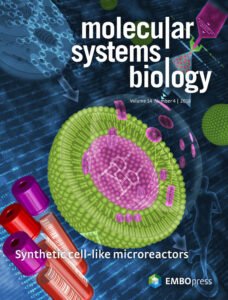
Academic Journal
Q1Molecular Systems Biology
About Molecular Systems Biology
Molecular Systems Biology is a scholarly journal published by Springer Science and Business Media Deutschland GmbH. SCImago 2025 places it in Q1 with an SJR of 4.229 and an H-index of 185.
Its listed coverage is 2005-2026 and its research categories include Agricultural and Biological Sciences (miscellaneous) (Q1); Applied Mathematics (Q1); Biochemistry, Genetics and Molecular Biology (miscellaneous) (Q1); Computational Theory and Mathematics (Q1); Immunology and Microbiology (miscellaneous) (Q1); Information Systems (Q1); Medicine (miscellaneous) (Q1). The 2025 dataset reports 85 documents and 1281 citations across the latest three-year reporting window.
Molecular Systems Biology is an innovative field at the intersection of biology, chemistry, physics, and computational sciences. It focuses on understanding biological systems through an integrative approach, which looks beyond individual molecules to study how these molecules interact within complex networks. By examining how genes, proteins, and metabolites work together in cellular environments, molecular systems biology provides a comprehensive understanding of the molecular mechanisms that govern life.
What is Molecular Systems Biology?
Molecular Systems Biology is a branch of systems biology that emphasizes the study of biological systems from a molecular perspective. Unlike traditional biology, which often isolates components like genes or proteins for study, molecular systems biology considers how these components interact and function as part of larger, dynamic systems. This holistic approach allows researchers to examine biological processes in a more integrated way, leading to insights that are often not possible with reductionist methods.
The goal of molecular systems biology is to understand the networks of molecular interactions that drive cellular functions, from gene expression to metabolic pathways and signaling mechanisms. By applying advanced computational tools, high-throughput technologies, and mathematical models, scientists can predict how molecular systems behave under different conditions and in response to external stimuli.
Key Components of Molecular Systems Biology
Molecular Systems Biology is driven by several core techniques and technologies:
-
Omics Technologies: These include genomics, transcriptomics, proteomics, and metabolomics, which provide high-throughput data on genes, RNA, proteins, and metabolites. These tools help in analyzing the molecular components of cells and understanding how they contribute to biological functions.
-
Computational Modeling: Using computational tools, scientists can create models to simulate complex biological processes. These models help predict molecular interactions, uncover regulatory networks, and identify potential therapeutic targets. They are crucial for testing hypotheses and making sense of vast amounts of data generated from omics technologies.
-
Network Analysis: Molecular systems biology relies on the concept of biological networks—interconnected molecules and processes. Network analysis helps map these connections, identify critical nodes in the system, and uncover potential areas for intervention, such as drug targets or biomarkers.
Applications in Healthcare and Disease Research
Molecular Systems Biology has far-reaching applications in healthcare and disease research. It provides a deeper understanding of the molecular basis of diseases, which is essential for developing more effective treatments and personalized medicine.
-
Cancer Research: By mapping the molecular networks that drive tumor growth, molecular systems biology helps researchers identify new biomarkers for early cancer detection and new targets for precision therapies. Understanding how cancer cells bypass normal regulatory pathways is essential for developing treatments that specifically target tumor cells without affecting healthy tissues.
-
Neurological Disorders: Diseases like Alzheimer’s and Parkinson’s disease involve complex molecular mechanisms. Through systems biology, scientists can identify molecular pathways that contribute to neurodegeneration, providing insights into potential therapeutic strategies that could slow or halt disease progression.
-
Metabolic Disorders: Molecular systems biology aids in understanding the molecular mechanisms of metabolic diseases like diabetes. By studying how molecules interact in metabolic pathways, researchers can uncover new approaches to managing these conditions.
Future Prospects and Challenges
Despite its promise, molecular systems biology faces challenges. The sheer complexity of biological networks makes it difficult to map every interaction. Additionally, integrating vast datasets from omics technologies requires advanced computational approaches and data analysis tools.
However, the future of molecular systems biology is bright. With advances in artificial intelligence and machine learning, researchers are poised to unlock new insights into cellular networks, disease mechanisms, and therapeutic options. The ongoing development of more powerful computational models and data integration techniques will further enhance the field’s potential, paving the way for groundbreaking discoveries in biology and medicine.
Journal Metrics
Metrics can change by reporting year. Verify time-sensitive values with the publisher or indexing service.
Aims & Scope
Molecular Systems Biology is an emerging interdisciplinary field that combines biology, chemistry, physics, and computational science to understand the complex molecular interactions that govern biological systems. It focuses on studying how individual molecules, such as genes, proteins, and metabolites, interact and function within larger biological networks. By analyzing the behavior of these molecular networks, scientists aim to uncover the intricate mechanisms that drive cellular processes, diseases, and overall organismal functions. The scope of molecular systems biology extends across various research domains, from fundamental biology to clinical applications in medicine, offering immense potential for innovation.
Understanding the Scope of Molecular Systems Biology
The scope of molecular systems biology is vast, covering a wide range of biological processes at the molecular level. Instead of isolating individual molecular components, this field emphasizes a systems approach that views biological functions as an interconnected web of interactions. By focusing on molecular networks, researchers can gain insights into how complex cellular functions arise from the collaboration between various molecules and their environments.
One of the key objectives of molecular systems biology is to predict how biological systems behave under different conditions. This is achieved through the integration of high-throughput technologies, computational modeling, and network analysis. The field encompasses various disciplines, including genomics, proteomics, metabolomics, and bioinformatics, to study biological systems holistically.
Core Areas of Research in Molecular Systems Biology
-
Genomics and Transcriptomics: The study of the genome (genomics) and gene expression (transcriptomics) is fundamental to understanding the molecular basis of life. Researchers analyze DNA sequences to identify genes, mutations, and regulatory elements, helping to decipher the genetic code that controls cellular functions.
-
Proteomics and Metabolomics: Proteomics focuses on identifying and characterizing proteins, while metabolomics studies the small molecules involved in metabolic processes. Together, these disciplines reveal how proteins and metabolites contribute to cellular functions and how changes in these molecules can lead to diseases.
-
Computational Modeling and Systems Biology: Computational modeling plays a crucial role in molecular systems biology by simulating biological processes and molecular interactions. Using data from omics technologies, scientists can build models to predict how molecules interact, form networks, and respond to various stimuli, such as drugs or environmental changes.
-
Network Biology: At the heart of molecular systems biology lies the study of biological networks—interconnected molecular components that function together to carry out cellular processes. Researchers use network analysis to identify critical nodes in these networks and understand how disruptions in these networks can lead to diseases like cancer, neurodegenerative disorders, and metabolic diseases.
Applications of Molecular Systems Biology
The scope of molecular systems biology extends into numerous fields, with practical applications across medicine, biotechnology, and drug development:
-
Personalized Medicine: Molecular systems biology enables the development of personalized treatments based on an individual’s molecular profile. By studying the molecular mechanisms behind diseases, researchers can tailor therapies that target specific molecular pathways, improving treatment efficacy and minimizing side effects.
-
Cancer Research: In cancer, molecular systems biology helps uncover the molecular networks that drive tumor growth and metastasis. By understanding the underlying molecular causes of cancer, scientists can identify novel biomarkers for early diagnosis and develop targeted therapies that specifically disrupt cancer-related molecular networks.
-
Neurodegenerative Diseases: Diseases like Alzheimer’s and Parkinson’s are linked to complex molecular disruptions in the brain. By studying molecular networks in the context of these diseases, researchers can identify therapeutic targets and develop strategies to slow or reverse disease progression.
-
Metabolic Disorders: Molecular systems biology is also crucial for understanding metabolic diseases such as diabetes and obesity. By mapping metabolic networks and understanding how molecules interact in these pathways, scientists can discover new approaches to manage or cure these conditions.
Challenges and Future Directions
While molecular systems biology holds great promise, it also faces challenges. The complexity of biological networks means that understanding every molecular interaction is difficult. Moreover, integrating large-scale data from multiple omics technologies requires sophisticated computational methods and advanced algorithms.
However, the field is poised for rapid growth. Advances in artificial intelligence (AI) and machine learning are helping researchers process vast amounts of data more efficiently, opening up new possibilities for understanding biological systems. As technology continues to evolve, molecular systems biology will continue to expand its scope, offering even deeper insights into the molecular foundations of life and disease.
Recent Research Articles
Latest publications matched automatically by ISSN.
Tracking cell fate through morphodynamics
Julia Dorr, Brian J Mitchell
2026-08-27 · DOI: 10.1038/s44320-026-00244-3Two essential criteria for transcription factor footprint discovery using V-plot
Qifan Zhang, Chenhuan Xu
2026-08-25 · DOI: 10.1038/s44320-026-00242-5Joint-RPCA: domain-aware multi-omics integration for systems microbiology
Bianca Cordazzo Vargas, Cameron Martino, Amanda Hazel Dilmore, Jessica L Metcalf et al.
2026-08-18 · DOI: 10.1038/s44320-026-00236-3Systematic comparison of estimates of transcription factor activity by ATAC-seq and multiplexed reporter assays
Max Trauernicht, Vinícius H Franceschini-Santos, Hatice Yücel, Teodora Filipovska et al.
2026-08-17 · DOI: 10.1038/s44320-026-00240-7Integrated metabolomics data analysis to generate mechanistic hypotheses with MetaProViz
Christina Schmidt, Jannik Franken, Denes Turei, Dimitrios Prymidis et al.
2026-08-17 · DOI: 10.1038/s44320-026-00231-8Deciphering global transcriptional dynamics coordinated by gene-gene regulatory interactions using single-cell data
Liying Zhou, Songhao Luo, Zhiwei Huang, Zhenquan Zhang et al.
2026-08-03 · DOI: 10.1038/s44320-026-00235-4Cross-genus analysis reveals architecturally programmed sgRNA synthesis patterns in coronaviruses
Zi Wen, Lei Chen, Dehua Luo, Ju Sun et al.
2026-07-30 · DOI: 10.1038/s44320-026-00239-0Macrophage response specificity to ligand mixtures is improved by signaling pathway antagonism
Xiaolu Guo, Supriya Sen, Julian Gonzalez, Alexander Hoffmann et al.
2026-07-29 · DOI: 10.1038/s44320-026-00230-9xDecoder unlocks the potential of genomic foundation models for few-shot personal gene expression prediction
Shumin Li, Ruibang Luo, Yuanhua Huang
2026-07-28 · DOI: 10.1038/s44320-026-00238-1Complex assembly and activity states as multifaceted protein attributes explaining phenotypic variability
George Rosenberger, Peng Xue, Isabell Bludau, Claudia Martelli et al.
2026-07-22 · DOI: 10.1038/s44320-026-00228-3qMAP decodes RNA fragmentation dynamics in development and disease
Hukam C Rawal, Jiancheng Yu, Xudong Zhang, Chen Cai et al.
2026-07-20 · DOI: 10.1038/s44320-026-00237-2Extracellular matrix phenotyping by imaging mass cytometry defines distinct cellular matrix environments associated with allergic airway inflammation
James E Parkinson, Morgan Bryant, Mohamed Ghafoor, Rebecca J Dodd et al.
2026-07-20 · DOI: 10.1038/s44320-026-00234-5Author Correction: Fast analysis and engineering of protein function by microbe-independent deep assembly and screening
Yan Wu, Pengli Wang, Lan Xiang Liu, Daesun Song et al.
2026-07-16 · DOI: 10.1038/s44320-026-00233-6Engineered E. coli swarming for binary and analog input recording
Marian Shaw, Sadhya Garg, Julia Kirby, Samuel Schmidgall et al.
2026-07-16 · DOI: 10.1038/s44320-026-00232-7Thermo-flux: generation and analysis of thermodynamic-stoichiometric metabolic network models
Edward N Smith, Nathan Fargier, José Losa, Matthias Heinemann et al.
2026-07-03 · DOI: 10.1038/s44320-026-00227-4Paradoxical non-catalytic kinase functions are driven by inhibitor-induced displacement of autoinhibitory domains
Viviane Reber, Sabrina Keller, Stefanie A Loosli, Yumi Arima et al.
2026-07-02 · DOI: 10.1038/s44320-026-00229-2E. coli prepares for starvation by dramatically remodeling its proteome in the first hours after loss of nutrients
Théo Gervais, Bjoern Kscheschinski, Michael Mell, Nevil Goepfert et al.
2026-07-01 · DOI: 10.1038/s44320-026-00226-5ParTIpy: a scalable framework for archetypal analysis and Pareto task inference
Philipp Sven Lars Schäfer, Leoni Zimmermann, Paul L Burmedi, Avia Walfisch et al.
2026-06-25 · DOI: 10.1038/s44320-026-00209-6Common xenobiotics modulate gut microbial responses to low‑calorie sweeteners in vitro
Sonja Blasche, Vinita Periwal, Nonantzin Beristain Covarrubias, Anna Lindell et al.
2026-06-25 · DOI: 10.1038/s44320-026-00225-6Quantitative interactome mapping of skeletal muscle insulin resistance
Yaan-Kit Ng, Ronnie Blazev, Julian P H Wong, Nichollas E Scott et al.
2026-06-23 · DOI: 10.1038/s44320-026-00224-7Reviews
Community Reviews
Version History
April 21, 2025 at 3:00 pm
April 21, 2025