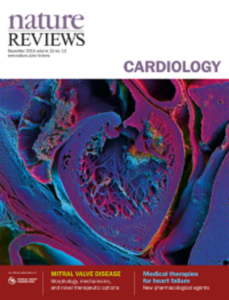
Academic Journal
Q1Nature Reviews Cardiology
About Nature Reviews Cardiology
About Nature Reviews Cardiology
Nature Reviews Cardiology is a monthly peer-reviewed journal published by Nature Portfolio (Springer Nature) and one of the most cited review journals in cardiovascular medicine. Part of the Nature Reviews portfolio, it aims to be the premier source of authoritative reviews and commentaries for the scientific and clinical communities it serves — practising cardiologists and cardiovascular research scientists. Its stated editorial ambition is to publish articles that are authoritative, accessible and enhanced with clearly understandable figures, tables and other display items, providing an unparalleled service to authors, referees and readers and maximizing the usefulness and impact of each article.
The journal's international standard serial numbers, as published by Nature Portfolio, are ISSN 1759-5002 (print) and ISSN 1759-5010 (online); the correct abbreviation for abstracting and indexing purposes is Nat. Rev. Cardiol. The U.S. National Library of Medicine catalogues the title (NLM ID 101500075) as "Nature reviews. Cardiology," published in London by Nature Publishing Group, recording both ISSNs and the April 2009 title change.
Nature Reviews Cardiology is consistently ranked at or near the top of cardiology journals by citation metrics. The journal's own reporting, based on its official Nature Portfolio metrics page, cites a 2025 Journal Impact Factor of 50.2 — a figure that places it among the highest-impact journals in the "Cardiac & Cardiovascular Systems" category. The journal is published monthly and reaches a global readership of clinicians, researchers and health professionals.
History: from Nature Clinical Practice to Nature Reviews Cardiology
The journal was established in 2004 under the title Nature Clinical Practice Cardiovascular Medicine, with its first issue published in November 2004. It was one of a family of Nature Clinical Practice journals launched by Nature Publishing Group to translate the latest research findings into clinical practice, providing cardiologists with authoritative and timely interpretations of key developments in the field.
In April 2009, the journal was renamed Nature Reviews Cardiology as part of a broader rebranding of the Nature Clinical Practice series into the Nature Reviews portfolio — a change announced by Nature Publishing Group in January 2009. The NLM Catalog records that the title began with Volume 6, number 4 (April 2009), preserving continuity of volume numbering across the rename.
To mark the journal's 15th anniversary in 2019, Nature Reviews Cardiology invited six members of its Advisory Board to reflect on the most important advances in cardiovascular research and clinical practice over the preceding 15 years and to look ahead to the next 15. The anniversary editorial ("Looking back and thinking forwards — 15 years of cardiology and cardiovascular research") highlighted practice-changing breakthroughs covered by the journal, including advances in procedural techniques for arrhythmias and hypertension and novel therapeutic strategies for heart failure and pulmonary arterial hypertension — a reminder of the journal's role as a chronicler of the field's evolution.
Aims and scope
Nature Reviews Cardiology aims to be the premier source of reviews and commentaries for the scientific and clinical communities it serves. Its scope is deliberately broad, ensuring that the articles it publishes reach the widest possible audience among practising cardiologists and cardiovascular research scientists.
The journal's coverage spans the full breadth of cardiology and cardiovascular medicine, including:
- Acute coronary syndromes, angina and coronary artery disease
- Cardiomyopathy and heart failure
- Arrhythmias and electrophysiology
- Hypertension and vascular disease
- Valvular heart disease
- Congenital heart conditions
- Cardiovascular imaging and diagnostics
- Interventional cardiology
- Surgery and transplantation
- Thrombosis and antithrombotic therapy
- Cardiovascular pathology, genetics and disease markers
- General cardiovascular therapies and cardiovascular public health
As a reviews journal, it does not primarily publish original research; instead it synthesizes, interprets and contextualizes the primary literature — translating bench discoveries and clinical-trial results into guidance that clinicians and researchers can use. Its articles are commissioned from leading experts and are known for high-quality commissioned figures and tables that distil complex mechanisms and trial evidence into accessible summaries.
The journal also aligns its publishing with broader scientific responsibility: Nature Portfolio reports that over 50% of the articles published in Nature Reviews Cardiology in 2025 related to one or more of the 17 United Nations Sustainable Development Goals, under Springer Nature's SDG programme (Springer Nature is a signatory of the SDG Publishers Compact).
Editorial leadership and governance
Unlike many journals edited by part-time academic editors, Nature Reviews Cardiology is run by a team of full-time, professional editors employed by Nature Portfolio, according to the journal's official about page. This in-house editorial model is characteristic of the Nature Reviews portfolio: professional editors commission reviews from leading researchers, develop articles intensively with authors, and manage peer review internally.
The editors receive advice and support from an external Advisory Board of internationally renowned cardiologists. Third-party journal directories list Gregory Lim as editor-in-chief; this could not be independently confirmed on the journal's public pages at the time of writing, so readers should consult the journal's staff listing for current masthead information.
The journal publishes an editorial-process summary describing its editorial input and checks, and general editorial enquiries — including correspondence and questions about the status of a manuscript — are directed to the editorial office (nrcardio@nature.com). As with other Nature Portfolio journals, the journal discloses that accessory content such as summary points may be generated with internal Springer Nature AI tools, always edited and fact-checked by authors or editors, with any substantive AI use declared on an individual-article basis.
Metrics and rankings
Nature Reviews Cardiology is one of the highest-impact journals in cardiovascular medicine. The key figures, with attribution:
- Journal Impact Factor: 50.2 — the 2025 Journal Impact Factor as reported by Nature Portfolio on the journal's official metrics page (verified on the journal's site, checked 2026-10-03). This is the standard two-year impact factor, not the five-year figure.
- Historically, the journal's impact factor has placed it first among journals in the "Cardiac & Cardiovascular Systems" category — for example, its 2021 impact factor of 49.421 ranked it 1st of 143 journals in that category according to the Journal Citation Reports.
Readers should note that impact factors are released annually by Clarivate and that the most current figure should always be checked against the Journal Citation Reports or the journal's own metrics page. CiteScore, SNIP and SJR values published by third-party aggregators are computed by different methodologies and should not be conflated with the Clarivate Journal Impact Factor.
OpenAlex, an open bibliometric database, records roughly 3,400 works and more than 214,000 citations for the journal, with an OpenAlex-computed H-index in the 250s — figures computed by different methods from the Clarivate metrics and cited here only as third-party context.
Open access and publishing model
Nature Reviews Cardiology is primarily a subscription journal rather than a fully open access title: OpenAlex metadata does not mark it as fully open access, though hybrid open-access options exist for authors who need them (for example, to comply with funder mandates). The journal is not listed in the Directory of Open Access Journals, which is consistent with a subscription-first model with optional open-access routes.
Because most content is commissioned by the professional editorial team, unsolicited submissions follow a different path than at original-research journals: prospective authors typically pitch review proposals to the editors rather than submitting finished manuscripts. Authors considering the journal should contact the editorial office to discuss suitability before preparing a full submission. The publisher does not publish a single fixed article processing charge for this title on its public pages; authors seeking open-access publication should confirm current fees and options with the publisher.
Abstracting and indexing
Nature Reviews Cardiology is indexed in the principal biomedical and citation databases, including PubMed/MEDLINE, Scopus and Web of Science (Science Citation Index Expanded). The U.S. National Library of Medicine maintains a catalogue record for the title (NLM ID 101500075) recording its London publisher, both ISSNs, and its former title Nature Clinical Practice Cardiovascular Medicine. Indexing in MEDLINE and the major citation indices ensures the journal's reviews are discoverable across the databases that clinicians, researchers and guideline developers search.
Landmark papers
The following highly cited reviews illustrate the journal's influence and its role in synthesizing fast-moving areas of cardiovascular science. Each DOI below was verified as resolving (HTTP 200) in the Crossref registry on 2026-10-11, with bibliographic details drawn from the Crossref record.
- "Inflammageing: chronic inflammation in ageing, cardiovascular disease, and frailty" — Ferrucci L, Fabbri E (2018). DOI: 10.1038/s41569-018-0064-2. This review linked chronic low-grade inflammation of ageing ("inflammageing") to cardiovascular disease and frailty, becoming the journal's most cited recent article with more than 3,400 citations recorded in Crossref.
- "COVID-19 and the cardiovascular system" — Zheng Y-Y, Ma Y-T, Zhang J-Y, Xie X (2020). DOI: 10.1038/s41569-020-0360-5. Published in the first months of the pandemic, this review synthesized the emerging evidence on how SARS-CoV-2 affects the heart and vasculature, and has been cited more than 2,400 times.
- "Epidemiology and risk profile of heart failure" — Bui AL, Horwich TB, Fonarow GC (2011). DOI: 10.1038/nrcardio.2010.165. A foundational epidemiological review of heart failure burden and risk factors, cited more than 1,600 times and representative of the journal's high-impact synthesis articles (note the original nrcardio DOI prefix, dating from before the publisher's DOI migration).
The journal's broader portfolio of heavily cited reviews — on topics such as the inflammatory response in myocardial injury and repair, the epidemiology and aetiology of heart failure, and mechanisms of cardiac hypertrophy — is frequently referenced in clinical guidelines and subsequent primary research, underscoring the translational role of authoritative reviews in cardiology.
Further landmark reviews
Additional highly cited reviews that demonstrate the journal's breadth (DOIs verified in Crossref, HTTP 200, 2026-10-11):
- "The inflammatory response in myocardial injury, repair, and remodelling" — Frangogiannis NG (2014). DOI: 10.1038/nrcardio.2014.28 (over 1,670 citations). A definitive synthesis of how inflammation drives both injury and repair after myocardial infarction.
- "Epidemiology and aetiology of heart failure" — Ziaeian B, Fonarow GC (2016). DOI: 10.1038/nrcardio.2016.25 (over 1,670 citations). An update on the shifting causes and global burden of heart failure, widely used as a teaching and reference article.
- "Mechanisms of physiological and pathological cardiac hypertrophy" — Nakamura M, Sadoshima J (2018). DOI: 10.1038/s41569-018-0007-y (over 1,560 citations). A mechanistic review distinguishing adaptive from maladaptive cardiac growth — the kind of bench-to-bedside synthesis the journal is known for.
The journal in the Nature Reviews portfolio
Nature Reviews Cardiology sits within one of the most prestigious review-journal families in science publishing. The Nature Reviews journals share a common editorial philosophy: commission authoritative reviews from leading experts, develop them intensively with professional editors, and present them with high-quality figures that make complex science accessible. Within the portfolio, the cardiology title serves as the bridge between cardiovascular basic science and clinical practice — its reviews are written to be useful to the cardiologist seeing patients as well as to the researcher at the bench. That dual audience is reflected in the journal's official aims, which explicitly name practising cardiologists alongside cardiovascular research scientists, and in its broad scope, which is designed to reach the widest possible readership across the discipline.
Readership and access
The journal's readership spans academic cardiology departments, hospital cardiology services, cardiovascular research institutes and public-health agencies worldwide. Because its reviews synthesize the evidence base behind clinical practice — from the mechanisms of heart failure to the epidemiology of cardiovascular risk — its articles are widely used in teaching, in continuing medical education, and as entry points to the literature for researchers entering a new subfield. Access is via institutional and personal subscriptions to Nature Portfolio, with hybrid open-access articles freely available; the journal's content is also discoverable through PubMed, Scopus and Web of Science, and its high citation profile means its reviews surface prominently in literature searches on cardiovascular topics.
Publishing in Nature Reviews Cardiology: guidance for authors
Nature Reviews Cardiology is a commissioned reviews journal, and its publishing route differs from original-research journals. Guidance based on the journal's official pages:
- Commissioning model: Most reviews are commissioned by the journal's full-time professional editors, who identify topics and invite leading experts to write them. Unsolicited authors should first contact the editorial office with a proposal outlining the topic, its timeliness, and the proposed authors' expertise.
- What the journal wants: Authoritative, accessible reviews and commentaries relevant to practising cardiologists and cardiovascular research scientists, enhanced with clearly understandable figures, tables and display items. The journal emphasizes usefulness and impact for both clinical and scientific readers.
- Scope fit: Topics should fall within the journal's broad cardiovascular scope — from acute coronary syndromes and heart failure to imaging, interventional cardiology, genetics and cardiovascular public health — and should synthesize the field rather than report new primary data.
- Peer review: Commissioned articles undergo editorial development and peer review managed by the in-house editorial team, with the journal publishing a summary of its editorial input and checks.
- Open access: The journal is subscription-based with hybrid open-access options; authors with funder mandates should discuss compliant routes and fees with the editorial office or publisher.
- Contact: General editorial enquiries, correspondence and manuscript-status questions go to the editorial office; the journal's about page lists the editorial contact address.
The journal does not publish an official acceptance rate. Given its impact factor above 50 and its position at the top of its category, competition for commissioned slots is intense; proposals should demonstrate both authoritativeness and clear clinical or scientific need.
Frequently asked questions
What is the ISSN of Nature Reviews Cardiology?
1759-5002 (print) and 1759-5010 (online), as published by Nature Portfolio.
Who publishes Nature Reviews Cardiology?
Nature Portfolio (Springer Nature), London.
When was the journal founded?
2004, as Nature Clinical Practice Cardiovascular Medicine (first issue November 2004); renamed Nature Reviews Cardiology in April 2009.
What is the journal's impact factor?
50.2 — the 2025 Journal Impact Factor as reported by Nature Portfolio on the journal's official metrics page. The journal has historically ranked first in the "Cardiac & Cardiovascular Systems" JCR category.
Is Nature Reviews Cardiology open access?
It is primarily a subscription journal with hybrid open-access options; it is not a fully open access title.
Does the journal publish original research?
No — it is a reviews journal publishing authoritative Reviews, Perspectives and Commentaries that synthesize and interpret the primary literature for clinicians and researchers.
How often is it published?
Monthly.
Can I submit an unsolicited review?
Most content is commissioned; prospective authors should contact the editorial office with a proposal before preparing a manuscript.
Where is the journal indexed?
PubMed/MEDLINE, Scopus and Web of Science (Science Citation Index Expanded), among the major biomedical databases.
What is the journal's abbreviation?
Nat. Rev. Cardiol. — the correct abbreviation for abstracting and indexing purposes.
Sources and verification notes
Facts in this profile are drawn from official sources: the journal information page (nature.com/nrcardio/about, including aims and scope, editorial structure, ISSNs, metrics page link and SDG statement), the U.S. National Library of Medicine Catalog record (NLM ID 101500075), the 15th-anniversary editorial record ("Looking back and thinking forwards," Nature Reviews Cardiology, 2019), and the Crossref registry (for article DOIs, verified 2026-10-11). The 2025 Journal Impact Factor figure is as reported by Nature Portfolio. Where a fact could not be confirmed on the journal's official pages — such as the current editor-in-chief's name — this profile says so explicitly rather than presenting a third-party listing as fact.
Verified field sources
- Journal Impact Factor: 50.2 — Official source; checked 2026-10-03. 2025 Journal Impact Factor reported by Nature Portfolio; not a five-year impact factor.
- Impact Factor year: 2025 — Official source; checked 2026-10-03. 2025 Journal Impact Factor reported by Nature Portfolio; not a five-year impact factor.
Source-backed journal facts
Topics in published research
Atrial Fibrillation Management and Outcomes; Cardiac Imaging and Diagnostics; Cardiovascular Function and Risk Factors; Coronary Interventions and Diagnostics; Cardiac Arrhythmias and Treatments; Lipoproteins and Cardiovascular Health.
OpenAlex classifies topics from published works. These topics are not the publisher’s official aims and scope.
Source: OpenAlex source record. Retrieved 2026-10-03. Source record updated 2026-10-02. OpenAlex metrics are different from SCImago metrics and the Clarivate Journal Impact Factor.
Journal Metrics
Quartile, SJR and the listed SCImago H-index use the 2025 imported SCImago dataset. A quartile may vary by subject category. Values without a source or reporting year are unverified historical entries. Verify the current Journal Impact Factor with Clarivate or the publisher before using it.
Aims & Scope
The publisher’s official aims and scope have not yet been verified for this profile. Use the journal website to check subject fit and accepted article types before submitting.
Recent Research Articles
Latest publications matched automatically by ISSN.
Cardiovascular resilience in centenarians
Pedro Carrera-Bastos, Abel Plaza-Florido, Inmaculada Pérez-Prieto, Shlomit Radom-Aizik et al.
2026-10-26 · DOI: 10.1038/s41569-026-01348-xThe evolution and future of conduction system pacing
So-Ryoung Lee, Pugazhendhi Vijayaraman, Weijian Huang, Marek Jastrzębski et al.
2026-10-23 · DOI: 10.1038/s41569-026-01354-zReply to ‘Distinguishing between nicotine replacement therapies and nicotine-containing consumer products’
Thomas Münzel, Marin Kuntic, John F. Keaney, Julia Lurz et al.
2026-10-22 · DOI: 10.1038/s41569-026-01361-0Distinguishing between nicotine replacement therapies and nicotine-containing consumer products
Ivan Berlin, Daniel Thomas
2026-10-22 · DOI: 10.1038/s41569-026-01362-zDuration of antibiotic treatment for infective endocarditis: should we move towards tailored therapy?
Mary Philip, Gilbert Habib
2026-10-15 · DOI: 10.1038/s41569-026-01360-1Heart-specific T cell responses: from antigens to disease mechanisms
Gustavo Campos Ramos
2026-10-12 · DOI: 10.1038/s41569-026-01356-xBeyond glucose lowering and ketogenesis: unveiling new cardioprotective mechanisms of SGLT2 inhibitors
Alessia Riccio, Gaetano Santulli
2026-10-02 · DOI: 10.1038/s41569-026-01357-wGlobal burden of venous thromboembolism: incidence and outcome estimates of deep-vein thrombosis and pulmonary embolism
Behnood Bikdeli, Sina Rashedi, Mariana Pfeferman, Christopher Amalan et al.
2026-09-27 · DOI: 10.1038/s41569-026-01334-3Beating the odds: bringing the human heart into a dish
Marcos Castro-Guarda, Jolanda van der Velden
2026-09-17 · DOI: 10.1038/s41569-026-01355-yBenefit of aficamten in non-obstructive hypertrophic cardiomyopathy
Gregory B. Lim
2026-11 · DOI: 10.1038/s41569-026-01353-0Pulmonary artery denervation shows promising results for heart failure-related pulmonary hypertension
Irene Fernández-Ruiz
2026-11 · DOI: 10.1038/s41569-026-01350-3High-altitude hypoxia and congenital heart defects
J. Pierre Zila-Velasque
2026-09-15 · DOI: 10.1038/s41569-026-01352-1Tricuspid valve repair reduces death and HF hospitalization
Karina Huynh
2026-11 · DOI: 10.1038/s41569-026-01351-2Genetic cardiomyopathy-associated myocarditis
Tobias Lerchner, Stephane S. R. Heymans
2026-09-08 · DOI: 10.1038/s41569-026-01349-wFishing for answers: omega-3 fatty acids and cardiovascular health
Ludmila Caceva
2026-09-03 · DOI: 10.1038/s41569-026-01347-yThe role of hypoxia-inducible factors in myocardial ischaemia–reperfusion injury and cardioprotection
Cong Luo, Tao Li, Jihoon Tak, Matthew DeBerge et al.
2026-09-02 · DOI: 10.1038/s41569-026-01339-yLangendorff-free dissociation of adult mouse hearts
Matthew Ackers-Johnson, Davor Pavlovic
2026-09-02 · DOI: 10.1038/s41569-026-01346-zIntracoronary imaging in percutaneous coronary intervention: why, when, how and which from large, randomized trials
Flavio Giuseppe Biccirè, Nieves Gonzalo, Joo-Yong Hahn, Ik-Kyung Jang et al.
2026-09-02 · DOI: 10.1038/s41569-026-01342-3Identifying the coronary metabolic dilator
Adam G. Goodwill
2026-09-01 · DOI: 10.1038/s41569-026-01345-0Dyslipidaemia and hepatic steatosis: mechanisms and implications for lipid-lowering therapy
Maurizio Averna, M. Mahmood Hussain, Giuseppe Danilo Norata
2026-08-27 · DOI: 10.1038/s41569-026-01336-1Reviews
Community Reviews
Version History
October 11, 2026 at 11:25 pm
April 13, 2025