Academic Journal
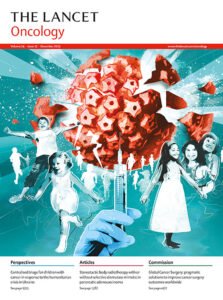
Q1The Lancet Oncology
About The Lancet Oncology
The Lancet Oncology is a scholarly journal published by Elsevier Ltd. SCImago 2025 places it in Q1 with an SJR of 9.432 and an H-index of 455.
Its listed coverage is 2000-2026 and its research categories include Oncology (Q1). The 2025 dataset reports 408 documents and 13495 citations across the latest three-year reporting window.
The Lancet Oncology is one of the world’s leading peer-reviewed medical journals dedicated exclusively to cancer research, diagnosis, treatment, and prevention. Published by Elsevier as part of The Lancet family of journals, The Lancet Oncology has established itself as a trusted and authoritative voice in the global oncology community. Since its inception in 2000, the journal has consistently delivered cutting-edge research and expert commentary, making it a vital resource for oncologists, researchers, and healthcare professionals worldwide.
A Global Leader in Cancer Research
With a strong emphasis on innovation, clinical practice, and policy, The Lancet Oncology covers all aspects of oncology. The journal features high-impact original research articles, comprehensive reviews, insightful editorials, and timely clinical practice guidelines. Topics range from molecular biology and genetics to immunotherapy, radiotherapy, surgery, and palliative care.
The journal’s global reach and reputation ensure that it plays a key role in shaping the future of cancer care. It regularly publishes content from leading research institutions and contributes to international discussions on cancer burden, health equity, and access to care.
Peer-Reviewed Excellence
One of the defining characteristics of The Lancet Oncology is its rigorous peer-review process. All submissions undergo thorough evaluation by experts in the field, ensuring the highest standards of scientific accuracy, ethical conduct, and clinical relevance. This meticulous approach has helped The Lancet Oncology achieve a consistently high impact factor, making it one of the most cited journals in the field of oncology.
Innovative Features and Special Series
The Lancet Oncology frequently publishes special series, commissions, and reports on pressing issues in global cancer control. These include in-depth analyses on cancer in low- and middle-income countries (LMICs), the impact of environmental factors on cancer risk, and the role of artificial intelligence in cancer diagnosis and treatment.
The journal also offers multimedia features such as podcasts, infographics, and expert interviews, making complex research more accessible to a broader audience. Its digital presence and open-access options ensure that valuable insights are shared across borders, contributing to global knowledge and collaboration.
Trusted by the Oncology Community
For healthcare professionals, researchers, and policymakers, The Lancet Oncology serves as a reliable source of up-to-date information and expert guidance. Its influence extends beyond academia, with published findings often cited in policy documents, clinical guidelines, and global health strategies.
Journal Metrics
Metrics can change by reporting year. Verify time-sensitive values with the publisher or indexing service.
Aims & Scope
The Lancet Oncology is one of the world’s leading oncology journals, renowned for its rigorous peer-reviewed research and global impact on cancer treatment, prevention, and policy. As a specialty journal under The Lancet family, The Lancet Oncology serves as a critical platform for disseminating groundbreaking findings in the field of oncology. It plays a pivotal role in shaping cancer care practices and policies worldwide.
What Is The Lancet Oncology?
Launched in 2000, The Lancet Oncology focuses exclusively on cancer-related content. With a strong commitment to clinical excellence, the journal publishes high-quality research articles, reviews, editorials, commentaries, and perspectives on a broad spectrum of topics across oncology. The journal addresses issues ranging from early detection and diagnosis to innovative treatment modalities, survivorship, and palliative care.
Its global readership includes oncologists, researchers, policymakers, and healthcare professionals who rely on The Lancet Oncology for up-to-date, evidence-based insights into cancer care.
Key Areas of Focus
The scope of The Lancet Oncology is broad, encompassing:
-
Clinical Oncology: Clinical trials, treatment guidelines, and outcome studies in solid tumors and hematologic malignancies.
-
Translational Research: Bridging laboratory discoveries with clinical application, especially in targeted therapy and immuno-oncology.
-
Cancer Prevention and Epidemiology: Population-level research, screening strategies, and public health interventions.
-
Global Oncology: Studies and reports addressing disparities in cancer care, particularly in low- and middle-income countries (LMICs).
-
Health Policy and Ethics: Insightful discussions on access to cancer care, cost-effectiveness, and ethical considerations in oncology.
This wide-ranging scope ensures that the journal remains relevant across disciplines and geographic regions.
Impact on Global Cancer Research
The Lancet Oncology holds a high impact factor and is widely cited in academic and clinical literature. Its influence extends beyond academia, informing public health policy and clinical guidelines globally. The journal has been instrumental in elevating the visibility of underrepresented areas in oncology, including pediatric cancers, geriatric oncology, and cancer care in resource-limited settings.
It also plays a central role in advancing global health equity through initiatives such as The Lancet Oncology Commission, which brings together experts to tackle complex challenges in global cancer control.
Commitment to Innovation and Equity
In recent years, The Lancet Oncology has prioritized publishing content related to innovation in cancer diagnostics and treatment—such as precision medicine, AI in oncology, and CAR-T therapy. Additionally, the journal advocates for equitable access to cancer care, highlighting systemic inequalities and proposing actionable solutions.
By fostering dialogue between clinicians, researchers, and policymakers, The Lancet Oncology continues to be at the forefront of transformative change in the cancer research landscape.
Recent Research Articles
Latest publications matched automatically by ISSN.
Correction to Lancet Oncol 2026; 27: 181–90
2026-09 · DOI: 10.1016/s1470-2045(26)00405-52030 hepatitis elimination targets might be missed in Europe
Sharmila Devi
2026-09 · DOI: 10.1016/s1470-2045(26)00393-1Sir Chris Hoy's Tour de 4 charity cycle ride returns
Peter Ranscombe
2026-09 · DOI: 10.1016/s1470-2045(26)00330-xA polycrisis in cancer care: Cuba's system under the oil blockade
Arachu Castro
2026-09 · DOI: 10.1016/s1470-2045(26)00303-7Adjuvant alectinib versus chemotherapy in resected ALK-positive non-small-cell lung cancer (ALINA): health-related quality-of-life and safety outcomes from a randomised, open-label, phase 3 trial
Rafal Dziadziuszko, Jin Seok Ahn, Fabrice Barlesi, Benjamin J Solomon et al.
2026-09 · DOI: 10.1016/s1470-2045(26)00283-4Sweden plans to restrict PFAS
Manjulika Das
2026-09 · DOI: 10.1016/s1470-2045(26)00382-7CARICOM moves towards regional framework for cancer
Paul Adepoju
2026-09 · DOI: 10.1016/s1470-2045(26)00383-9Beyond visual tumour-infiltrating lymphocytes assessment
Soong June Bae, Joon Jeong
2026-09 · DOI: 10.1016/s1470-2045(26)00395-5Manual, digital, and AI tumour-infiltrating lymphocyte scoring: a secondary analysis of the APHINITY randomised trial
Luis E Lara González, Fabiola Giudici, Roberto Salgado, Haixi Yan et al.
2026-09 · DOI: 10.1016/s1470-2045(26)00247-0UK study to report cancer risk in armed services personnel
Tony Kirby
2026-09 · DOI: 10.1016/s1470-2045(26)00375-xArtificial intelligence-based tumour infiltrating lymphocyte quantification in patients with triple-negative breast cancer: an independent validation study
Julia R Dixon-Douglas, Damien Drubay, Roberto Salgado, Balazs Acs et al.
2026-09 · DOI: 10.1016/s1470-2045(26)00339-6Chemoradiotherapy versus short-course radiotherapy for response-adapted organ preservation in early-stage and intermediate-stage rectal cancer (STAR-TREC): 12-month results of an international, multicentre, open-label, parallel-group, randomised, phase 2/3 trial
Simon P Bach, David Sebag-Montefiore, Victoria Homer, Alexandra Gilbert et al.
2026-09 · DOI: 10.1016/s1470-2045(26)00228-7Challenges in the use of the European Society for Radiotherapy and Oncology–European Organisation for Research and Treatment of Cancer oligometastatic disease classification system in ovarian cancer
Gabriella Macchia, Alessio G Morganti, Alexandra Taylor, Nicole Concin et al.
2026-09 · DOI: 10.1016/s1470-2045(26)00296-2Beyond cancer: The Right to be Forgotten
The Lancet Oncology
2026-09 · DOI: 10.1016/s1470-2045(26)00399-2Chemotherapy with or without pembrolizumab followed by maintenance pembrolizumab with or without olaparib as first-line treatment of patients with advanced BRCA non-mutated epithelial ovarian cancer (ENGOT-OV43/GOG-3036/KEYLYNK-001): a randomised, double-blind, placebo-controlled, phase 3 trial
Ignace Vergote, David Cibula, Matthew Powell, Annouschka Laenen et al.
2026-09 · DOI: 10.1016/s1470-2045(26)00223-8High-dose radiotherapy in patients with high-risk prostate cancers treated with long-term androgen deprivation therapy (GETUG AFU 18): a randomised, phase 3 trial
Christophe Hennequin, Paul Sargos, Lise Roca, Marion Silva et al.
2026-09 · DOI: 10.1016/s1470-2045(26)00277-9STAR-TREC and TESAR trials: strengthening the evidence for organ preservation in rectal cancer
Emmanouil Fokas, Ralf-Dieter Hofheinz
2026-09 · DOI: 10.1016/s1470-2045(26)00251-2Durvalumab and tremelimumab, with or without lenvatinib, combined with transarterial chemoembolisation in participants with embolisation-eligible hepatocellular carcinoma (EMERALD-3): a global, randomised, open-label, sponsor-blinded, phase 3 study
Masatoshi Kudo, Ghassan K Abou-Alfa, Zhenggang Ren, Jeong Heo et al.
2026-09 · DOI: 10.1016/s1470-2045(26)00278-0Ivonescimab plus chemotherapy versus placebo plus chemotherapy in patients with advanced EGFR-mutated non-small-cell lung cancer after disease progression on EGFR tyrosine kinase inhibitor therapy (HARMONi): a multicentre, randomised, double-blind, phase 3 trial
Xiuning Le, Antonio Passaro, Yuanyuan Zhao, Yan Huang et al.
2026-09 · DOI: 10.1016/s1470-2045(26)00282-2SHR-A2102, a nectin-4 directed antibody–drug conjugate, in patients with pretreated advanced solid tumours: a multicentre, single-arm, phase 1 trial
Runbo Zhong, Huangming Hong, Min Yan, Qiming Wang et al.
2026-09 · DOI: 10.1016/s1470-2045(26)00238-xReviews
Community Reviews
Version History
April 13, 2025 at 6:10 pm
April 13, 2025