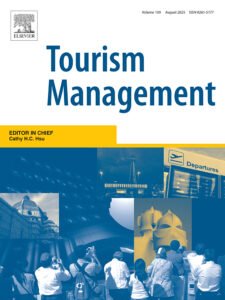
Academic Journal
Q1Tourism Management
About Tourism Management
Tourism Management is a scholarly journal published by Elsevier Ltd. SCImago 2025 places it in Q1 with an SJR of 4.496 and an H-index of 296.
Its listed coverage is 1982-2026 and its research categories include Development (Q1); Strategy and Management (Q1); Tourism, Leisure and Hospitality Management (Q1); Transportation (Q1). The 2025 dataset reports 210 documents and 8327 citations across the latest three-year reporting window.
Tourism management is a critical field that encompasses the planning, development, marketing, and regulation of tourism activities. As the global tourism industry continues to grow, effective tourism management has become vital for ensuring sustainable development, economic growth, and cultural preservation. In this article, we will explore the importance of tourism management and how it contributes to the success of the tourism industry.
What is Tourism Management?
Tourism management refers to the strategic approach to organizing, managing, and promoting tourism-related activities. It involves a range of tasks, including destination management, visitor services, travel operations, marketing, and policy formulation. The goal is to create a seamless experience for tourists while ensuring the long-term sustainability of the destination.
The Role of Tourism Management in Economic Growth
Tourism is a major contributor to the global economy, providing millions of jobs and generating substantial revenue. Effective tourism management ensures that this revenue is maximized while supporting the local economy. This includes managing accommodation facilities, transportation systems, attractions, and other essential services. Proper management also helps in the creation of jobs, supporting local businesses, and encouraging investment in infrastructure and public services.
Sustainable Tourism: A Focus of Modern Management
Sustainability is at the core of modern tourism management. With an increasing number of travelers visiting popular destinations, there is a growing concern about the environmental, social, and cultural impacts of tourism. Sustainable tourism management aims to minimize these impacts by promoting responsible travel practices and encouraging the preservation of natural resources and cultural heritage.
To achieve sustainability, tourism managers must balance the needs of tourists, local communities, and the environment. This involves implementing policies that reduce the carbon footprint of tourism, such as promoting eco-friendly transportation, supporting sustainable accommodation, and creating programs for waste management and conservation.
Tourism Marketing: Attracting the Right Visitors
Effective marketing strategies are essential for attracting tourists to a destination. Tourism management involves creating a strong brand identity for the destination, promoting its unique attractions, and targeting the right audience. Digital marketing, social media platforms, and influencer collaborations have become crucial tools in reaching a global audience.
Tourism managers must also ensure that the marketing campaigns highlight the destination’s unique selling points, whether it’s its natural beauty, historical sites, cultural experiences, or adventure activities. By aligning marketing efforts with the target audience’s preferences and interests, tourism management can increase visitation and promote repeat tourism.
Tourism Policy and Regulation
Tourism policy plays a significant role in shaping the direction of the industry. Governments and tourism organizations work together to create policies that govern tourism activities. These policies address issues like visa regulations, environmental protection, security, and tourism taxes. Tourism management ensures that these policies are effectively implemented and that all stakeholders, including tourists, local communities, and businesses, are well-informed and compliant.
Journal Metrics
Metrics can change by reporting year. Verify time-sensitive values with the publisher or indexing service.
Aims & Scope
Tourism is one of the world’s largest industries, contributing significantly to the global economy and providing millions of jobs. As the demand for travel and leisure experiences continues to rise, the role of tourism management has become more important than ever. With the rapid development of the tourism sector, professionals in tourism management are responsible for organizing, promoting, and overseeing various aspects of the tourism industry. Understanding the scope of tourism management is crucial for both industry professionals and aspiring students looking to enter this dynamic field.
The Role of Tourism Management
Tourism management involves the strategic planning, development, and marketing of tourism-related services. Professionals in this field work to ensure that destinations, attractions, accommodations, transportation services, and hospitality services are delivered efficiently and effectively. Tourism managers also handle the financial aspects of businesses, such as budgeting, pricing strategies, and resource allocation. Additionally, they ensure that tourism operations comply with legal, ethical, and environmental standards.
Increasing Demand for Tourism Professionals
The growing interest in travel, fueled by increased disposable income and global connectivity, has created a substantial demand for skilled tourism managers. According to the World Travel & Tourism Council (WTTC), the travel and tourism sector accounted for over 10% of the global GDP in recent years, and this trend is expected to continue. As a result, there is a consistent need for professionals who can manage the complexities of tourism operations, handle customer service, and contribute to sustainable tourism practices.
Key Areas of Tourism Management
-
Destination Management: A critical aspect of tourism management is ensuring that a destination’s appeal is preserved while providing travelers with unique and enriching experiences. Destination managers are tasked with marketing attractions, managing visitor flow, and ensuring that local culture and heritage are respected.
-
Hospitality and Accommodation: Tourism management also covers the hospitality sector, including hotels, resorts, and other accommodation providers. Managers in this area are responsible for ensuring that guests have a comfortable stay, overseeing operations such as booking systems, service quality, and staff management.
-
Tour Operator and Travel Agencies: Tour operators create and sell holiday packages, while travel agencies help customers plan their trips. Managers in these areas work to develop customized itineraries, promote destinations, and manage relationships with clients.
-
Sustainable Tourism: In recent years, there has been a growing emphasis on sustainability in tourism. Professionals in this area work to minimize the environmental and social impacts of tourism, promoting eco-friendly practices, responsible travel, and preservation of natural resources.
-
Event Management: Large-scale events, such as festivals, conferences, and sports events, are significant drivers of tourism. Event managers play a crucial role in organizing these events, ensuring seamless operations, and enhancing the destination’s reputation.
Career Opportunities in Tourism Management
The scope of tourism management offers a wide range of career opportunities. Graduates with a degree in tourism management can pursue careers as destination managers, tour operators, event planners, hotel managers, travel consultants, and marketing specialists. The industry also offers the potential for entrepreneurship, with opportunities to establish travel agencies, tour companies, and hospitality businesses.
Additionally, the rise of digital tourism has opened up new roles related to online marketing, social media management, and digital content creation. With the tourism industry’s growth and diversification, the career possibilities are vast and varied.
Recent Research Articles
Latest publications matched automatically by ISSN.
Advancing family bonding: A conditional framework from immersion to communitas
Rui Guo, Yuchen Wang, Tingting Gong, Chunxiao Li et al.
2027-04 · DOI: 10.1016/j.tourman.2026.105526Career plateau and multifaceted turnover pathways in the airline industry: Evidence from full-service and low-cost carrier cabin crew
Jihyun Cho, Hakseung Shin, Hyunjee Kwon
2027-04 · DOI: 10.1016/j.tourman.2026.105536Coupled supply and demand forecasting in platform accommodation markets
Harrison E. Katz
2027-04 · DOI: 10.1016/j.tourman.2026.105514Introducing a Conditional Support Framework: How young residents view the Olympic games
Argyro Elisavet Manoli, Sungkyung Kim, Philipp Wassler
2027-04 · DOI: 10.1016/j.tourman.2026.105521When tourism competitiveness becomes human development: The conditioning role of institutional quality in Central and Eastern Europe
Robertico Croes, Monika Bąk, Michał Suchanek
2027-04 · DOI: 10.1016/j.tourman.2026.105523Reinventing the package holiday: Consumer preferences and optimal pricing for hotel room upgrades
Apostolos Ampountolas
2027-04 · DOI: 10.1016/j.tourman.2026.105522From waste to Watts: Causal evidence on AI-enabled waste-to-energy and financial performance in tourism and hospitality using an empirics-first investigation
Gomaa Agag
2027-04 · DOI: 10.1016/j.tourman.2026.105517Impacts of tourism development on residents’ quality of life: A dual spillover perspective
Ruijuan Hu, Jason Li Chen, Gang Li, Yuan Qin et al.
2027-04 · DOI: 10.1016/j.tourman.2026.105524GenAI support to the rescue: Mitigating employees’ psychological stress following tourism service recovery
Xing'an Xu, Guangxiu Jiang, Xiaoting Huang, Qiuxia Chen et al.
2027-04 · DOI: 10.1016/j.tourman.2026.105519Beyond green claims: a social-ecological assessment of cruise tourism sustainability
Liliana Solé Figueras, Peter J. Stavroulakis, Nefeli Alexandraki
2027-04 · DOI: 10.1016/j.tourman.2026.105518Tourism's temporal pathways: A deceleration framework
Aikaterini Manthiou, Van Ha Luong, Quoc Cuong Nguyen
2027-02 · DOI: 10.1016/j.tourman.2026.105511Geopolitical risk and tourism firm resilience: Global evidence
Giray Gozgor, Dogan Gursoy, Berk Kucukaltan, Chaonan Wu et al.
2027-02 · DOI: 10.1016/j.tourman.2026.105499Events under fire: Developing an urgent anthropology for events during armed conflicts
James Kennell, Oksana Shyber, Jonathan Skinner
2027-02 · DOI: 10.1016/j.tourman.2026.105512Collaborative governance and resilience in fashion tourism: Building sustainable and adaptive creative ecosystems
Zahed Ghaderi, Aylin Ghaderi, Luc Béal, L.'Hocine Houanti et al.
2027-02 · DOI: 10.1016/j.tourman.2026.105497Employee-led disclosure of anthropomorphism in tourism GAI failure recovery: A mind perception model from tourists and employees
Xiaoxiao Qi, Zixuan Huang, Wen Chang
2027-02 · DOI: 10.1016/j.tourman.2026.105509Registered Report Stage I: Signaling green, securing greenbacks: Sustainability claims and venture funding in hospitality & tourism start-ups
Simone Bianco, Elisa Chan, Huihui Zhang, Hyejo Hailey Shin et al.
2027-02 · DOI: 10.1016/j.tourman.2026.105495From perceived attractiveness to visitation: Multi-scale measurement and influencing factors across 143 Chinese historic cities
Xukai Zhao, He Huang, Nan Bai, Yuxuan Chen et al.
2027-02 · DOI: 10.1016/j.tourman.2026.105515Artificial intelligence-based employee selection in tourism and hospitality: Justice, inclusion, and gender differences in resume screening and interviews
Xiaolin (Crystal) Shi, Xi Yu Leung, Billy Bai, Dimitrios Buhalis et al.
2027-02 · DOI: 10.1016/j.tourman.2026.105478Cities under pressure: Tourism intensity and the erosion of social capital in Italy
Filippo Marchesani, Stefania Denise Escobar, Edmund Goh, Federica Ceci et al.
2027-02 · DOI: 10.1016/j.tourman.2026.105513Tell me the truth: Consumer responses to feedback solicitation with robots versus humans
Sungwoo Choi, Lisa C. Wan, Anna S. Mattila
2027-02 · DOI: 10.1016/j.tourman.2026.105501Reviews
Community Reviews
Version History
April 23, 2025 at 9:07 am
April 23, 2025